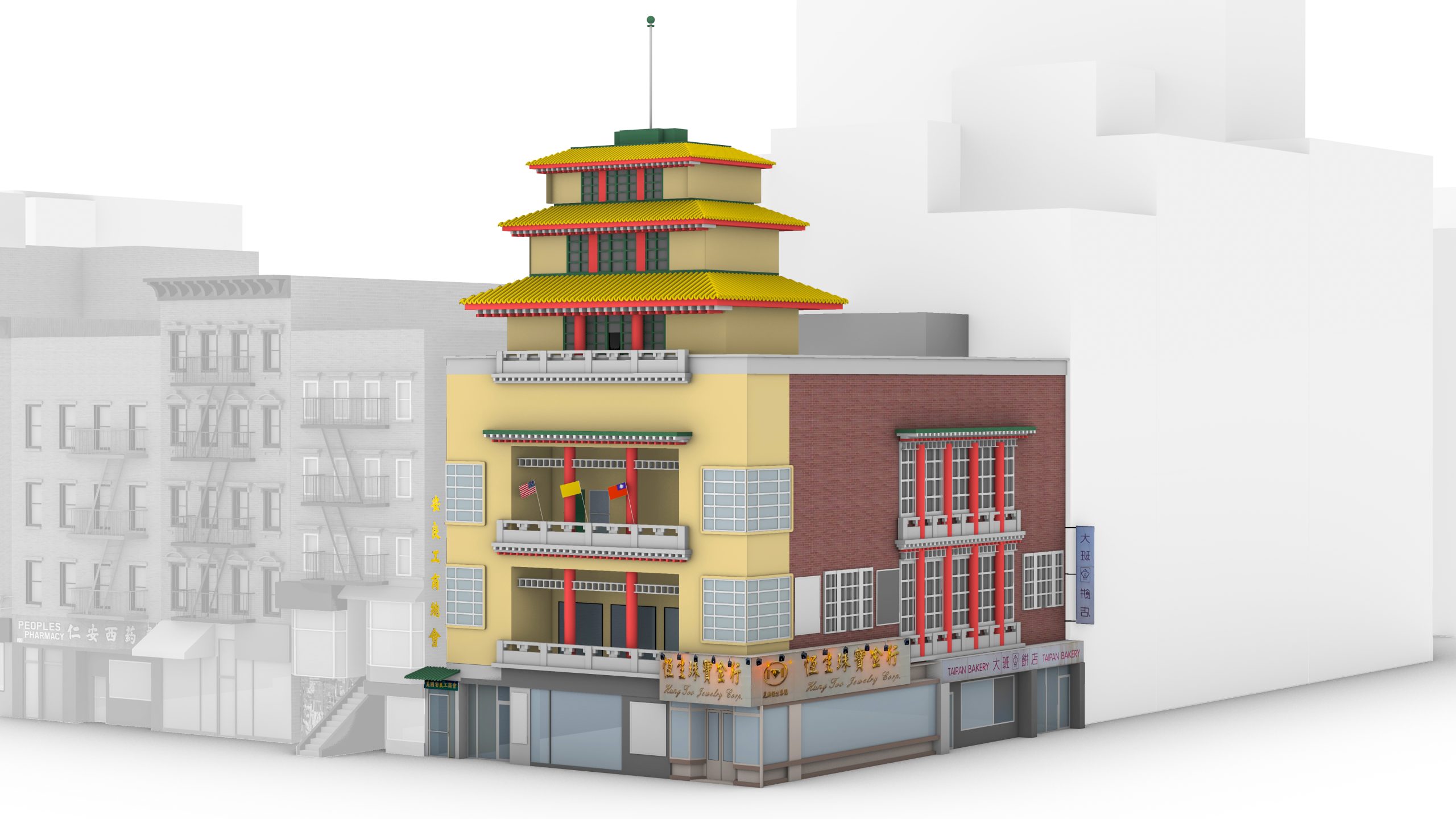
83 Mott
On Leong Chinese Merchants Association
Architect: Poy Gum Lee / Andrew J. Thomas
Built in 1951
2024

83 Mott
1940s
Interview
WITH HARVARD TANG (PRESIDENT OF the ON LEONg CHINESE MERCHANTS ASSOCIATION)
Interview conducted in June 2022.
+ Please give me a brief introduction of yourself – Where were you born and what is your family’s story in New York City?
My name is Harvard — they usually call me Harvey. Since 2018, for about five years so far, I’ve been the national president of the On Leong Chinese Merchants Association. I was inducted in Taipei because with the On Leong Chinese Merchants Association, the national president is chosen/elected, and not appointed, from the convention. Each term’s duration as the national president is two years, with the most being two terms. However, because of COVID, without the convention, I’ve been extended for another year, until 2023. (Our convention is usually in mid-April.)
The On Leong Chinese Merchants Association in the U.S. has 14 chapters, including in Boston, New York, etc…
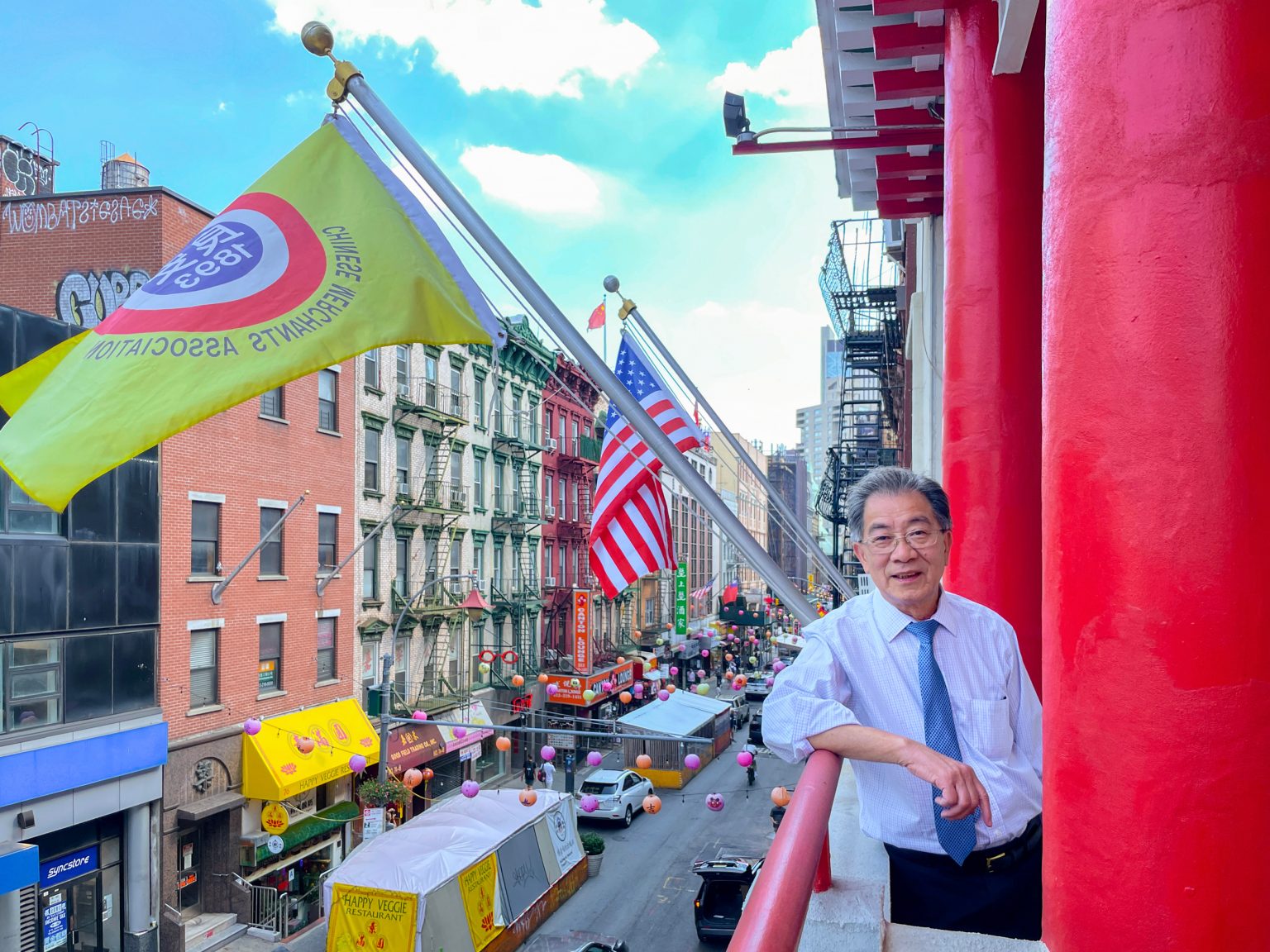
Harvard Tang on the balcony of the association headquarters during our interview, June 2022.
I immigrated with my parents in 1964 to New York from Hong Kong. I was 13. I went to school — junior high, high school, college, all in New York. I went to Junior High School 65 and high school at George Westinghouse in Brooklyn. I went to Baruch College and majored in business and got my BBA. After that, I went to military service because at that period of time, it was the Vietnam War. They sent me to Germany and I finished 2 years of military service and then came back to New York. So now, I belong to the American Legion. I’m the chairman of the committee.
My father opened the bookstore at 74 Mott in 1982. At that time, Chinatown had 6-8 book stores, which were very popular. But today… there are only two left. [The bookstore at 74 Mott closed in 2023.]
After I came back from military service, I came back to help my father. He usually goes overseas for a few months, so no one was able to take care of the store… and since then, I’ve still been working there. At that time, we had four bookstores, including one on 28 Pell Street (open since the 1970s), another on Mott Street… There was a period of time when there were a lot of gangsters around and Chinatown wasn’t safe, so many people didn’t come to Chinatown and business was down, so we closed the Pell Street one.
We sell books, magazines, newspapers and we sell a lot of stationery. We sell hong bao (red envelopes) for the New Year. Today, as time has gone by, people don’t read books much anymore. At that time, people didn’t have casinos – in the 1960s and 1970s, people liked to read!! It was the only entertainment they had, so they came to Chinatown with their kids to learn Chinese. At that time, people came to Chinatown to shop.
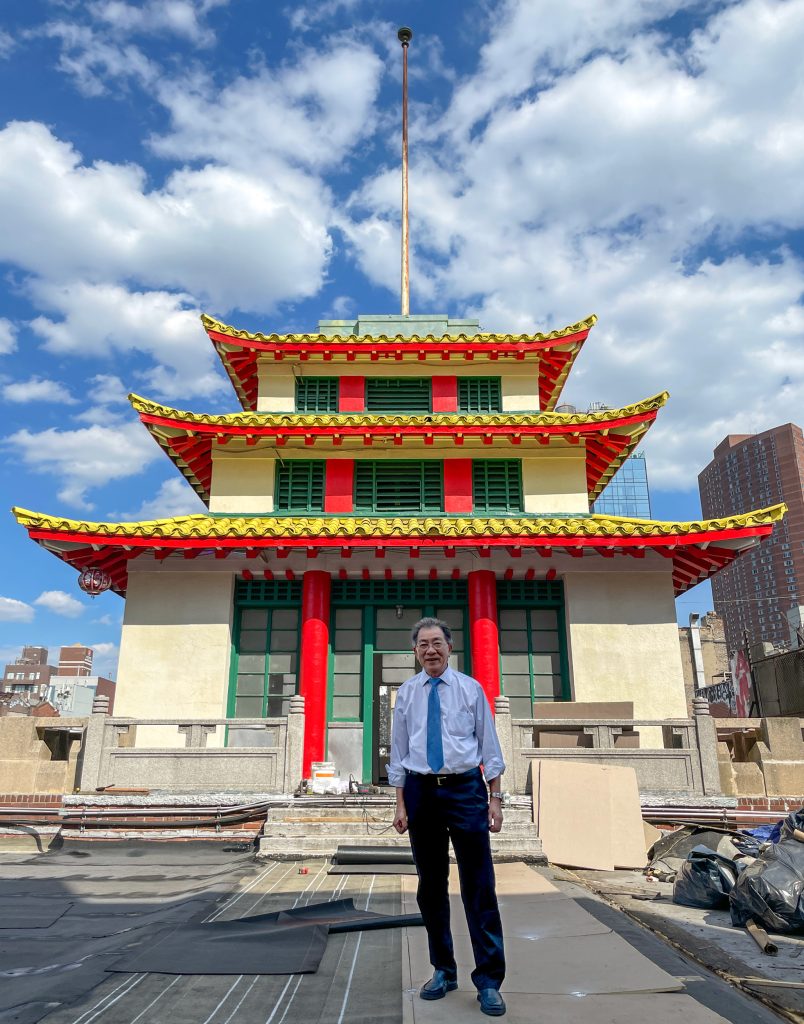
Harvard on the roof of 83 Mott, under renovation at the time of our interview, June 2022.
+ How long have you been living in Chinatown?
How did you come to be connected to Chinatown?
I have lived in Chinatown for over 15 years and grew up on Division Street.
After I had kids, I needed a bigger place and moved to Queens. Every day, we worked six days a week, so I came to Chinatown every day. This Chinatown had so many associations, at that time, and because our store was on Mott Street, my father became the secretary of the On Leong Chinese Merchants Association.
+ What was Chinatown like back then?
It was quiet. Chinatown in the “old times” didn’t have a lot of people around. At that time (the time of the gang wars), my grandpa, a World War II vet, was here and his advice was: Don’t go over Canal Street, because there is Little Italy… But we were good kids, so we didn’t deal with the bad guys.
Usually we ate at home.
This Chinatown, from that time until today, still has old buildings. Most are 100 years old and haven’t changed much. Chinese people own many buildings in Chinatown because of family associations. This is how we continue. No one wants to sell the building. That’s why it’s still like this in this Chinatown.
+ What is the name of the association: Chinese Merchants Association or the On Leong Tong?
We were established in 1893 — it’s been 129 years.
In the old times in Chinatown, they called this association a “tong” because the older Toishanese called it that, which meant “club” or “association” [as they’re known by] today. Later, because “tong” was affiliated with the mafia, they changed the name to the On Leong Chinese Merchants Association.
+ Can you tell me about the history of the different buildings where the association’s headquarters were?
In 1893, we were at 14 Mott Street. In 1921, we moved to 41 Mott Street, which is now The Lee Family Association.
At the time, more members joined and we needed a bigger place, so we built a new building [at 83 Mott]. We finished building it in 1951.
+ What other buildings has the On Leong Chinese Merchants Association owned in New York Chinatown? Which buildings does the association currently own?
We own only this building, which is the New York headquarters. The On Leong Chinese Merchants Association has national headquarters (which used to be in Boston but is now in New York), the New York headquarters and all the chapters in different cities.

Harvard Tang points to the frame Certificate of Merit awarded to the association in 1951 by the East Side Chamber of Commerce for the “artistic qualities” of their building.
The On Leong Chinese Merchants Association has dealt with the Chinese Consolidated Benevolent Association (CCBA) for a long, long time. The On Leong Chinese Merchants Association was established because people immigrating to the U.S. didn’t know English and didn’t know how to start businesses, and the association wanted to help new immigrants. Our by-laws, our goals, are to provide business help to members. We are here to help.
Our goal is education and donations – we donate to the CCBA to educate the youngsters and to hospitals. In the old times, the On Leong Chinese Merchants Association donated money back to China. Many years ago with the earthquake, we donated back to help our people.
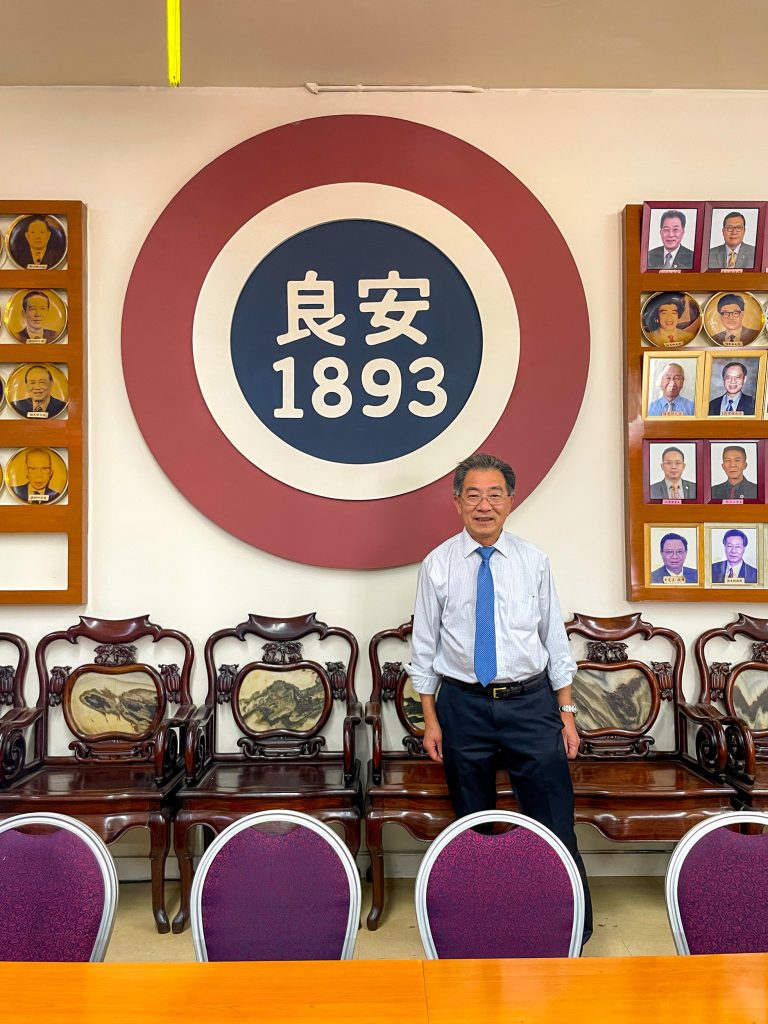
Harvard standing on the elevated podium of the association’s meeting room, 2022.
+ Tell me about the history of the new building at 83 Mott Street. When was the building built? Do you know why the original design by Poy Gum Lee was replaced by that of Andrew Thomas?
The building was built in 1951.
Poy Gum Lee designed it. He designed a few buildings in Chinatown.
This corner at Mott and Canal is a gateway to Chinatown.
+ Do you know of any major renovations or changes to the building since it was first constructed?
Today, the building is getting old. After the pandemic, we’ve been trying to attract more people to the association. Now, we have renovated the balconies, installed a new roof, and repainted… We took out all of the broken parts and are re-doing it. These renovations have begun since the pandemic started, with some already completed.
Over 30 years ago, we built up this [elevated] area for the officers to sit and hold meetings. At these meetings, we’d arrange chairs on the other side of the room for the members.
We have a lot of old plaques and vintage items in the building, like these old swords and batons for lion dancing. Old plaques are hanging up in the main hall… they were given from the government in China, in Taiwan. Some are from the early 1900s.
We have a lot of old paintings and old stuff in the stockroom up in the pagoda.
+ How are the balconies used?
We have balconies on the 3rd floor. On Chinese New Year, we use them to watch the parades.
We put out sticks for the lions to have to get up to the 3rd floor to get the hong bao [red envelopes].
Every year, every new year, we worship Guan Gong [the Chinese deity] and have a big ceremony here. In the On Leong Chinese Merchants Association, we always worship General Guan Gong, who stands for good business and royalty.
+ [A question from Kerri Culhane, architectural historian:] When the On Leong Chinese Merchants Association opened their headquarters on 41 Mott Street in 1921, it commemorated the 10th anniversary of the revolution. The branches in Boston, Philadelphia & New York (and possibly elsewhere) all started new buildings in 1947/48, which were completed in 1950 or 1951 – what was the occasion that was being commemorated, if any?
Because our membership was growing, we went to different cities… and they wanted to establish local chapters in these cities.
New York’s is the oldest… the second oldest is Boston and Philadelphia, then Chicago…
+ Who are the current tenants of this building?
There are three floors in the building. On the ground floor are the commercial units that we rent out: there’s a jewelry shop and two bakeries. In the old times in the 1960s, it was a big restaurant serving Cantonese food, and then we broke it up into different stores.
We’re now on what we call the third floor. On the second floor is the acupuncture shop. There’s a roof and then there’s a pagoda (and there’s another room in the pagoda). Usually the pagoda has been used for storage.
+ Who are the association’s members? What members visit? What activities take place at the association building?
Men and women are members — most are business owners or workers. In the old times, it was usually just restaurant or laundromat owners and workers too. Now, it’s different with all kinds of trades.
We have a table or two for people to play mahjong. Whenever our members have time, they come. We have quarterly meetings here four times a year. After the meeting, we go to dinner and socialize.
We also do karaoke here — the members love that — and we recently last week just had a barbecue here. We put the grill on the balcony and brought the food itself. For the Mid-Autumn Festival, with the mooncakes, we party here. Everybody loves that.
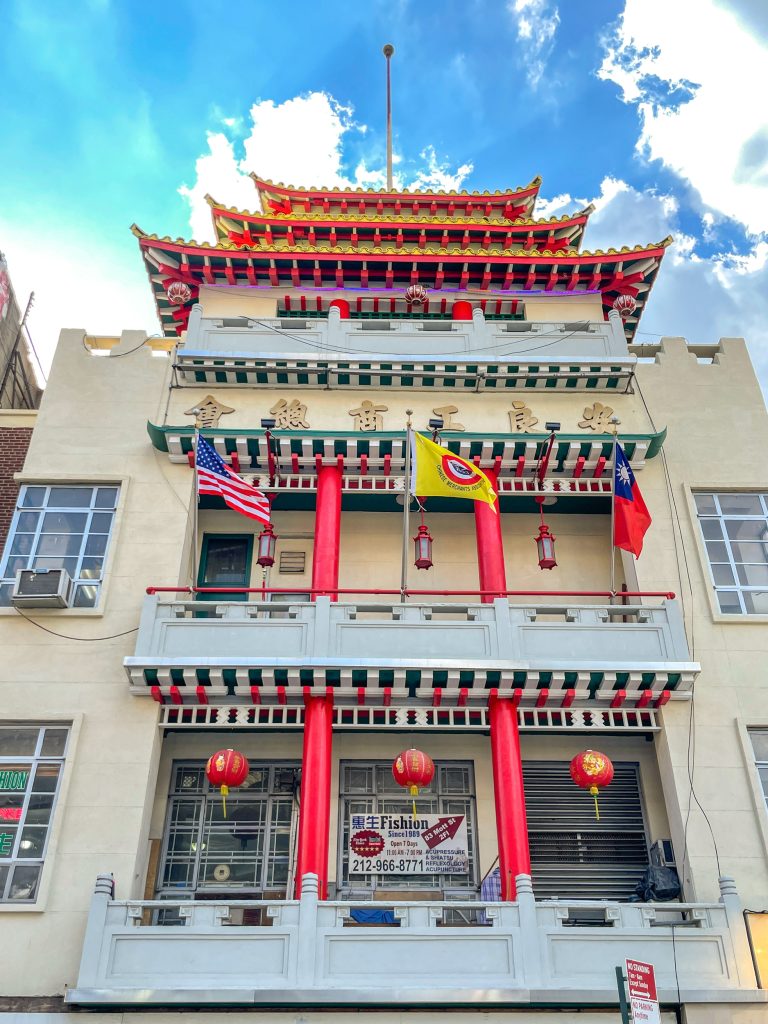
The west facade of the On Leong Chinese Merchants Association building, 2022.
+ As president of the association, what are some of your responsibilities?
I deal with headaches. If I receive any complaints from different chapters, I have to go, bring elders and headquarters people and deal with this. Before COVID, I went to different chapters every year for visitation; they have to report to me so I know what’s going on at that chapter. I would go regularly once a year.
Even in this Chinatown community, starting in December they do installations, where new officers are elected and inducted. On that day, each association has dinner parties. February (Chinese New Year time) is a big time in Chinatown — everybody is celebrating.
I, along with the New York headquarters president, am overseeing the renovation of the building.
Each chapter of the On Leong Chinese Merchants Association has two presidents. Why? One is member elected, “elected by the local people” and the second is elected from the 14 chapters.
I’ve been a part of the On Leong Chinese Merchants Association for a long time — I joined in the 1970s. You have to be 18 to join. For a long time I was a part of the association but I didn’t come because I didn’t have time. When my father retired, I started to come more. Around 2005-2006, I was the general national secretary and afterwards, I was the New York headquarters’ president. Now I am the national president. My father was proud of me. I am someone who likes to help people. It’s all volunteer work. I also belong to the Chinese Chamber of Commerce.
After 9/11, New York City tried to get more volunteers to help out, so I joined the New York City Emergency Response Team.
(Left) Cover of the commemorative publication for the On Leong Chinese Merchants Association’s 2014 convention.
(Right) Explanations of the historic artifacts exhibited in the association headquarters at 83 Mott.
+ What are your fondest memories of the On Leong Tong building?
I love the Guan Gong shrine in the building. I always light incense to honor Guan Gong — this is my favorite thing. This I never miss — I tell you.
I also love to see people and socialize.
+ How have you seen your association and Chinatown impacted since the pandemic started? How have you felt about this?
We shut down for a few months but we still had a president or somebody to get the mail, to clean. Now, people are coming back, which is a good thing. I know a lot of family associations still don’t have people coming back.
Well… COVID has been really bad for the community. Talking about my store [on 74 Mott]; I closed for a few months too because no one could come in. I’m hanging in there — it’s not just for the money; it’s because I have a feeling for the business. I try to carry on the Chinese tradition… If I’m not open, where will a grandma get her hong bao?
Interview
WITH KERRI CULHANE (ARCHITECTURAL HISTORIAN)
Interview conducted in April 2022.
+ Can you give me an introduction of yourself and your connection to Chinatown? How did you come to be connected to Chinatown?
I am an urban and architectural historian by training, and for the last 20+ years I have worked with community-based organizations interested in telling the immigrant histories of the Lower East Side, including Chinatown. In 2008 I was hired by the Two Bridges Neighborhood Council to research and write a National Register of Historic Places nomination for Chinatown and Little Italy. Since both communities have co-existed and largely overlapped for the past 150 years, from a spatial perspective, it was impossible to write about them independently of another. The nomination won the Excellence in Historic Preservation Award from New York State in 2010, but I was always dissatisfied with the National Register history, which is, for a district of over 600 buildings, by its very nature overly general. In the course of research, I came up on some very tantalizing tangents that I have been slowly following up on over the past 12 years. During the course of THAT research, I have found information that contradicts some of the accepted truths about Chinatown that made their way into the nomination.
My current research is working to clarify the historical record and deepen the understanding about the development of Chinatown, politically, socially, culturally and as a built environment. A very important tangent was the discovery of the work of Chinatown native Chinese American architect Poy Gum Lee, AIA (1900-68) in Chinatown. Since 2019, I have been working on a doctoral thesis in architectural and urban history & theory at the Bartlett School of Architecture, University College London, exploring Chinese and Chinese American self-representation in Chinatown from its founding in the late 1870s up until the transformative Immigration and Nationality Act of 1965. Lee’s life and work constitute the historical throughline of the thesis.
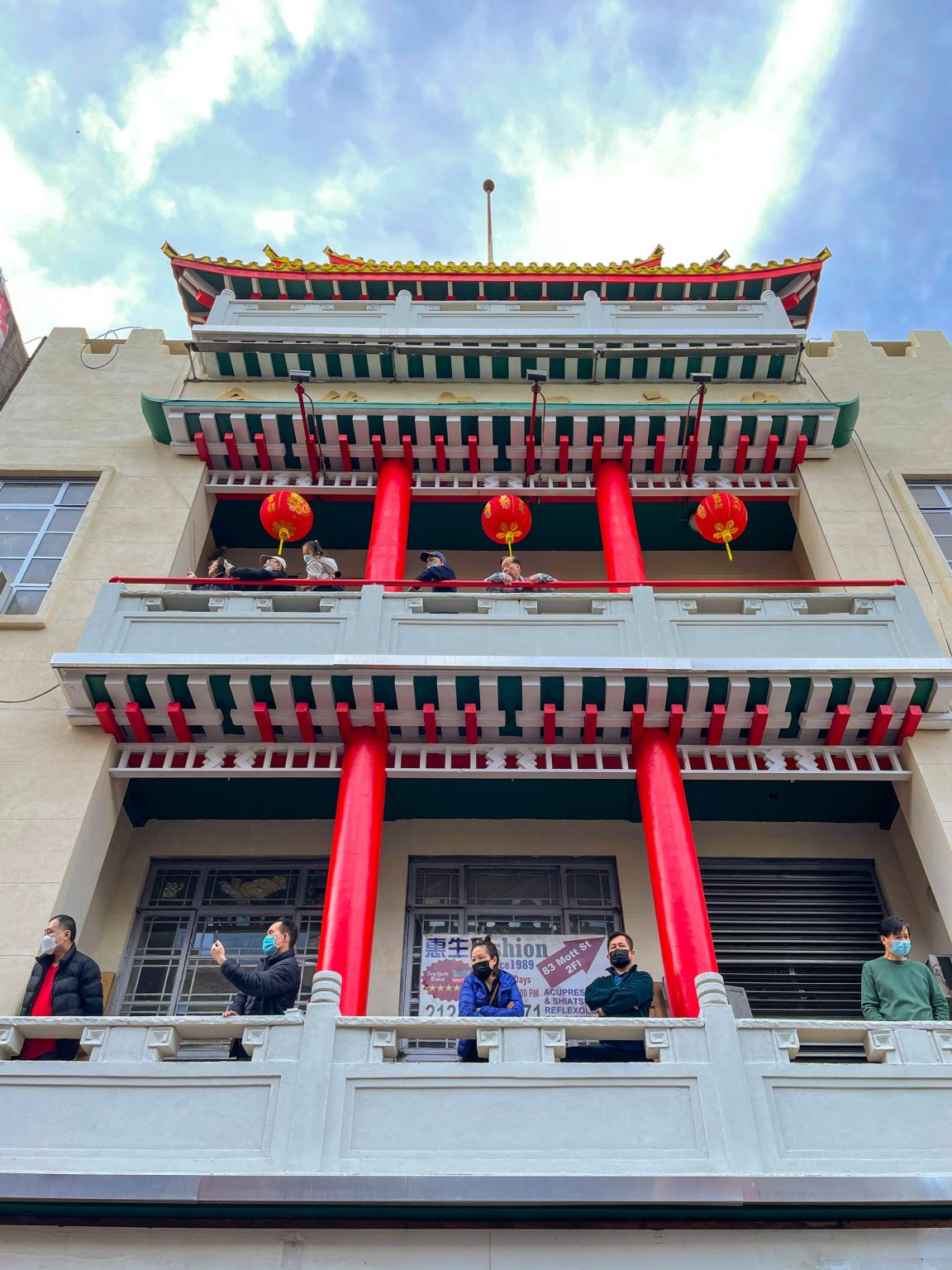
Association members on the balcony of 83 Mott, watching lunar new year celebrations, February 2022.
+ What buildings have you researched deeply in Chinatown?
I have learned something about every building in Chinatown by looking at the building permits and conducting onsite surveys, but the buildings that stand out are the associations, those that were remodeled or built anew to house the merchant, district and family huiguan and gongsuo. These organizations, which historically formed the sociopolitical backbone of Chinatown, were social structures imported from China to serve the needs and interests of overseas Chinese starting in the mid to late nineteenth century. They were the first buildings modified by Chinese, either as leasees or owners, to serve the Chinese community. Early modifications were made to the exteriors to mimic the urban shophouses of Hong Kong and the Pearl River Delta, which incorporated broad galleries or covered balconies. I found a note in the 1895 building permits in which an architect made a case for the galleries with the Department of Buildings, calling them a “Chinese device” that would make the buildings more like “stores in China.” [Read the article here.] Interior modifications included the joining of multiple tenement apartments into single rooms to house association meeting halls or temples.
There is a common assumption that “Chinatown” architecture is intended solely for tourists, but this overlooks the modifications made to house the people and institutions that MAKE Chinatown. Of course, buildings are powerful expressions of identity and power, and how Chinese and Chinese American identity was communicated and understood plays out in the streetscapes of Chinatown. The CCBA and the On Leong Tong, historically the two most powerful associations in Chinatown, were both collaborators and competitors for political dominance, and their competition is legible in the built environment.
In 1888, the New York Times called the CCBA’s (Chinese Consolidated Benevolent Association) headquarters at 16 Mott the first “genuine Chinese building” in Chinatown, even though it was a remodeled early 19th c. townhouse turned tenement. This “understanding” of Chinese architecture sparked my interest in studying how these buildings were designed to be used by the Chinese community and received by the rest of non-Chinese New York. In the postwar era, when Chinese were more accepted in America due to Sino-American alliance during the Second World War, the CCBA, with the backing of the Republic of China, began the process of raising funds to design and build their new headquarters, Poy G. Lee, newly returned from China, was their architect of choice. He designed two versions of the CCBA in 1947 and 1957, but unfortunately for everyone, it took nearly 15 years and a change of architect to get the current “mid-century mundane” (this is a term borrowed from architectural historian & historic preservationist Frampton Tolbert) CCBA building at 60-62 Mott Street built (Andrew S. Yuen & Associates, 1958-60).
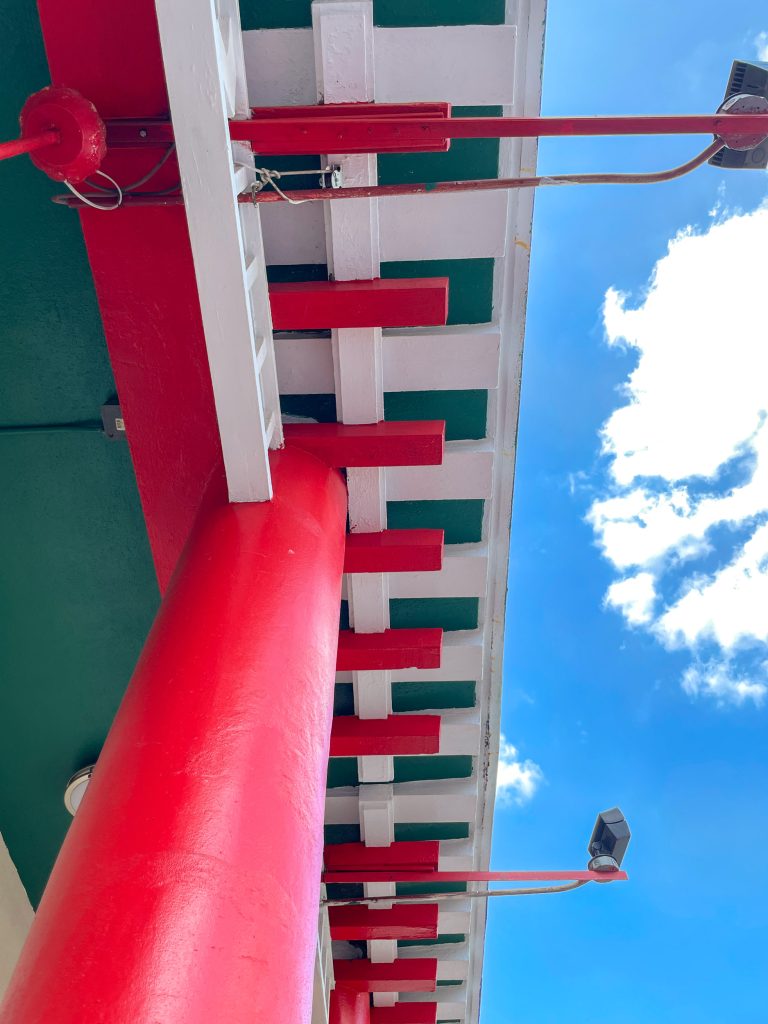
Column and eave detail, 2022.
The building at 41 Mott, now the Lee Family Association, was the first new construction commissioned for a Chinatown association—the On Leong Tong (1919-1921). The building, designed by white architect Richard Rahmann (there were no practicing Chinese architects at the time) was commissioned to commemorate the 10th anniversary of the Chinese Revolution (1911). It was of the shophouse typology, with a tiled Chinese roof. The layers of history in this building make it one of the most significant for my study. Young Poy Gum Lee, whose father was a member and past president of the On Leong, interned in the Rahmann office in 1918. It demonstrated the economic and political power of the On Leong in the 1920s. Later on, as the Lee Family association, it was remodeled in the 1970s to feature a very minimal modernist facade by China-born architect Wei-Foo Chun, the designer of Confucius Plaza (1967-77), at a time when overtly Chinese architectural expression was no longer the preferred mode for Chinatown’s association buildings.
The On Leong went on to commission Lee to design their new building at the corner of Mott and Canal (83 Mott) in 1948, outflanking the CCBA to get an impressive new building built by 1950 (the CCBA’s was not done until 1960). Even though Lee’s design was reworked by a white architect (Andrew Thomas) he still got the credit for the building.
+ Tell me about your research process. It would be really interesting to hear about your communication with tracking down Poy Gum Lee’s family and how your MOCA exhibition came about…
My independent post-National Register research has unfolded over nearly 12 years now, even though I was just sort of picked away at it initially. Many years were spent casually trying to track down information about Poy Gum Lee, and trying to make contact with his family by randomly googling and unsuccessfully emailing them through addresses found online. In 2014, I proposed doing an exhibition about Lee, the first Chinese American architect to practice in Chinatown, at MOCA. Curator Herb Tam was receptive, but he didn’t know at the time that I really had little material to go on.
Luckily, in winter 2015, I finally made circuitous contact with Lee’s family in California. In Shanghai, the very generous Cíntia Kou (a photographer, among her many talents) had been leading walks around town to document the “Disappearing Corners” of the city as redevelopment accelerated. Some of Lee’s buildings in Shanghai were on her tours —Lee was well-known in China for his work there, where it turns out he was a founding member of the Society of Chinese architects in the 1920s, and among the first professional Chinese architects to work in China. She had been in touch with Lee’s family, and put me in touch with them. I flew to San Francisco to meet with Lee’s youngest daughter and his grandson, the keepers of Lee’s archive.
They could not have been more generous and trusting with this amazing trove of architectural drawings, photos, letters, newspaper clipping and other items that documented Lee’s remarkable and unique transnational career. They shipped the archive to MOCA for me to use to curate the exhibition, which I built almost entirely on the contents of the archive. They then generously donated the archive to MOCA, and many researchers have now been able to access it, expanding the understanding of Lee’s work. The exhibition, Chinese Style: Rediscovering the Architecture of Poy Gum Lee (1900-1968) opened at MOCA in September 2015.
+ What have you found in your research is the most interesting, or most impactful chapter of the building’s past life? In your opinion, what are the most noteworthy or interesting architectural features of the building?
For me, the expression of Chinese identity in the built environment, whether a modest balcony modification to approximate a shophouse gallery or a full-blown Chinese roof, reflect larger themes of the Chinese and Chinese American experience in New York and in the US in general. How the built environment informed outsider perceptions of Chinese, and how the spaces sheltered and enabled the Chinese American community (its politics, society, culture and economy) to develop demonstrates how the buildings served as a material strategy for an outsider immigrant group to negotiate acceptance in a very racist country.
+ What do you believe is the importance / impact of these buildings being constructed by these associations, by these members and residents of the Chinatown community? What are your fondest memories of this building?
As white, non-Chinese speaking woman, I am an unlikely historian of Chinatown. Conducting research into buildings owned by Chinatown’s traditional, patriarchal associations, access and trust has been a challenge. I have focused on the empirical record (building permits, the physical buildings, and the larger historical themes), and have made every effort to gain trust by sharing my findings freely with anyone interested, and trying to contribute to knowledge and understanding of Chinatown as a built environment. I have made some great connections with elders in the community, including Eric Ng, who in turn connected me to others who were willing to share (and sometimes not, but it’s always worth trying!). Through collaboration with organizations like MOCA in 2015 for the Lee exhibition and most recently Think!Chinatown, where I have served on the board for the past few years, I am able to share my research but also gain a cultural competency that enables me not only to be a better researcher, but to direct my research to inform current issues in Chinatown, for example the debates around 70 Mulberry, the former P.S. 23, which burned on the eve of the Lunar New Year in January 2020. The ensuing discussion illuminated the role of historic buildings and the larger built environment in the economic, social and cultural future of Chinatown.
+ How do you think Chinatown has changed over the past century (architecturally, culturally or as a community)?
One of the most cited academics writing about Chinatown, the geographer Kay Anderson, describes Chinatown as an “idea” – it is a racial construct formed by the encounter of Chinese and a dominant white society, albeit one with distinctly physical dimensions. From its very beginning in the 1870s, Chinatown has served as a cultural home (but not necessarily the physical home) for members of the Chinese diaspora in the New York region. Its architecture still largely reflects the late nineteenth century streetscapes in place when the Chinese arrived, with the steady accrual of modern storefronts, signage and even a few new buildings. The use of overtly Chinese architectural signifiers has ebbed and flowed over the years, reflecting the changing status of the Chinese in America, changes in architectural taste, and the changing nature of the Chinatown economy. Chinese America is diverse (economically, geographically, socially, culturally), especially in the wake of the 1965 Immigration & Nationality Act. There is no unified or singular expression of Chinese identity in the built environment; this is especially true in New York Chinatown, where streetscapes have been increasingly marked by an informalism that reflects the transition from a tourist economy to an enclave economy that serve the needs of the diasporic Chinese and really the pan-Asian diaspora for goods and services.
As with most immigrant enclaves, historically, the goal for the subsequent generations is to move beyond the immigrant neighborhood and assimilate into the American middle and upper classes. The reclaiming of Chinatown by younger generations who are taking on family businesses, investing time and energy into community building, working to protect affordable housing and small businesses, and fighting back against the stereotypes that are still perpetuated, further demonstrates the shift from tourist Chinatown toward a multigenerational community.
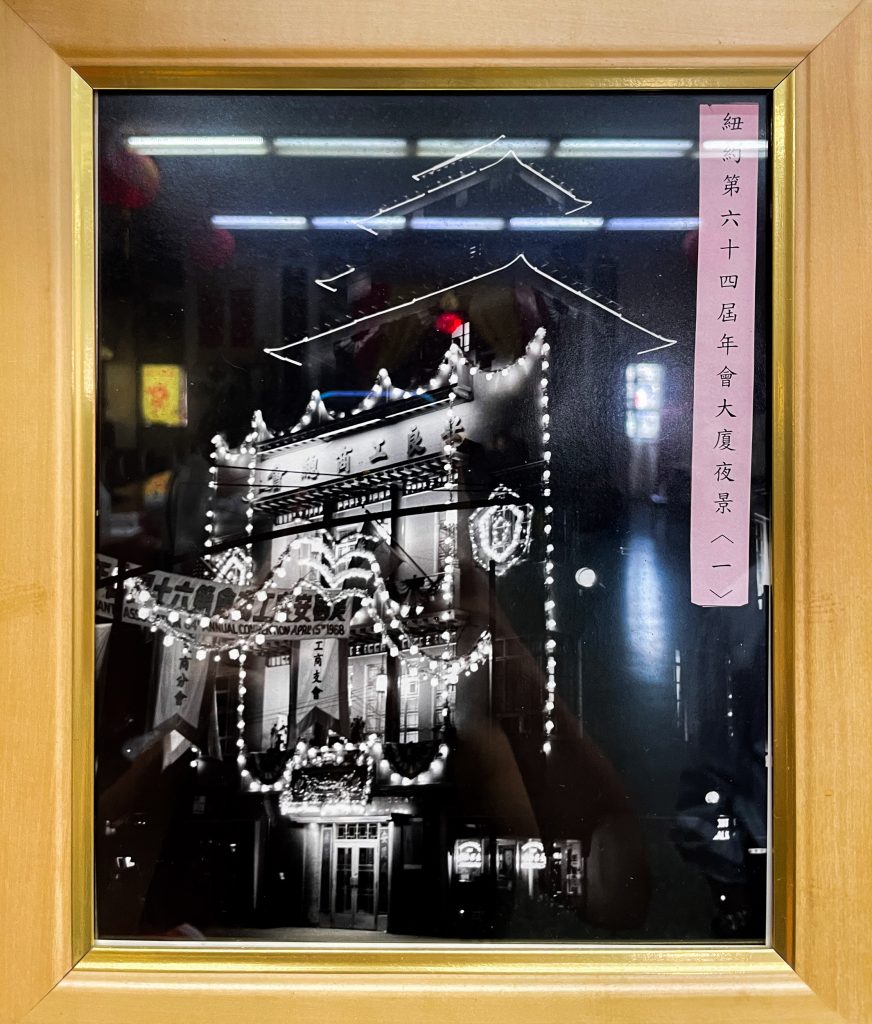
Framed photograph of 83 Mott in 1968, with banners celebrating the association’s 64th annual convention, is displayed on the building’s walls.
That being said, gentrification nibbles away at Chinatown—or authentrification, think of the artists and galleries and restaurants moving in and using Chinese signage or other winking references to signify what they no doubt feel is a transgressive move into an exotic locale. This is the same “thrill” sought by the white slummers of a century ago who came to Chinatown in tourist busses to see people dressed up like hatchet men and opium smokers. In a recent New York Times puff piece, the white fashion and furniture designer owners of the bar du jour that just opened on Bayard Street even make reference to the alleged “secrets” of Chinatown. So as far as Chinatown has come, it remains, in the words of folklorist Winston Kyan, “American’s preferred destination ghetto.” Physically, socially and economically it is constantly changing, but the general American (mis)understanding of it remains, sadly, the same.
83 MOTT - ON LEONG CHINESE MERCHANTS ASSOCIATION - BUILDING PHOTOGRAPHS
Photographs taken between 2022 – 2024.