
Kimlau Square
Kimlau Square dedication in 1959
Memorial arch designed by architect Poy Gum Lee in 1961
2025
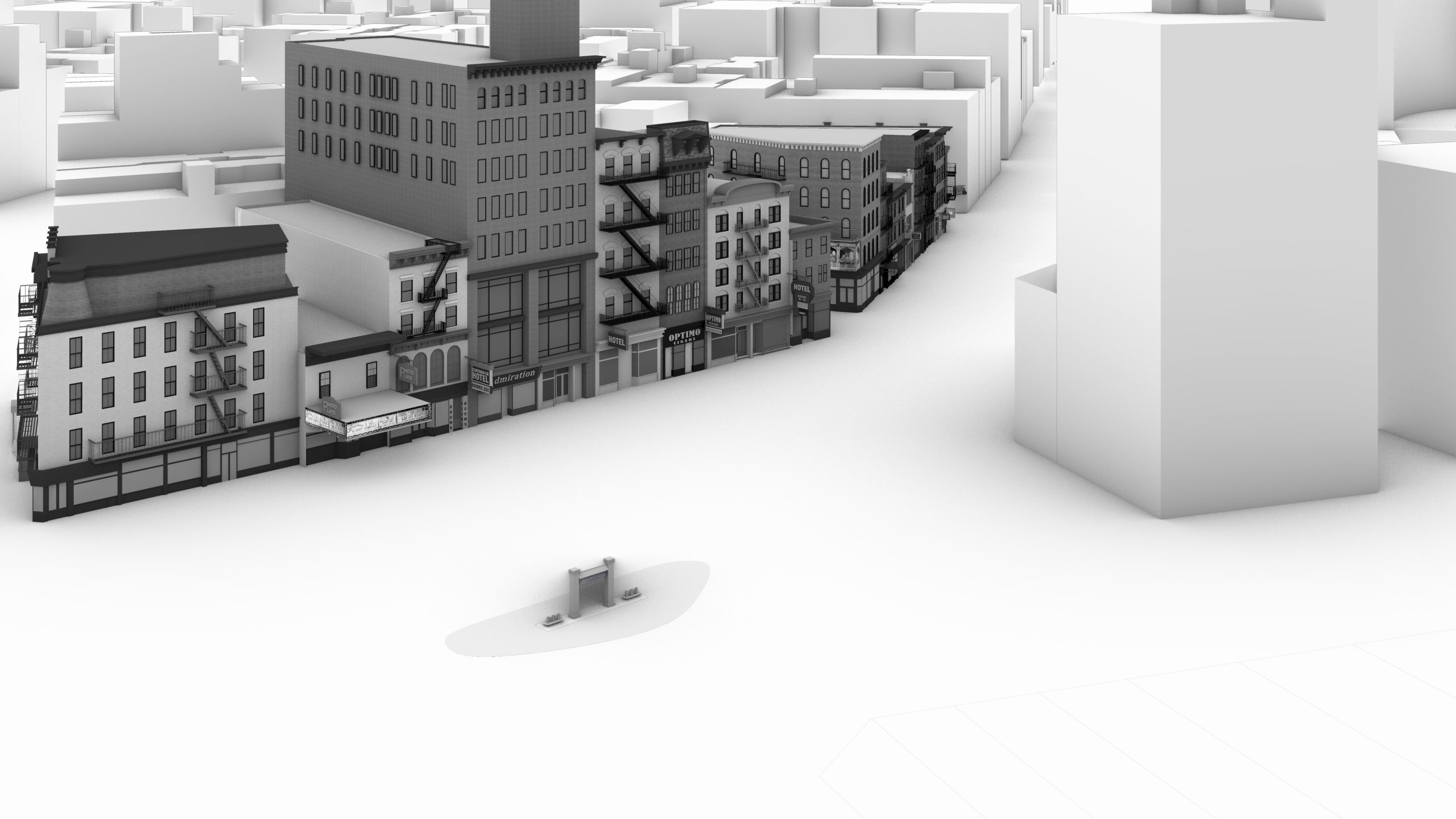
Kimlau Square
1960s

Chatham Square
Elevated Train Line - Chatham Square station
1940s
Interview
WITH GABE MUI (ADJUTANT OF THE AMERICAN LEGION POST 1291)

Gabe Mui by the portrait wall honoring past Commanders at the American Legion Post 1291 building on Canal Street, 2024.
Interview conducted in February 2025.
+ Would you give me a brief introduction of yourself?
I was born in Taishan, China and at eight years old, my family moved to Hong Kong. I basically grew up in Hong Kong and immigrated with my family to the U.S in 1966. After my high school graduation, in the summer, we came over to the U.S.
I went to school for a little bit before I got drafted. Actually, I had to report to the draft board as soon as I got here. You had to sign papers before you came, because at 18 years old, you had to report. Immigrants had to report within six months upon arriving, which I did. At that time, if you were a student, they would allow you to obtain a student deferment, so I went to school… I obtained the deferment, but after I graduated, I had to report back. They sent me a notice to report back to a draft board and I was drafted at that time. I served two years.
+ How did you feel when you found out you were getting drafted?
Not very good – because at the time, the Vietnam war was still going on. I took it better than my mother. My mother was worried. When I went to basic training in New Jersey, I wrote home to tell my family what I was doing over there. After a couple of weeks, my brother told me: Don’t write home anymore, because every time, Mom’s crying. So she did not take it as well as I did. I was a kid; I was so busy with the training, so I didn’t really feel bad about it, knowing it could have been me that ended up in Vietnam at that time… but I wasn’t thinking that way.
I was fortunate. After basic training, you would go to AIT, which is advanced infantry training. After that, right before you would finish with the training and they would start giving out orders, where were you going to be reporting? I was very fortunate that I was one of the four in my class of 45 who did not have to go to Vietnam. Everybody else had to go to Vietnam.
+ Was your class ethnically diverse?
It was. There were people coming from the south and people coming from the west. It wasn’t just people from the local area. Everybody was drafted and put together, so it was all over the place.
+ Did you ever experience racism in the military?
You know, that’s one question that a lot of people ask. I know a lot of people do face discrimination, but to me, I personally never experienced anything. In training, nobody was going to discriminate against anyone and nobody was going to pick on anyone. But once you got into your regular unit, now you would be in a room or in a platoon with other people. There were people who might make fun of you, but it was not in the “picking [at you]” nature. It was more like just having fun, joking. So I never experienced any discrimination.
+ After you came to the U.S., where did you grow up?
I never lived in Chinatown. My whole family lived in the Bronx. Occasionally I would come to Chinatown to buy stuff or go to eat, but I didn’t have much involvement with Chinatown at that time.
+ How long have you been involved with Chinatown, with the Post and the monument?
I joined the Kimlau Post in 2000. Once I joined, I was fully involved with it. I was here regularly every week. At the time, I was still working. I was only working at Con-Edison on 14th Street, very close by. Once I joined the Post, I got involved right away. At the time, we were doing the 60th anniversary journal. Because of my background, I’m pretty good with computers and graphics.
I studied to be a power engineer. and I began working in Con Edison in the Planning Department. We would plan for how a certain area would have an increase in power, what we would need to build to supply that, etc. After a while, I got involved with computers. I really love working with computers. At the time, the PCs were just coming out in the 1980s. Later on, I transferred over to IR [department], which is a technology, doing programming and working with computers.
Because of that, it just happened to be a perfect fit to work on the 60th anniversary journal. I knew graphics and how to handle all the software. I dove right into it and became very involved, coming every weekend. Later on, they said: Well, we’re going to need you to be an officer.

Gabe Mui at his desk as Adjutant of the Kimlau Post. Photographed at our interview session, February 2025.

Gabe’s “Legionnaire of the Year 2022” award, photographed at our interview session, 2025.
+ Do you remember the dates of your involvement?
2000 – I joined The Post.
2003 – I became the Executive Committee member for 1 year
2004 – Became the Chinese secretary
2005 – Became the Vice Commander for two years
2007 – Then I became a Commander
2009 – I became an Adjutant (sort of like a chief administrator / CEO) and I’ve been adjutant ever since
2008 – I became a County level Commander
2015 – Became a District commander
2019 – Became a Department [State level] Vice Commander, I was appointed as the Department [State level] Foreign Relations Committee Chairman and also served on the National Security Commission
2022 – Selected as the Department Legionnaire of the Year
The Post is the lowest level in the American Legion. The next level is County, after that is District, and the next level is Department (which is State level). Then the highest level is National, of course. Over the years, I’ve been steadily increasing my responsibility.
In 2022 I was chosen by all the past commanders as “Legionnaire of the Year”. They only give out the award to one person per year. It was a pretty big honor.
As Adjutant, Gabe represents the Post at many of Chinatown’s community and association meetings.
+ Let’s talk about your history with the Chinatown Working Group.
It seemed like a very good idea at the time. It started in… maybe 2007, with the idea to get everybody in Chinatown to agree on how we’re going to move forward to make Chinatown better.
In the beginning it was a very good idea and the ambition was good. Everybody agreed on it, but later on, it was kind of expanded. I don’t know why they did that, but they started bringing in Lower East Side people and they were complaining: Why are you guys planning for the local area without letting us be a part of the voice?
Then once they came in, they would bring their agenda. They said: We’re not just going to concentrate in Chinatown. What about what is going to be done to benefit the Lower East Side? Then some people suggested: Why call this a Chinatown Working Group? It’s not just Chinatown. We did this for about nine years!
It just never had any resolution. It was always bickering, it was complaining, “what’s for me?” and never, never moving forward. The Working Group was… the whole thing in the air. I had to set up for the meetings and clean up after the meetings. For nine years I did that. Then after that, I said, Wait a minute, we’re not moving forward. You’re wasting my time.
So I told them: You can no longer work and you can no longer hold your meetings here. We basically quit. It wasn’t just me, most of the groups in Chinatown basically pulled out. CCBA [Chinese Consolidated Benevolent Association] pulled out, everybody pulled out. Now they still have the Chinatown Working Group… without anyone in Chinatown! They are still sending me meeting minutes that I don’t even bother reading. Nothing was done. Nothing really meaningful came out from that.
That was my first involvement in Chinatown. Later on, we formed the Chinatown BID. Well, the [Chinatown] Partnership came first, and then we formed the Chinatown BID. The Legion became a board member and we testified in City Hall and advocated for the Chinatown BID. The first chairman of the Chinatown BID was David Louie – he is also a Legion member. He did it one year and then he turned it over to me. The chairman would basically oversee the director (oversee Wellington), give advice and be in charge of the board. I was chairman of the Chinatown BID for five years. Also, because the Legion is one of the 60 organizations that belong under the CCBA, so obviously I also got involved with the CCBA. Now I basically represent our Post and attend all of the meetings. So that’s how I get involved with Chinatown!
Also, in the last few years, I’ve become the Moy Association president.
+ How would you describe your relationship to the monument?
The monument was built in 1962 and has become our symbol ever since. We have our Veterans Day, Memorial Day and other functions that we host there at the memorial arch.
My involvement with that is when I was a vice commander, we started to notice that the monument was not upkept. The background of the monument is that when we built it, we built it on city land, which was basically a traffic island. The original design was three bays (which means four columns), but because it was a traffic island, they could not have a monument so big – so we had to trim it down to just the one bay (two columns and one base). That’s the way it is now. Later on in the 1980s, they started merging the traffic island and made it into Kimlau Square. It was not connected; it was sitting in the middle of Bowery; basically a traffic island. You’d have cars going around on both sides. So when we had to do any ceremonies or anything, we would have to stop traffic. Later on, it was basically merged with East Broadway with the whole traffic pattern redesign.
We used to have a metal plaque in English in one of the flower planters in the square. Somebody stole that. That was dedicated by Giuliani at that time. I don’t think you could find the plaque anymore since it is gone, but we still have the Chinese version of it right there [in the Post].

Gabe Mui looks at Poy Gum Lee’s stamped blueprints of the Memorial Arch, February 2025.
So once we built it [the monument], we had to turn it over because that land belongs to DOT [Department of Transportation]. Once they merged [the streets], that became a park – they designated it as Kimlau Square, Kimlau Park. Then the DOT turned their responsibility over to the Parks Department. They are the ones responsible for the upkeep. We are not allowed to do anything to it. Once we built it, we’ve never been allowed to maintain it because in the beginning it was under the DOT, and then later on under the Park Department. Over the years, no one noticed that some of the concrete base on the two chairs was cracking.
Original correspondence with Poy Gum Lee, the architect of the Kimlau Square Memorial Arch, dated 1961. Photographed at our interview session, February 2025.
+ When did you notice the cracking going on?
In 2006, 2007. Ever since then, we’ve been asking the Parks Department to do something. It’s been almost 20 years and nothing has happened. Nothing. Well, over the years, what they did is start to come up with different plans, like redesigning the square. That was the design by DOT and the Parks Department and we signed off and said – Well, that’s great. We like the design because it’s a bigger plaza. We advocated for a long long time. But then after we signed off, DOT came back to us, maybe a couple of years later. They said: Well, we cannot go forward with that plan because right there where the design is, there’s a plan for the Second Avenue subway. There would be an entrance, an exit that would not work with the design. So that basically was killed because of that… The Second Avenue subway is not going to be built for the next 60 years – who knows? Maybe a hundred years! Then they were talking about their plan again. Nobody knows.
That’s the main reason we gave the go-ahead to repair it now. We worry if in the future the square is going to be redesigned or not. Currently, it’s the benches that need to be [repaired] and the arch.
+ Have they figured out why they’re cracking?
We were promised this [information] three years ago, out of all the meetings we had. They said: We’re going to do the engineering study to find out what is causing the crack. Well, obviously, there’s a lot of reasons for that. We were told it’s pretty much hollow because there’s a water tunnel, utility wires and also a subway tunnel down below. That’s one of the reasons why we were not allowed to build the three bays – because the weight would not have been supported. Somehow there’s also some movement, either from the traffic above or some movement below, that is causing the vibration that started cracking the monument.
We were promised to have the full engineering study, but over the last three years, all they have done is drill a couple of holes. Then they have never come back with anything, with any findings. Finally, I think it was in October or November, we had a meeting with DOT, the Parks Department, EDC… and we finally said: Let’s fix it. What they promised us is that they don’t know what’s causing the cracking. As of today, they still don’t know what is causing the vibration and the cracking.
They said they will take it apart and then test the ground. That’s their procedure right now. They’re going to go ahead and start taking it down.
+ How long will it be taken down for?
I was told that they [DOT, Parks and EDC] would start dismantling sometime this summer. They’re going to board it up and then it will take one year to dismantle it, do the study and then reassemble. But the kicker is that, if they find that the ground is not suitable, they won’t put it back up. We don’t know what’s going to happen.
We really don’t know what the outcome will be. The reason why we want to do it now is because the money was in there in the capital budget. There was some money in there before, but they moved it away. We don’t want that money to go away too, because the money to fix the memorial is not part of DRI [Downtown Revitalization Initiative] money and not part of Mayor Adams’ money. It was basically from before, when the market was still around. We don’t know if they’re going to take the money away or not; nobody can guarantee that. So, since the money is there, we want to fix it right now and that’s the reason why we gave the go-ahead to get it done after 20 years of this.

One of the two original stamped copies of the approved Kimlau Square Memorial design, bearing Poy Gum Lee’s seal and signature, shared with the Post in 1961. Photographed in February 2025.
+ Is there anything else you feel is historically important to mention about the plaza or the monument?
Traditionally, the Chinese always have something to dedicate, to memorialize veterans. As a matter of fact, San Francisco has one, Chicago has one in Chinatown. (I think ours was built first.) There was good sentiment in the late 1950s that we need to build something to memorialize the veterans that sacrificed during wars.
+ Do you know a little bit about that process in the 1950s?
Basically I heard it from the old timers. At that time, they knew they were going to build it and they knew that they wanted to put up the money to build it. But in Chinatown, there was no place you could build it.
They spent a few years going back and forth with City Hall and finally got approval – after four or five years of working with City Hall. They came up with the traffic island in Bowery, the middle island of Bowery. That’s when they started building it, but because it’s City land, like I said, they had to turn over the City. Once we built it, we no longer own it.
+ We talked a little bit about it, but can you share any information about the past lives of this plaza? Do you know of any major renovations or changes to this plaza since it was first designated?
What you see is what you see when it was first built. Like I said, they merged the traffic island in a redesign of the footprint, but the memorial basically has not changed. There’s no change [since it was built].
+ What are your fondest memories of this plaza and monument?
My favorite memory is obviously of all the parades and ceremonies. When you’re a commander, you have to give a speech, but once you become an adjutant, you have to run the show. That would be the first time I felt, Wow, I have to do this. I have to prepare everything: the line up, who is giving the speeches, who the guests are and what’s the protocol of what to salute, when to give the invocation, etc. That stuck out in my mind – I’m doing this now!
Other than that, one of my most impressionable memories is: In the 60 anniversary journal, there’s one picture there [taken] at the same angle. Before the 9/11 attack, in the picture, you’re actually seeing the two towers still standing. In the following year, on the same Memorial Day parade, we hosted the ceremony there and there’s a picture at the same angle, only now with the background empty. That sticks out in my mind.
+ What do you think this monument means for the community?
In this whole Chinatown here, we have no monument. We have nothing like that. You go to Washington [DC], you go to San Francisco, they all have the paifang [arch]. That’s what we’re trying to do right now with the gateway [request for proposals]. The memorial arch now basically represents Chinatown. It’s our paifang. It’s well known – in Chinatown, you will walk by it and we have parades there and it’s very significant. Otherwise, they wouldn’t make it a landmark, right? That’s important to the Chinatown community that it’s dedicated for veterans and it’s a shared space for the community, even if it’s a small one.

Photograph of photographs in the American Legion Post 1291’s 60th Anniversary commemorative issue.
Interview
WITH KENNETH WONG (VICE COMMANDER AND FORMER POST COMMANDER OF THE AMERICAN LEGION POST 1291)
Interview conducted in July 2022.
+ Would you give me a brief introduction of yourself and your connection to Chinatown?
I was born in Hong Kong and came over from Hong Kong when I was eight years old with my parents and two sisters. That was back in 1962, 1963. I stayed in what was called “Chinatown” on East Broadway, at 95 East Broadway between Allen and Forsyth by the Sun Sing Theatre. We also had the Governor Theatre (Joung Dook) in Chatham Square, where the Citibank is now. We would walk over to Bayard, Mott, Pell to go to Chinatown, unlike what we have today — today Chinatown extends north to Houston!
I lived on East Broadway since we came. I attended P.S. 2 on Henry Street and Pike, then Junior High School 65 (which was knocked down in 1982 and then became Sun Yat Sen School) and then Seward Park High School. I also attended the True Light Church for years, as soon as we came over, as my aunt and uncle were members. I was a member of the church and did Chinese School. I spent a year at CCNY (City College of New York) before I joined the Navy. I stayed in Chinatown until I joined the Navy. When I joined the Navy, we still had the draft. I didn’t wait for the draft — I knew it was coming. When volunteering, it was a minimum of four years of active duty.

Kenneth Wong at his desk at the American Legion Post 1291 building on Canal Street. Photographed at our interview session, 2022.
I have a total of 25 years in the Navy, both active and reserved — that was the period of the Vietnam conflict, right up through the Gulf War. I did my basic training in the Great Lakes, Illinois, about 15 miles north of Chicago. I trained as a hospital corpsman, a medic. Then I went on a ship, a destroyer, a relatively small ship less than 600 feet long. I went as far up the north Atlantic to Iceland / Newfoundland and down south as far as Argentina, out to Europe. Our home port was in Norfolk, Virginia.
My father fought in World War II with the Kuomintang against the Japanese.
+ How long have you been involved with the American Legion Post 1291 and what’s your role here?
I joined the American Legion in 2004. As long as you served in the military, you could join. Back then you had to be on active duty during one of the wars – World War I, World War II, the Korean War,the Vietnam War, the Gulf War. I thought this was kind of stupid. They’ve since changed this.
I am a past Post Commander (2016-2018) with two consecutive terms. I first served as Vice Commander from 2012-2016 and am presently serving a fourth tenure as Vice Commander (2021-2022, 2022-2023, 2023-2024, 2024-2025).

The memorial, gifted by the American Legion, barricaded off in Kimlau Square in 2023.
+ How long has Kimlau Square and this monument been here? What’s the American Legion’s relationship to this monument?
The memorial was built in 1960. There are cracks in the monument now and it needs to be repaired.
When they erected this in the 1960s, it was mainly for those who had perished in World War II (1941-1945) and the Korean War (1950-1953). At the time, the Vietnam conflict hadn’t really started yet. Since then, we’ve had the Vietnam Conflict and the Gulf War and it’s basically what it stands for — those who made sacrifices in all of these wars.
Five years ago, we noticed the cracks and notified the Parks Department. That’s why the barricades are up for now. We’ll see what happens as far as repair and replacement is concerned.
When we do our Memorial Day and Veterans Day parades and 9/11 gatherings, we march from the CCBA to the Kimlau Memorial, where we have our service.
Interview
WITH WELLINGTON CHEN (EXECUTIVE DIRECTOR OF THE CHINATOWN BID AND CHINATOWN PARTNERSHIP)
Interview conducted in July 2022 and July 2026.
+ Tell me about your connection to Chinatown.
I’m the director of the Chinatown BID & Chinatown Partnership. I came to New York thanks to my mom, a nurse, and this country’s shortage of nurses. I was nine years old when my father died, so we went to Brazil and my mom went to get a nursing visa. We returned to Hong Kong to wait for the visa, as per policy. It was a hot summer day on August 7, 1970 when my mother and I arrived here in New York from Hong Kong. I was a teenager then. Schools were going to open in September, so we needed to figure out a way to support ourselves.
My very first job was on Canal Street in an industrial loft building. I can only describe this building as giant; exposed brick with the interior bricks painted all black. I was helping to ship wigs for an entrepreneur who appeared on TV as a male model, and I developed an expertise for packing these. It was my first encounter in this country with human kindness. My supervisor was a young Thai-American, and he asked me to go out and get him a soda. I told him I had no money to do so. He turned around, gave me some money and said, “Kid, go get yourself a soda too.” It was a very hot day. People remember the kind things you do for them.

Wellington photographed at our interview session in Kimlau Square, 2022.
Back then, I wasn’t paying as much attention to Chinatown. I lived in Flushing, but every weekend I came to Chinatown to shop for groceries. You could park in the municipal garage at 1 Police Plaza – 450 spots! It was the only municipal garage in Chinatown. The prices were really reasonable. You would then go have dim sum, go grocery shopping, and bring your stuff back to the garage. At that time in the 1970s until the 1980s, there was no other Chinatown.
I became involved indirectly in community revitalization and resuscitation during my architecture school years. Flushing wasn’t doing well (although today Flushing has the largest concentration of people of Asian descent in North America): people were leaving and there was economic instability, which was what was happening across the urban belt. The subway was full of graffiti inside out, crime was high and people were fleeing to the suburbs. I remember during blackouts, people were smashing glass storefronts and looting TVs. Stores were all heading to the suburbs. I was detoured from my architecture career because there was an open call from a community leader. I started attending public hearings on the local community board, sitting in the back as a kid. I volunteered, conducting surveys of pedestrian counts, how wide the sidewalk was, vacancy rates, etc…
I was the first Chinese-American to serve on the board in Queens. I served for 13 years before I got recruited to the city government. I was also a zoning commissioner from 1990-1995.
+ What’s your relationship to this monument?
I’m on the Landmarks Commission and I was honored to vote in the first landmark dedicated to Chinese-American contributions. It was a way to pay back.
The American Legion members were the first two chairmen of the BID and the Chinatown Partnership: David Louie and Gabe Mui.
In 2021, it was landmarked.
+ Describe the design of the Memorial Arch and of the Lin Ze Xu statue. Tell me about the history of this plaza and what the monuments commemorate.
Both memorials represent significant figures in the Chinese community.
The Kimlau monument, the memorial arch, was built in the 1960s. The famous Chinese architect, Poy Gum Lee, designed it. It commemorates the contributions and sacrifices of veterans who “lost their lives to fight for freedom & democracy… freedom is not free.” Lieutenant Kimlau was shot down in 1943 in Papua New Guinea. He was in his 20s. Chinese, as paper sons, fought on both sides of the Civil War, but were not recognized for their contributions. Even on their tombstones, they weren’t recognized.
This memorial is not only to honor Lieutenant Kimlau, who died before reaching his 27th birthday, but also to honor all those who paid the ultimate sacrifice, all those who never came home.
On the plaza there’s also another statue, which commemorates the first anti-drug czar who lost to the British, Lin Ze Xu, a tragic figure in Chinese history. He warned the world about the dangers of the opium trade, and the resulting Opium Wars led to the cession of Hong Kong and Macau and a period of humiliation for China. That history still lingers today, and the tension between East and West remains high. These are mainly Mainland supporters who put up this statue.
The Kimlau monument was put up by those who support Nationalists and Taiwan.
Therefore there’s conflict. It’s a place of convergence and of conflict. Both sides hang different flags on the square on October first (mainland China flag) and October 10th (nationalist Taiwan flag.) The positioning of the statues is very telltale — the statue faces east; its looks towards the rising sun, east, towards Mainland China. It turns its back on Mott Street, on the civic center. It was put up after the Kimlau Memorial arch was put up. Then, people call it different things. Those from the American Legion will call it Kimlau Square. Others will call it Lin Ze Xu Square.

NYC Parks signage of the history of Kimlau Square, photographed in 2022.
+ Who owns the monument? Who is the caretaker of it?
Technically, my understanding is that it’s on Parks land, so NYC Parks maintains it, but the memorial was fundraised and erected by the American Legion.
+ Tell me about the past lives of this plaza. What major renovations or changes has this plaza undergone?
The plaza is a constant work-in-progress. It hasn’t stayed in one shape —This place was never properly planned. This is a convergence point where seven streets come together: Mott Street, Worth, Bowery, E. Broadway, Oliver Street, James Place, Park Row.
Historically, after the colonists came and after the Lenape Indians were displaced, the square was a livestock trading ground until the early 1800s. In old photos, you’ll see the horse-drawn carriages. It’s the site of the 1863 Riots, when the Civil War imposed the draft and the Irish objected (they didn’t have the $300 to be exempt from the draft) because they didn’t want to defend African-Americans. They thought it was unfair that the rich could get away from being drafted. This was always a somewhat chaotic setting.
Later, it had the elevated train line of the Bowery El over it, which is why the street is so wide. The construction of the two elevated train lines cut through the area. One cut southwest, one cut southeast, and what remained was this leftover space. After the streets were reconfigured, that leftover space became where the Lieutenant Kimlau Memorial was placed.
If you look at the 1962 records, they called it a “traffic island.” That tells you everything. To this day, this place never had a proper setting to mourn, honor, commemorate, or celebrate. It was never planned as a civic space. First came Lieutenant Kimlau’s memorial. Then, decades later, the Lin Ze Xu statue came along. They basically said, “Oh, it doesn’t work here, let’s move it over there,” and pushed it aside. Then they closed off access from St. James Place to East Broadway. That’s how you ended up with what is now called the square.
But it was never really a square.
The other thing is that Chinatown has more than 10 miles of perimeter, and it’s the third-largest park system in the city out of 78 parks, but we don’t have one official plaza that meets Department of Transportation (DOT) standards for people to mourn, gather, celebrate, or come together.
We are social animals. We are a communal society. That’s why something like a lazy susan is meaningful—we come together around a table and share a meal. This is an important, prominent juncture. At a collision point like this, we should have conversation, collaboration, and a true communal space. That is what this place represents to me.
+ How is this plaza important for Chinatown?
The future of the plaza is critical to Chinatown, not only for the Chinese community, but also for the historic and cultural context, and for the future repositioning of this area. The Second Avenue Subway will eventually come down here. That’s a given. So the question is: how do you want to welcome visitors? When people come out of the station, are they stepping onto a sidewalk in front of Citibank? Are they coming out into a park? Or are they coming into a plaza—a true gathering place?
Imagine someone coming here to commemorate the 9/11 heroes, or for widows and their children and grandchildren to gather. You need proper sound systems, lighting, seating, a place to raise the flag, a place to change uniforms, bathrooms, and proper infrastructure so that when you play the national anthem, the sound system doesn’t fail halfway through.
This is why it is so important.
Remember: after 400 years on this island, the Kimlau Memorial remains the first and only landmark in New York City that says anything about Chinese Americans. If this plaza is designed properly, and if a path is created in front of the Kimlau Memorial, this becomes the first and only gathering place for us—and for everyone who wants to visit Chinatown.
+ The plaza will be redesigned within the coming years and is proposed to move to the other side of the intersection. How is the proposed plan being shaped?
The plan should reflect the will of the people who created the memorial in 1962. Actually, it reflects the will of the veterans and VIPs who installed the memorial. In 1962, when we commemorated Lieutenant Kimlau, where were the VIPs standing? They stood on the north side, facing south. Every photograph shows the same thing. Nobody stood on the other side.
They planted their feet there. They chose that location.
When we talk about honoring the dead, we need to honor their decisions. The veterans could have stood anywhere, but they stood on the north side, facing south, because that was good feng shui. If you come down Mott Street, you see why. Why would you cross the street and stand in the shadows, looking the other way, with your face in darkness?
So I think the positioning is correct. The nuance is in the details and how everything is arranged.There is another opportunity that nobody is thinking about: this is the golden opportunity to address stormwater management.
+ How do you imagine the future of this plaza?
This plaza could become the future gathering place that the world knows about. I believe this will become a vibrant core. It’s the Columbus Circle of the future. It’s just a matter of time.
The question is: how do we not squander the opportunity?
You need to plan for the infrastructure. You need storage for equipment. You need stormwater management. You need lighting. You need underground sound systems. You need places for veterans to perform ceremonies, for tributes to happen, for people to gather.
Right now, we have been shortchanged for so long. Think about Lunar New Year. Where do all the dragons and lions go? Where do they gather? We have 38,000 landmarks and public monuments, but this is the only Chinese American landmark.

Wellington playing games at one of the activities organized for an Open Streets day on Pell Street, 2024.
The details matter. Those decisions are what will determine the quality of the space. That’s why we need to think beyond the immediate. Don’t just look at the key performance indicators and say, “This isn’t included.” We need to think about the future. We should demand storage, stormwater systems, lighting, underground sound systems, and all the infrastructure needed for a true civic space.
We need to create a meaningful place for those who never came home.
+ What are your fondest memories of this plaza?
Every year, whether on 9/11 or Veterans Day, it has become a major gathering place. On July 4th, both sides gather on that square. There are many commemorations that take place there. That’s why it’s a very important meeting place. Kimlau Square is the first place you see coming down from Bowery or from Park Row, or from Wall Street.

Wellington photographed while photographing on Division Street.
+ How did you come to start the Chinatown BID?
When 9/11 happened, Chinatown was in deep trouble. South of Canal Street was a frozen zone. I spoke to Thomas Tam, a former City University of New York trustee and he said, “We are part of the frozen zone but not getting the support that the rest of Lower Manhattan is getting.”
A few years later, people began to object, even non-Asians. They put together a team to look at how Chinatown could use help. I heard they literally pulled the proposal out of the trash can. In February 2005, I was approached by somebody in the Chinatown Revitalization committee. They said that they were forming a new nonprofit and looking for a director. At the time, I wasn’t interested because I was working to bring the Olympics to New York and we’d already spent five years on it at that point! I didn’t know at the time, but people submitted names with different categorizations. Their first search did not produce a result. They reached out again and I suggested they use a search firm. Somewhere in April-May, the search firm reached out to me and I gave them some names. In September, I got another call that they still hadn’t found someone… that’s when I considered the job. There were two final candidates. I interviewed and was selected.
+ What were the first years of your work at Chinatown Partnership / Chinatown BID like?
The Chinatown Partnership is a LDC (local development corporation), which by state law is a non-profit that has the right to go in and do adaptive reuse, without competitive bidding, of underutilized municipal buildings. This was my speciality in design-build firms I worked in.
Back then, we didn’t have an office and we were renting a temporary cubicle at 150 Lafayette Street, which at the time was not yet demolished. We didn’t have employees, only a piece of paper from the IRS. The IRS challenged our nonprofit status before we even got started. That’s how we began. We assembled a team, sent out RFQs. Lamgen Leòn was the very first office manager.
The funding for the ‘Explore Chinatown’ campaign was limited in time; it had maximum three to four years to use. We were fully funded for the first 24 months but had to start bringing in our own income by month 25…. which is when we held our first gala.
Surveys were conducted and people said that Chinatown needed sanitary help (garbage on the street, graffiti, debris, etc). We had some initial funding for ‘Clean Streets’ and marketing. Back then, no one wanted to mention the word “BID” — it’s like the 3rd rail on the subway; everyone is afraid to touch it. The only way we were to sustain supplemental cleaning was to start the BID. It was such a hard sell (mostly because people didn’t want to pay money for it. They thought it was the government’s responsibility to do this.
+ How did you see Chinatown impacted by the pandemic?
Chinatowns have been the first to take a dive. Before the COVID outbreak, there was already a decline in business. People were scared and thought it was the epicenter of the Wuhan virus. The lockdown was in March, but by February there was already a screeching halt to business. We were promoting Chinatown around Valentine’s Day to get people to come down.
It’s been hard for businesses and the mental psyche of Chinatown and Asian residents too. Subsequently, there was the rise in Asian hate. It’s still continuing. Almost 70% of victims of Asian hate crimes are women. Can’t we just all get along? Sad to say, there’s no vaccine for that. It’s not just Asian hate, it’s everything else — Anti-Blackness, Anti-semitic hate, domestic violence…
KIMLAU SQUARE - HISTORIC IMAGES

April 29, 1962 – Dedication of the War Memorial at Kimlau Square. Photograph courtesy of The American Legion Post 1291.
These framed photographs, showing the various dedications at the memorial and Kimlau Square from 1959 – 1964, are exhibited in the American Legion Post 1291 building at 191-193 Canal Street. Photographs of the photographs were taken in 2022 at our interview session.
KIMLAU SQUARE - PHOTOGRAPHS
Photographs taken between 2022 – 2024.