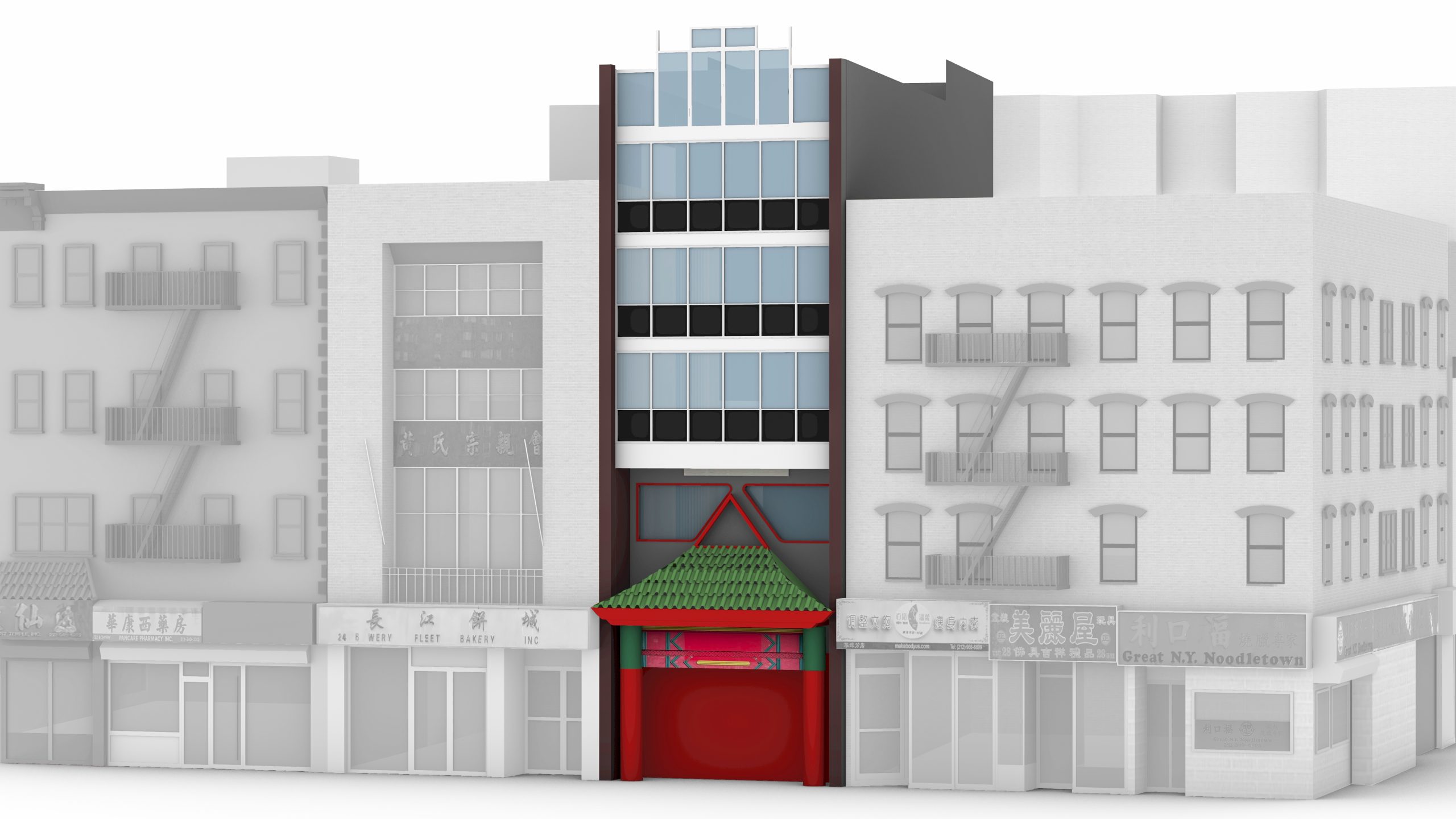
26 Bowery
Architect: Charles Rentz
Built in 1887, altered in 1985 and 1968
2024
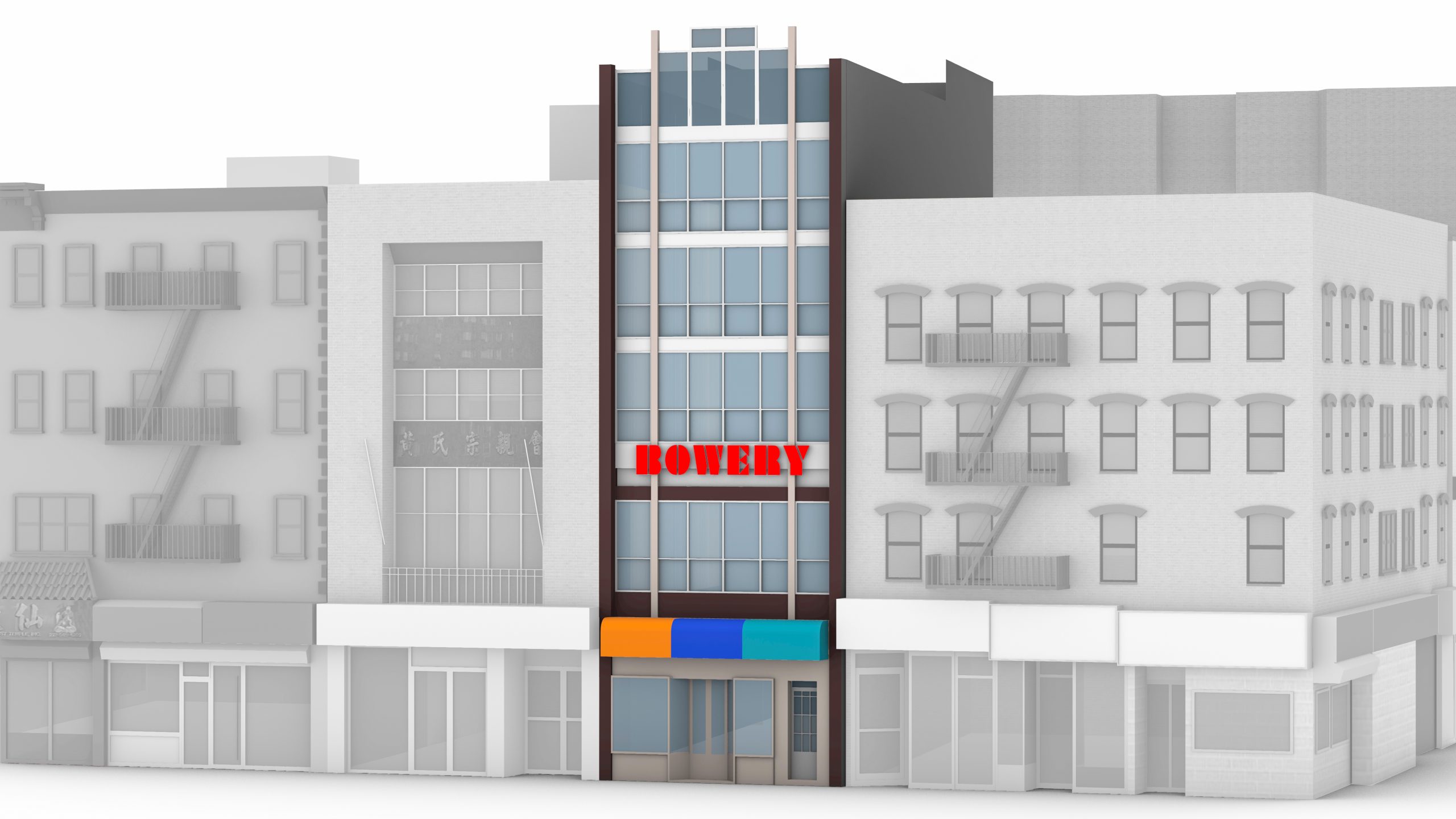
26 Bowery
Asian American Arts Centre
Architect: Charles Rentz
Built in 1887, altered in 1985 and 1968
Early 1990s
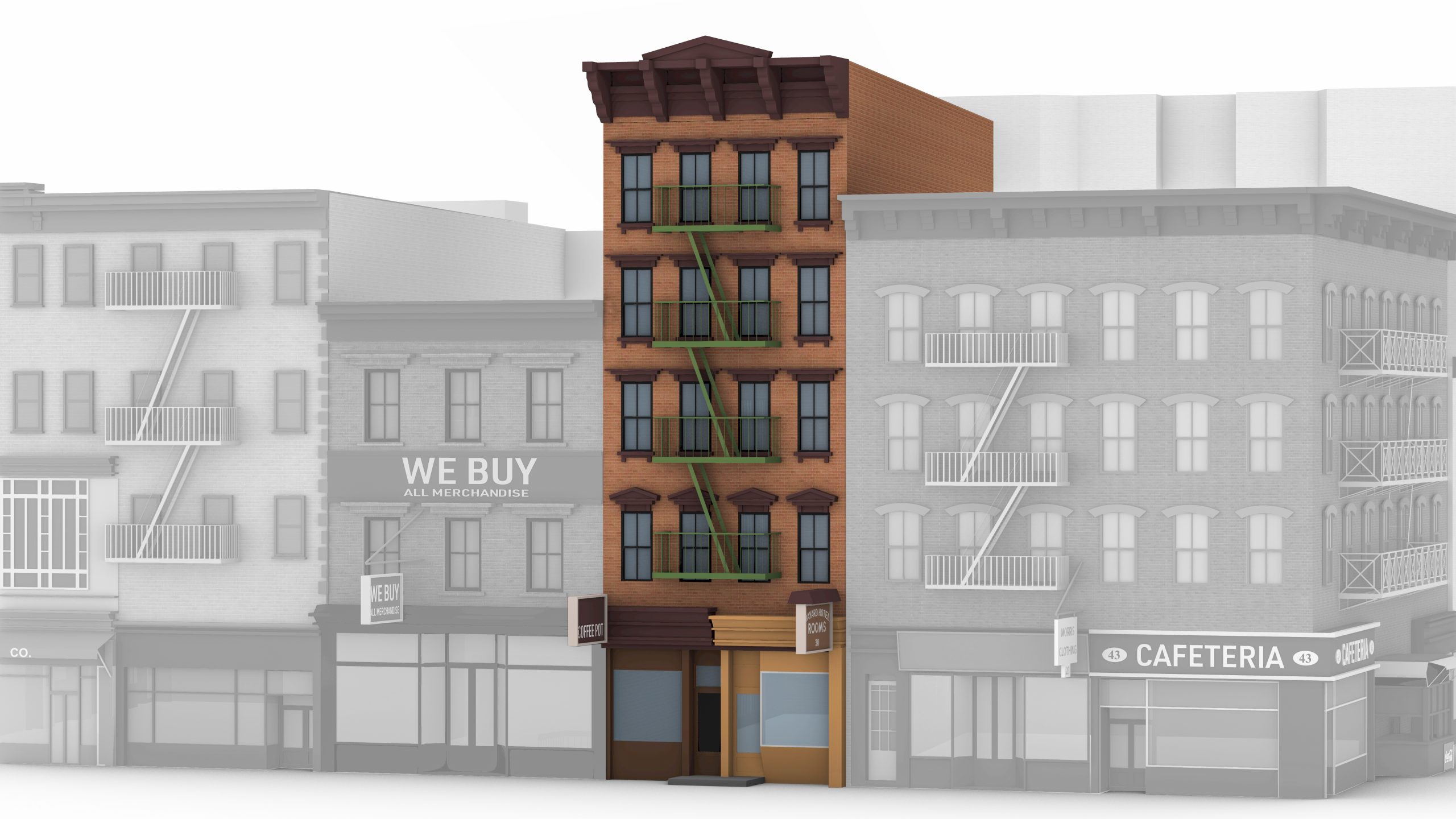
26 Bowery
Architect: Charles Rentz
Built in 1887
1940s
Interview
With ROBERT LEE (CHINATOWN RESIDENT AND CO-FOUNDER OF ASIAN AMERICAN ARTS CENTRE)
Interview conducted in April 2022.
All photographs in this interview are courtesy of Robert Lee and Asian American Arts Center unless otherwise noted.
+ Would you give me a brief introduction of yourself and your connection to Chinatown?
I grew up in Newark, New Jersey. My father’s laundry was there. My father used to drive into Chinatown in New York City to pick up supplies once a month. I remember looking out of the window and at the parking lot where he always parked his car. I remember once, seeing a crowd on Mott and a crowd on Bayard and wondering what was going on… and you could see a white guy in a 3-piece suit with a bunch of Chinese people around him… What was happening was that the FBI was making a raid on the gambling going on in the basement businesses.
When my sisters were teenagers and I was 10 or 12 years old, their boyfriends would hang out at Lonnie’s [at 19-21 Mott]. You could get hamburgers here. You could see the Chinese American newsletter at the counter.
We got to see Chinatown from more of an Asian American view.
+ What Chinatown buildings are you connected to?
26 Bowery!
A lot of us were a part of Basement [Workshop] in the early days. In this photo [below], there’s a lot of people like Faye Chiang who took over Basement when Danny left. There’s Frank Ching, who’s very important, who helped put together Bridge Magazine. Fay Chew who took over MOCA once Charlie Lai and Jack left. There’s Michio Kaku, who wrote books on string theory and Tomie Arai and Alan Wong. All of the early people are in this project.
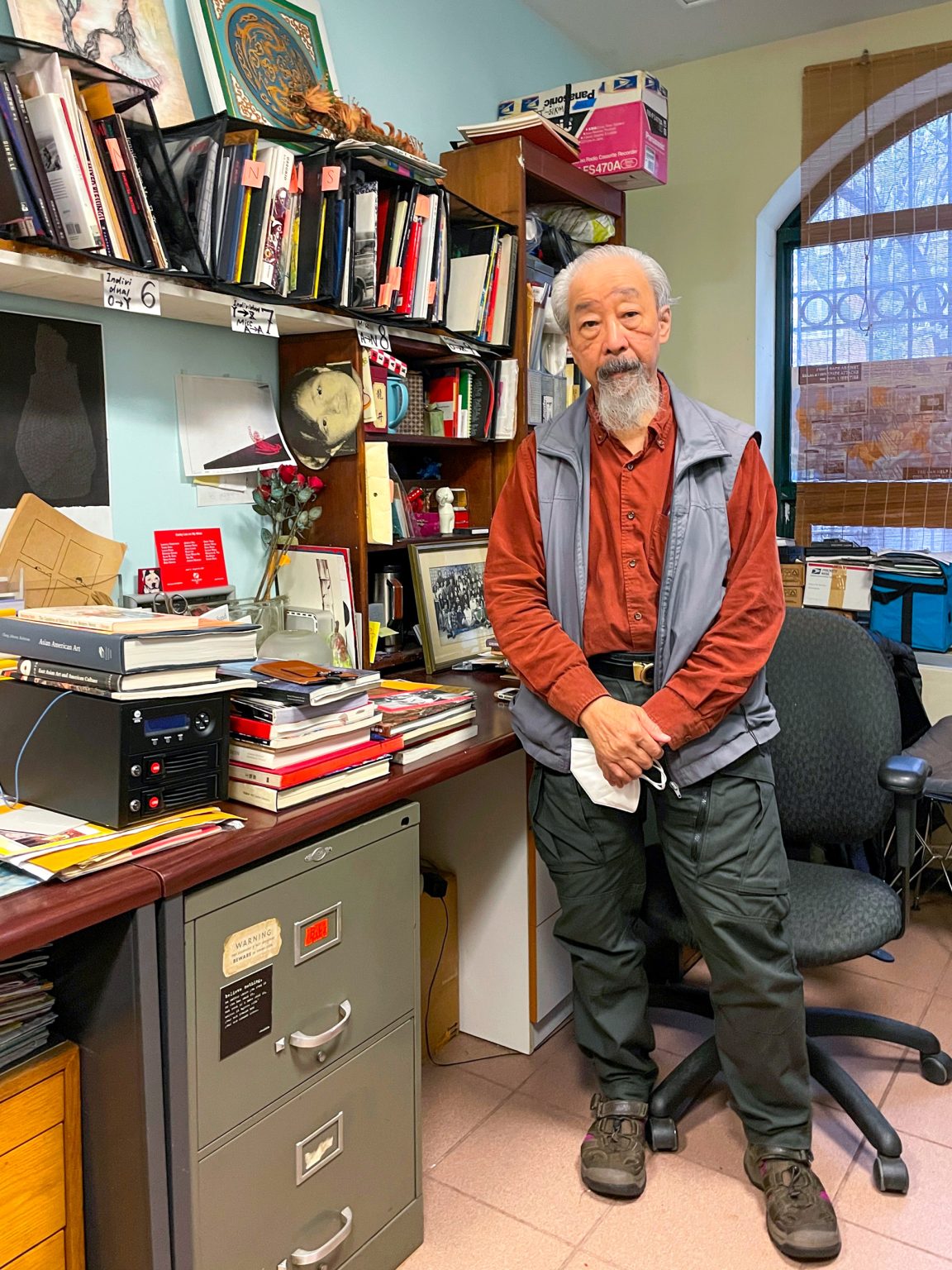
Bob Lee at the Asian American Arts Center offices in the Lower East Side. Photograph by Cheryl Wing-Zi Wong, taken during our interview, April 2022.
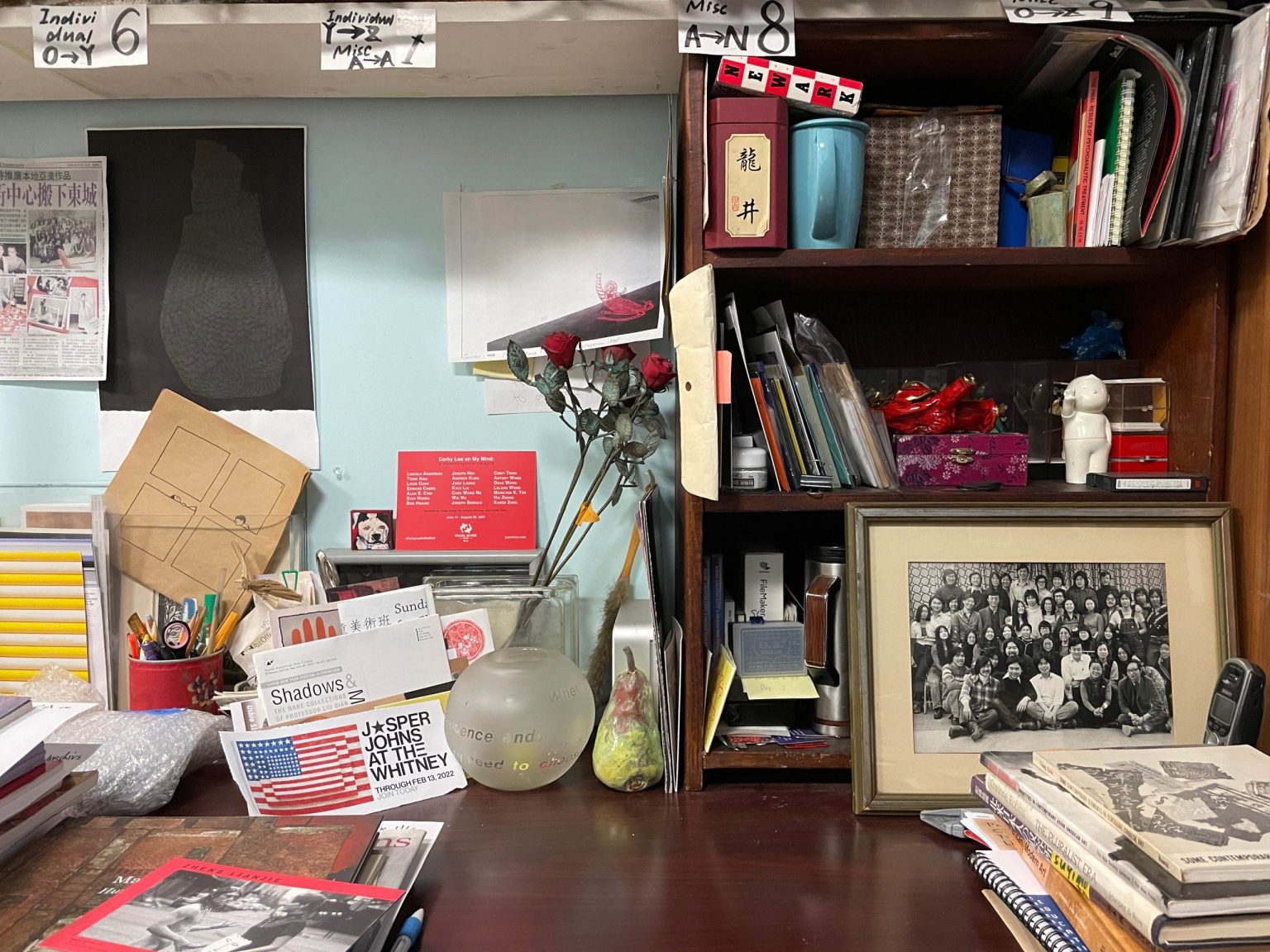
Members of Basement Workshop can be seen in the framed photograph at the AAAC offices. Photograph by Cheryl Wing-Zi Wong, 2022.
I met [my wife] Eleanor in 1969 when they were still at Elizabeth Street. She was working with her brother Danny and helped to get the 501c3 that came in the late 1970s. She was into dance and moved her dance operation and split from Basement — and we created our own nonprofit (Asian American Dance Theatre) in 1974. Two years later, we found the loft at 26 Bowery and moved there. We were there until 2009, 2010.
All of those years, we developed the dance theatre. We developed two dance companies, one traditional Asian American (Balinese, Korean, Japanese, Indian, many Asian forms of dance) dance and a contemporary dance company.
In 1981-1982, I was working with CEDA as an artist, like many others across the country, hired under the Johnson administration. We had about 100+ folks from the Chinatown community who were hired for a year or two. That’s where I ran the art program and offered free classes for the community. After CEDA went defunct, I moved the program to my wife’s nonprofit space and taught some art classes there. So then that developed into the exhibition program and the archive program for visual artists.
Our first show was in 1983 and we had three, four or five exhibitions every year. Sometimes they would occur in other locations, (one was at the office of the NY City Cultural Affairs office, one in City Hall, etc.) but mostly here in our space.
This is where our little girl was born and raised, where she watched the dancers and learned to dance, where she rode her bike and played piano and looked at art. It’s where my cat learned to pee in the toilet.
An interesting side note about the building: Dean Parisot directed Galaxy Quest in 1999 which is still celebrated today. He and Sally Menke lived on the 5th floor of 26 Bowery when he won his first Academy Award for a short in 1988.
Photographs of 26 Bowery in 1992 (left) and in 2002 (two photos on the right).
+ Describe the building.
The staircase is one long staircase, so you can see two to three flights up in one direction. We were on the third floor, so you had two flights to get up there. We originally set it up so that we had our living quarters in the front where the building’s front windows were. There’s a large space upon entry, when you walk in the door, that comes up to the middle of the floor. We set up a little office there to receive the parents and the children coming in for dance class, and later art class.
From that middle room / the reception area, you would go into the large space (more towards the back of the building) and that’s where the dance classes would take place. Some dance performances happened here and many rehearsals too. In the very back of the building, we sectioned off a 10-foot wide area with the kitchen, bathroom, sink, etc — and eventually we turned that into a small office as well. In that area on the side of the building, there are three windows, and that’s where you could see the neighboring building — the Wong Association — and we could go out there and walk on the roof and where my cat could go outside to play.
(Left) Bob’s wife, Eleanor Yung, at the front door of 26 Bowery in 1986.
(Center) Walnut sign of the Asian American Dance Theatre and Asian Arts Institute.
(Right) A later sign for the Asian American Arts Centre.
In that room, opposite the windows, on a wall, about 25, less than 30 feet long, was a set of mirrors we bought… so it was a dance area for rehearsals. When you walked in, the windows were on the left and the mirrors were on the opposite wall. Eventually we built a partition so that you walked through a door to get into that area.
Later on, we moved out and the front room became available. At first, it was divided between a bedroom and some offices, and then it became a front gallery for a number of years, and then eventually, we converted it back into offices. That’s when we were using the back room by the kitchen as an office for a while. At a certain point, it changed from a gallery space back to an office, where it was originally. So we used the space quite well, in order to house all the stuff we had collected and to provide cultural services for the community.
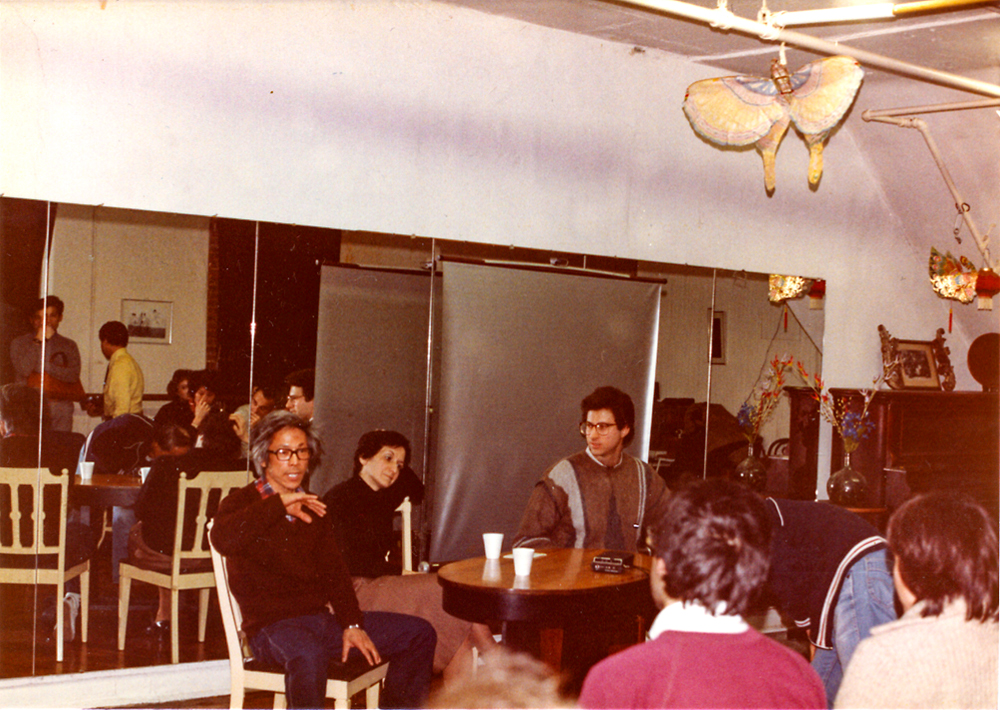
An event at the AAAC for the Zhang Hongtu exhibition, c. 1980s. The mirrored wall can be seen in the background.
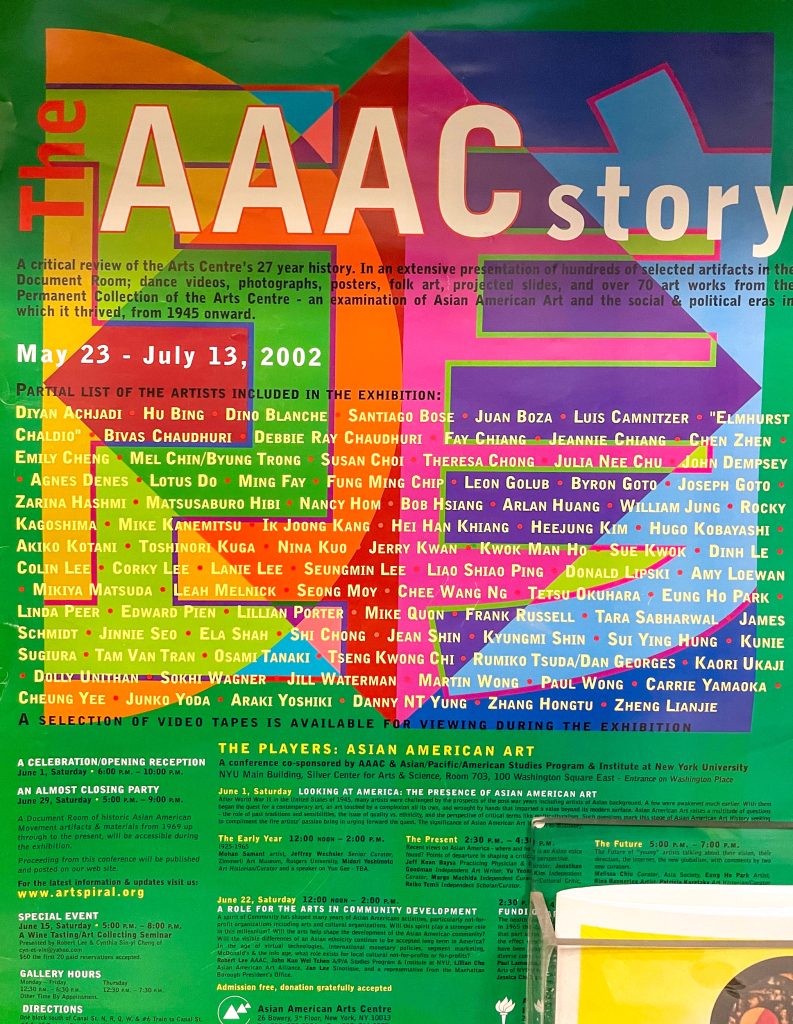
Poster for “The AAAC Story” exhibition, a critical review of 27 years of history of the center. Photograph taken by Cheryl Wing-Zi Wong during our interview session, 2022.
+ What were the most memorable exhibitions you put on in the space?
There were over 25 years of exhibitions. There are a number of them you might consider more important, depending on where you’re coming from. There were formal exhibitions that were funded and that we produced invitation cards for. We had a set of them that we tried to place in various libraries.
We did something back in the 1980s, though the formal funded mailer/card happened in 1983. The next group was in 1984, etc. etc. until 2009. We had a few exhibitions while we were in this space [the current site of the Asian American Arts Centre on Norfolk Street in the Lower East Side] when we lost the gallery at 26 Bowery. We also did a few exhibitions across the street at the Clemente.
That exhibition, called “Above Ground” was with a group of women in China who were activists. They held an exhibition across the street. We did others there. The exhibitions in the 1980s were very much beginning to try to see that there is such a thing as Asian American artists, and to see what they would do if you asked them to make an artwork about their childhood, or about their father… or looking at certain artists and seeing that they have a certain theme, like landscape, identity, Orientalism (Edward Said’s theory of Orientalism). We did a series of four exhibitions on identity that year, which was around 1986. By 1988, we were doing an exhibition on public art in Chinatown. We felt that it was important to bring a contemporary image of Chinatown in terms of public art — and we asked a group of artists to create a sketch or plan for public art. I selected a dozen different locations that were available, that should we get funding to actually do one, we could place it there. It was an important show for us. A magazine in Hong Kong picked it up and re-published the whole catalogue.
But then, in 1989, the Tiananmen Square massacre happened. We were having discussion groups at the time, but once it hit, we decided that we could mount an exhibition on this and the exhibition itself continued for one year. We opened the door to anyone and everyone who wanted to exhibit. It was mostly artists who submitted. We had one piece that was submitted by a child, but his father was an artist. After we opened the exhibition, by October of 1989, we had 100 to 150 artworks. We had asked artists to either create artwork on a door or to make a very small piece. We could stack all the doors on the wall. We got an invitation to move the exhibition to another space — Blum Helman in Soho — and that was a big opening. We got reviewed there and mentioned in the American Art magazine and a lot of publications. We were still accumulating a lot of artwork. We also got an invitation to move the exhibition to PS1 in Long Island City and it happened around April of 1990. That show was like 180 artworks and close to 200 doors. There were a lot of artists volunteering to help us move things.
For a year or so, we traveled it around the country. We selected about 80 pieces to travel. We continued to travel it and then in 1994, we got an invitation to send the traveling show to Flint, Michigan. In 1990, for the 1-year memorial, we sent a few pieces to Hong Kong to exhibit there. We thought that then we would be able to bring the show to China. Many of the artist’s works were already donated to the Art Center for this purpose. We were holding onto them and kept them in storage. Two or three years passed and then we realized that the government wasn’t going to change. By that time, all the volunteers had disappeared and we sort of got stuck with the artwork and had to have a storage space to hold it. We kept it all of these years and finally in 2014, we received a grant to do an exhibition. We selected a portion of the artworks in storage to exhibit for the 25th Anniversary. This was done in White Box on Broome Street.
Pamphlets and cards of various AAAC exhibitions throughout the years. Photograph by Cheryl Wing-Zi Wong, 2022.
In 2019, we got a call from a Chinese group called Humanitarian China. Once they were released from prison, they would resettle some of them in California. They were very interested in acquiring our exhibition of doors and things like that. They were based out of San Francisco and they teamed up with an artist who had an outdoor exhibition space along the highway that links Los Angeles to Las Vegas. He had all of these artworks – the “Goddess of Democracy” and the “Tank Man”. He had a building on that land that he hoped to turn into a museum, so we transferred ownership of a lot of the doors to this organization. They’re still waiting to see if they’re going to create a museum one day. We still have a few of the pieces and are still looking for museums who might be interested in the artwork that we have. We did manage to get Princeton a few years ago to take several of the artworks, about 30-45 pieces.
So, the Tiananmen show is the transition into the 1990s for us. The exhibitions that we had back in the 1990s were a little bit different. We were doing a bit more curating on historical, sociological issues: What is Asian American art? What concerns the Asian American community? Who are some of the Asian American artists we’re discovering?
We had annual shows and another committee group coming in and selecting those. As the archive collected more artists, we would pick out a bunch of those and various groups would come in, collectively look at the work and make a decision.
The “Eye to Eye” panel at 26 Bowery in 1983. The gallery space was often transformed for various events.
In 1986, we received a grant from Rockefeller to look at our predecessors from 1945 until 1965 – the generation just before the generation of artists I was dealing with – and look at what their generation did. We called those artists milieu artists. These were Asian American artists. That was more of a research project. We collected about 80-90 pieces of these artists. Many lived on the West Coast. We went out there to interview them, to meet them.
When we came back with all of that data, we wanted to do a big show, but we were a very small organization, as we still are, so we could only manage to exhibit the senior artists by putting on three- or four-person exhibitions. We did three or four of those over different years and we would call those the Milieu Exhibition.
We did a show — “Ancestors” — on the relationship between African Americans and Asian Americans. We were suggesting that we pay homage to all of the ancestors of our land. The exhibition focused on African Americans, but the theme tried to look at all the many different types of ancestors that were part of our United States.
Photographs from “Art Slam” events at the AAAC in 2008. The partitions separating the gallery from the other spaces can be seen.
Another show that we did at the end of the 1990s was called “Seven Pounds, Nine Ounces.” It had to do with the reintegration of tradition into contemporary art. Our vision was that – in the West, there’s this idea that there’s a break between generations; each new generation creates a new art movement. We felt that there was another way of looking at it – we were looking more at the continuity between one generation and the other.
We used a grant to start an archive, an artists’ archive. We started the archive collecting artworks from the Asian American artists — postcards, slides, documents – in 1982. Once we got the grant from the LMDC to make this archive a digital archive, we selected about 150 artists to include in this archive. We were able to ask them for updated slides, new materials and update their files. We created a website, Art Asia America, where you can see about 170 artists there. It took us about two years before we launched it, in 2009.
Saturday art classes in the gallery, 1980s and onward.
+ Can you give me a physical description of the space?
The space was about 2000 square feet. The front room with the gallery was around maybe 20’ x 20’ or 25’. The larger room, the back room gallery was about 25’-30’’ x 20’ in terms of the interior dimensions.
We always had two galleries at the same time, excluding the office / reception area in the middle. It had a wall where we could hang things. You could imagine that the staircase was there, so instead of the room being 25’ wide, it was more like 15’ wide and sectioned off for the office.
The ceilings were 9’ high. There were little areas where you could hang stuff. All three spaces could be used for exhibition.
+ How long was it a live-work space?
For the first year or two before we moved across the street to Confucius Plaza.
+ What was it like as a live-work space?
When we got the building, it was owned by one of the last Jewish landlords in Chinatown. There used to be a lot of buildings owned by the Jewish community. He was selling shoes there on the ground floor [where McDonald’s later was] and he was catering mostly to the police department. On the second floor, he had a lot of police uniforms.
But then, after a few years, he sold it to a Chinese guy, and he introduced us to him. He turned out to be the head of a gang on Pell Street called the Flying Tigers. It got into some harry situations; we were in court for 2-3 years — he forced us to pretty much close down the dance school and they threatened our family. We finally got to win the case but not before the government came down and confiscated the building. Many of the businesses that opened up on the ground floor would eventually want to leave.
That whole story got written up in The New Yorker magazine. I thought that rather than me telling you the story, I would share with you the article here. The woman who wrote the article was only picking up the nasty parts of the story of Chinatown – she would never mention the cultural things we were doing, the positive things that were going on in Chinatown. The New Yorker Magazine would not accept requests from us to put an ad in for our school. It’s a one-sided story where the author only included the sensationalist, negative parts of the story. She eventually published a book with a nasty portrayal of our community. I guess it’s stories like this that help to sell magazines.
We were determined to continue. We were able to stay there until 2009. At that point, we couldn’t win the fight with the landlord.
I think that our effort to create a cultural dimension for the community has been out there for all of this time; but it rarely gets into what we had to struggle with.
+ Did you and Eleanor do a lot of renovation in the space?
Yes — my friends and I were there installing sheetrock!
Friends, family, dancers, friends of dancers, staff of Asian American Dance Theatre came and helped out.
For the gallery, there was 1-2 feet for storage and we built a wall in front of the glass windows.
+ Who came to the Centre for dance and art lessons?
Chinatown community kids and sometimes others.
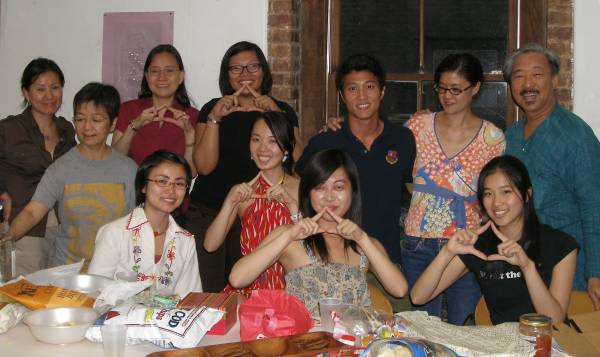
Staff and interns at a party in the space, 2008.
+ What was Chinatown like in the past?
I graduated around 1966 and came across into the city and more often into Chinatown by the late 1960s. At this time, the IWK (radical, pro-China group) were doing protests. I got involved with them and then I met Basement Workshop and Eleanor… I got involved with the Chinatown Health Clinic, a community-rooted health clinic on the second floor on Catherine Street, who was putting on the street fair in 1971-1972. At 22 Catherine, the building was Pearl River on the first floor, Chinatown Health Clinic on the second floor, Basement Workshop on the third floor and Peter Kwong, Chinatown historian on the fifth floor.
Big Wong — where you can get pi gwut (spare ribs) — was originally located north of Canal closer to Hester. There used to be a dumpling place on Doyers Street. Her name was Connie. We lost them — and no one makes dumplings as good now.
South Wind was on Division across from Confucius Plaza. They used to make stuffed tofu. Their pork chop, which was fantastic.
+ Do you know of any major renovations or changes to the building since it was first constructed?
[Regarding the facade…] One day, the wall was gone and bricks were on the floor. They were knocking into our bedroom and we had to clean it all up… They basically removed all of the bricks on the facade and installed glass panels in place. It was probably a year or two after we moved in.
When McDonald’s rebuilt the facade, the front door for tenants was changed from glass to metal and locked against fire department regulations. The fire department came and tore it off.
Photographs from the “Farewell to 26 Bowery” party, 2009, just before the AAAC moved out of the space.
26 BOWERY - BUILDING PHOTOGRAPHS
Photographs taken between 2022 – 2024.