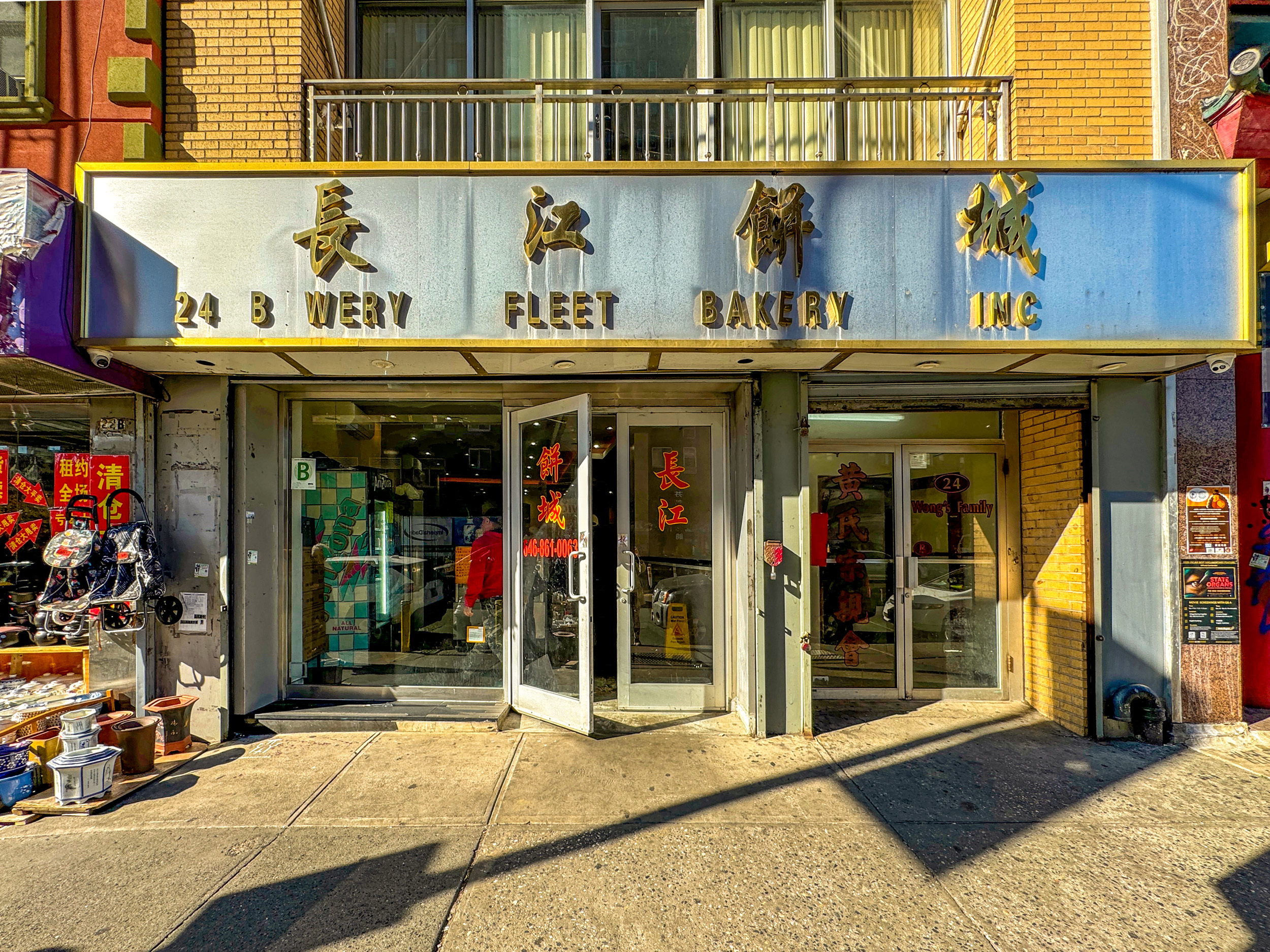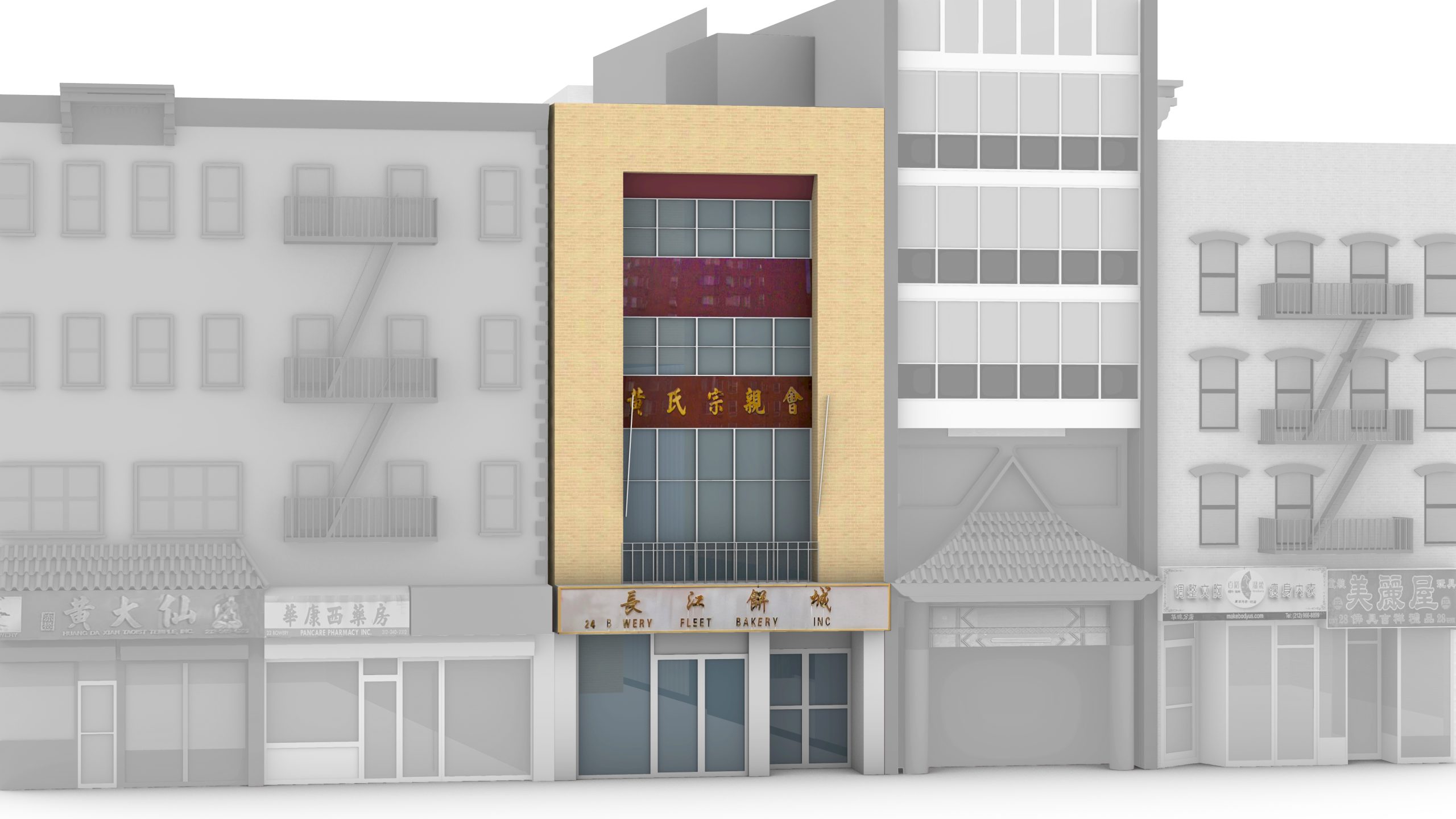
24 Bowery
Wong Family Benevolent Association
Architect: Poy Gum Lee
Built in 1964, alterations to an early rowhouse
2024
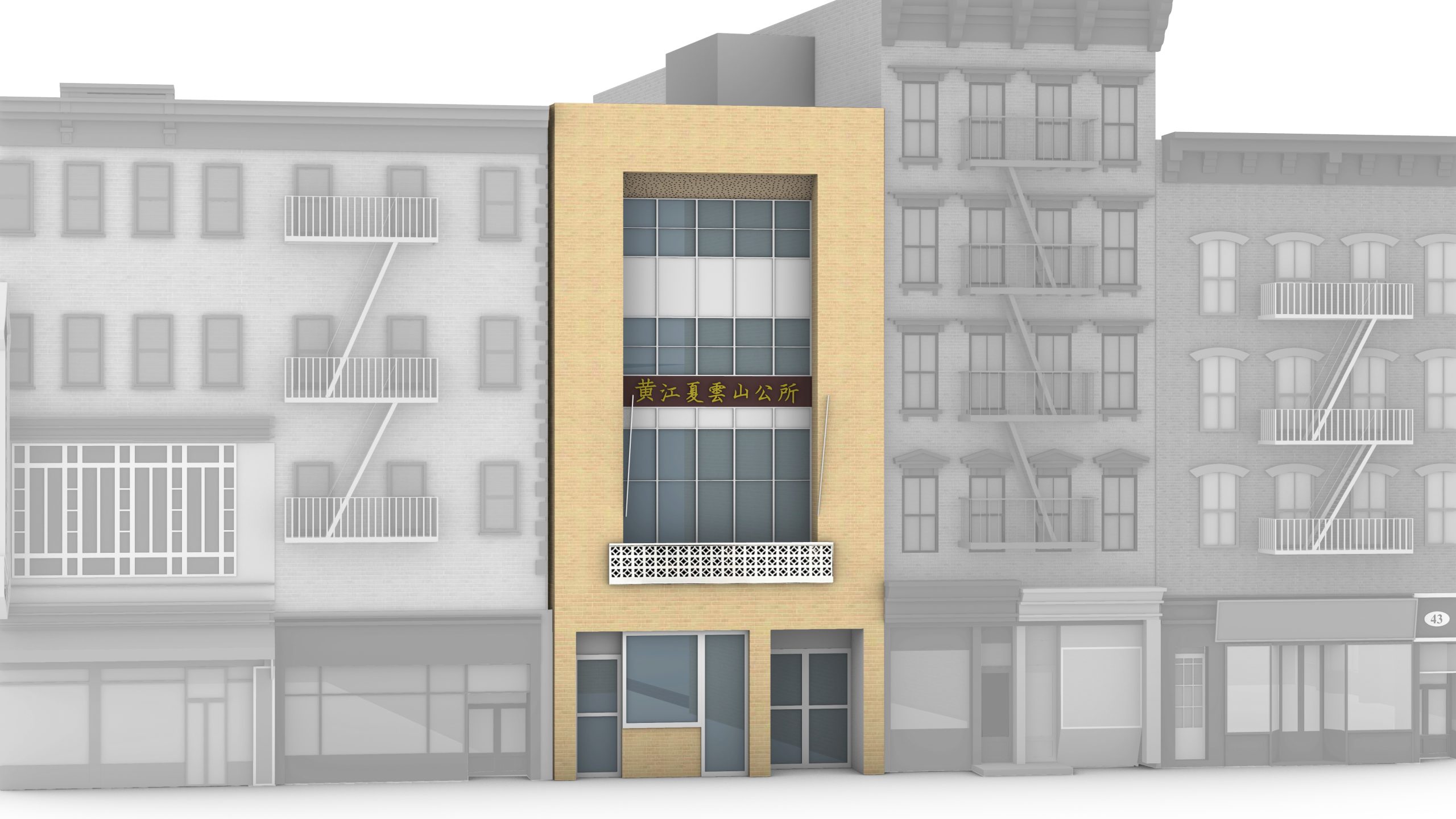
24 Bowery
Wong Family Benevolent Association
Architect: Poy Gum Lee
Built in 1964, alterations to an early rowhouse
1964

24 Bowery
1940s
Interview
WITH FANG WONG (NATIONAL SENIOR ADVISOR/ELDER, DIRECTOR OF BUILDING AFFAIRS AND FORMER NY CHAPTER AND NATIONAL PRESIDENT OF THE WONG FAMILY BENEVOLENT ASSOCIATION)
Interview conducted in July 2022.
+ Would you give me a brief introduction of yourself and your family?
I was born in Toishan, China and moved down to Canton, Guangzhou when I was little. When I was three, my mom and my brother and I moved down to Hong Kong. My father was always here in New York City; he went back after World War II and stayed for a couple of years [in Hong Kong], and then came back to the U.S. before I was even born.
I was 12 when I boarded a plane and immigrated to the U.S. We landed on November 13, 1960 – I remember that one! – at the old terminal in JFK, which I think was New York International Airport at the time. That was the first time I saw my dad. He had a laundry business up in Harlem at 8th Avenue between 148th Street and 149th. That’s almost the center of Harlem. I spent three years living at the back of the laundry and then we rented an apartment on Bowery and Broome Street, right between all of the bars and the drunks back then.

Fang Wong (second from left) with fellow association member Kenny Wong and Jada Tin-Kei Harlan Wong to the right, at one of the bimonthly association meetings, July 2022.
+ How long did you live in Chinatown? How did you come to be connected to Chinatown?
I was 15 when we moved to Chinatown and I lived here for 5 years before I joined the army in 1969. When I was in the army, my parents always lived in NY and so when I was on leave, New York was where I would go. I called New York my home on record. I stayed in the army for 20 years. My last overseas appointment was in Germany and I came back in 1982, I think. We bought a house in New Jersey and that’s been my home since then.
New York City’s Chinatown is still a base, even after my parents passed away. You have the association, and other distant cousins, and you have some kind of connection, which is a major reason why I come back here and help when I can.

Two years later: Fang Wong (top) with Jada Tin-Kei Harlan Wong (bottom left) and Kenny Wong (right), holding lucky golden gingko leaves at the annual day of voting for new Wong Association officers, November 2024.
+ What was Chinatown like in the 1960s? Tell me about your childhood as a new immigrant.
It was quite different, obviously. There wasn’t as much people or traffic. At that time in the 1960s, the immigration policy started changing and loosening up. All of sudden, you had a lot of immigrants here: wife, young kids. Before that, in the 1950s or right after the war, there were hardly any females and families. It was pretty much a bachelors’ society at the time. When we came in the 1960s, families started coming and visa policies and controls were more acceptable to us, allowing families to be connected. At the same time, there were a lot of veterans coming back from the war and they were allowed to bring their families.
Chinatown back then was smaller. It was a small area.
When I first came [to the U.S.], I went to school up in Harlem. Up there, the landscape there was different because I was the only non-Black at the whole school. [I did not experience racism – ]Everyone treated me great because I was the only non-Black. Everyone was excited that I was different. In 6th grade, kids didn’t know about race. Back then, the race issue didn’t seem to be such a problem. Harlem was great.
Then, all of a sudden when I moved down here to go to Junior High School 65, it was one quarter Chinese, one quarter Italians, one quarter Hispanics and Blacks and one quarter Jewish. It was a mix. With that, you kind of learn to get along with everyone and by the same token, you do get in trouble with each other because of the backgrounds and how kids are. We still hung around with our own, but with the Chinese students, you had two groups – one was the ABCs [American born Chinese] and the other were the overseas Chinese who came from Hong Kong, etc. There were all kinds of little groups separating.
I went to Chinese School at the Chinese Consolidated Benevolent Association (CCBA) in the 1960s. The first couple of years, I had to commute after my regular school uptown. I took the D train down and then back up. Sometimes, we kids would stay around after school – they had a gym upstairs at that time and they’d allow us to play basketball. I stayed late until 9 or 10 o’clock and rode the D train right back; I would never even think about it. But I understand that now, my old neighborhood has already changed. About 10 years ago, I had to go up for a function with the American Legion. We have a post up there and we drove past my same block – it was all new buildings and I couldn’t recognize it.
Fang at the association building, overseeing meetings and payments of annual membership dues. Photographs taken between 2022-2024.
I hardly saw my brother as he’s 10 years older — he worked in restaurants and as a restaurant worker, he only had one day off a week. We didn’t see each other that often, maybe just once a week when he was off.
My favorite snack spot, Wun Gay (Cloud Store), was a combination bakery and coffee shop across from the Chinese School [at CCBA] on the other side of Mott Street. At that time, it was very popular in Chinatown and they were very famous for ga ying bao, a sweet bun. It’s no longer there. I happened to know the owner because he was in the army during the Korean War. We both joined the American Legion on Canal Street. He was stationed in Korea during the war and after, when he came back, he liked to make pastries. He went back to Hong Kong to find himself a teacher working in the bakery. He learned how to make ga ying bao and came back with that recipe. At that time, no one in Chinatown made it. Once he came back with the recipe and started putting it out – He only made it at 3-4PM – you would see people lined up for it because he made only so many batches.
+ How long has the Wong Family Association been in this building?
Where was the association previously located in Chinatown?
I was told there were several Wong Associations that went by different names. One was supposedly on Mott Street, but I’m not sure exactly where. I suppose the other ones were here. Back in the 1930s, they merged. All of the United States Wong Associations said it wasn’t right. During one of the conventions — I think it was in the 1930s – they said let’s merge and standardize the name. That’s how they ended up here [at 24 Bowery.]
They bought this building in the late 1950s, but were renting the building before. When I came in 1960, they had already bought the building and were raising funds to renovate it. They got enough donations from all over the United States – all of the Wongs chipped in – and renovated for two years. We moved the Wong Association’s things (furniture, etc.) to 2 East Broadway, I think — downstairs is now a paint shop but back then we had a small apartment for the youth section of the Wongs. They hung out there. We squeezed in there during the renovation.
In 1964, there was the grand opening of the newly renovated building, which coincided with the National Wong Convention in New York and with the 1964 World’s Fair. It was New York’s turn to have the convention. The convention was supposed to be in 1963, but they delayed it (because the building was still under renovation) to coincide with the New York World’s Fair. I happened to be here at the time. I was a little kid. I was involved with coming down here with my father. We moved everything overnight, probably a weekend, in 1962 to squeeze it into the space at East Broadway. When it was time for the grand opening, we paraded everything back, put it where it was supposed to be. It was neat. When you’re a little kid, that was exciting.
+ What was the grand opening of the building like?
It was like any of the conventions. I don’t remember much because I was too young. There were several big banquets after that were hosted by the New York chapter and by outside organizations friendly with us. There were some ceremonies where only the big guys were allowed in. I can’t tell you where the big conference was held; back then, I didn’t know such things and was just looking forward to where the banquet was held.
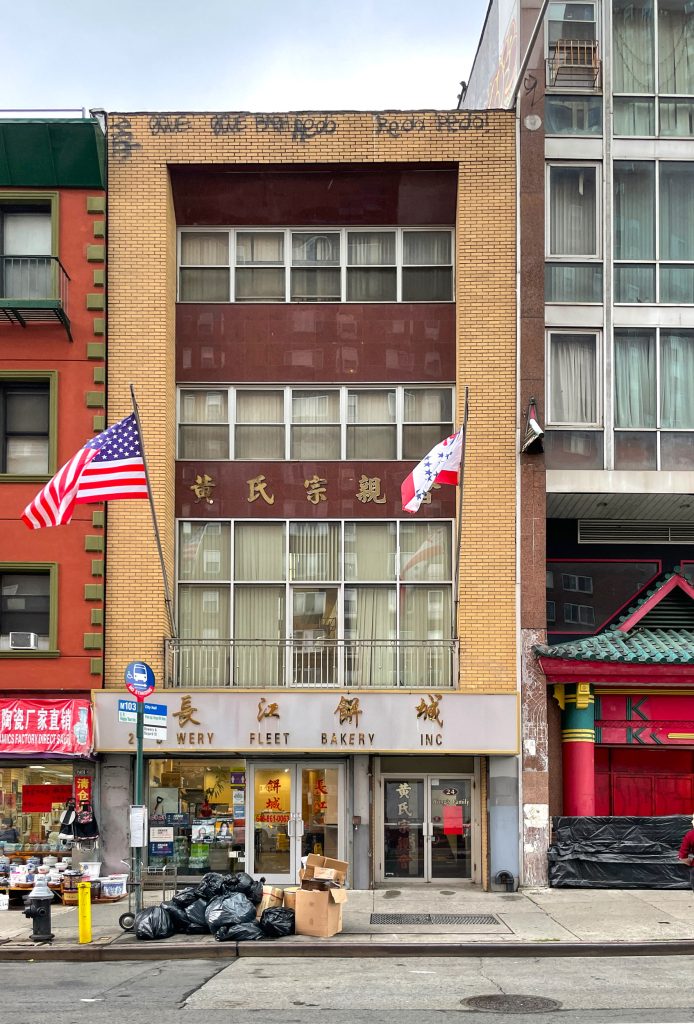
The New York headquarters of the Wong Association, July 2022.
You had a couple hundred members with their families who came from all over the United States. Back then I didn’t know much aside from there being a lot of people coming to New York. It was just like a regular convention, where we have different teams handling different things. There were quite a few banquets hosted by the New York chapter and banquets hosted by outside organizations that were friendly with us. They would host lunches or dinners on different nights. I think the largest ones were held at Ping’s [Restaurant], which is at the base of the Chinese Freemasons. Supposedly back then, the food was better there than others and they could fit more tables. There was also another restaurant in The Lee Association building, which is gone now. And then there was the Toi Wan restaurant on Canal Street in the basement of the On Leong [Chinese Merchants Association building at 83 Mott St]. We used all of these restaurants in the 1960s.
Election Day at the association, where members cast ballots for next year’s officers, November 2024.
(Left) The two 2025 nominees for association president.
+ How did you join the Wong Association?
My father and my grandfather were both members of the Wong Association, so I joined. When he still worked and had his laundry shop uptown, we closed the laundromat every Sunday and that’s pretty much where we would spend our Sunday – here at the Wong Association – because they had activities going on here. This is where you got to meet all of the other wives and their kids…
This is the list of roles I’ve held in the Wong Association:
Director, NY Chapter Cemetery Committee (2015 – current)
I manage the two separate cemeteries in New Jersey (total over 700 plots). Duties include: Maintaining the database/records of all donors who contributed to the program; Dealing with funeral directors from various funeral homes (24/7) who required authorization letters when plot(s) are needed for deceased members; Prepare authorization letters to the respective Cemetery Administrator; Answering questions in general to members concerning the program and overall responsible for the smooth administration of the program.
Director, NY Chapter Building Affairs (2012 – 2014, 2017- current)
I’m responsible for the overall well-being of the Association building, including the following: Negotiate and manage tenant lease, provide supervision on all necessary building repairs, ensure compliance with building and fire code and payments to insurance and city agencies.
Board Member, Scholarship Committee (2014 – current)
I participate in the selection of our annual scholarship awardees.
NY Chapter President (2015 – 2016)
I supervised the overall operation of the association, making sure we comply with the National Constitution and By-Laws of the USWFBA and resolutions of the National Convention. I supported the activities of the USWFBA Board of Directors.
US Wong Family Benevolent Association National President (East) (2018 – 2022)
I served as the senior representative of the USWFBA and Co-Chair of the USWFBA Board of Directors to uphold and protect the organization’s operation/interest in the United States. I maintained and supported those purposes and activities as stated in the USWFBA Constitution and By-Laws and as adopted by the National Convention and/or USWFBA Board of Directors.
USWFBA National Senior Advisor (2022 – current)
I serve as mentor and advisor to all levels of the USWFBA on an as-needed basis to benefit and further the Wong clan’s overall advancement of our experience into the mainstream.

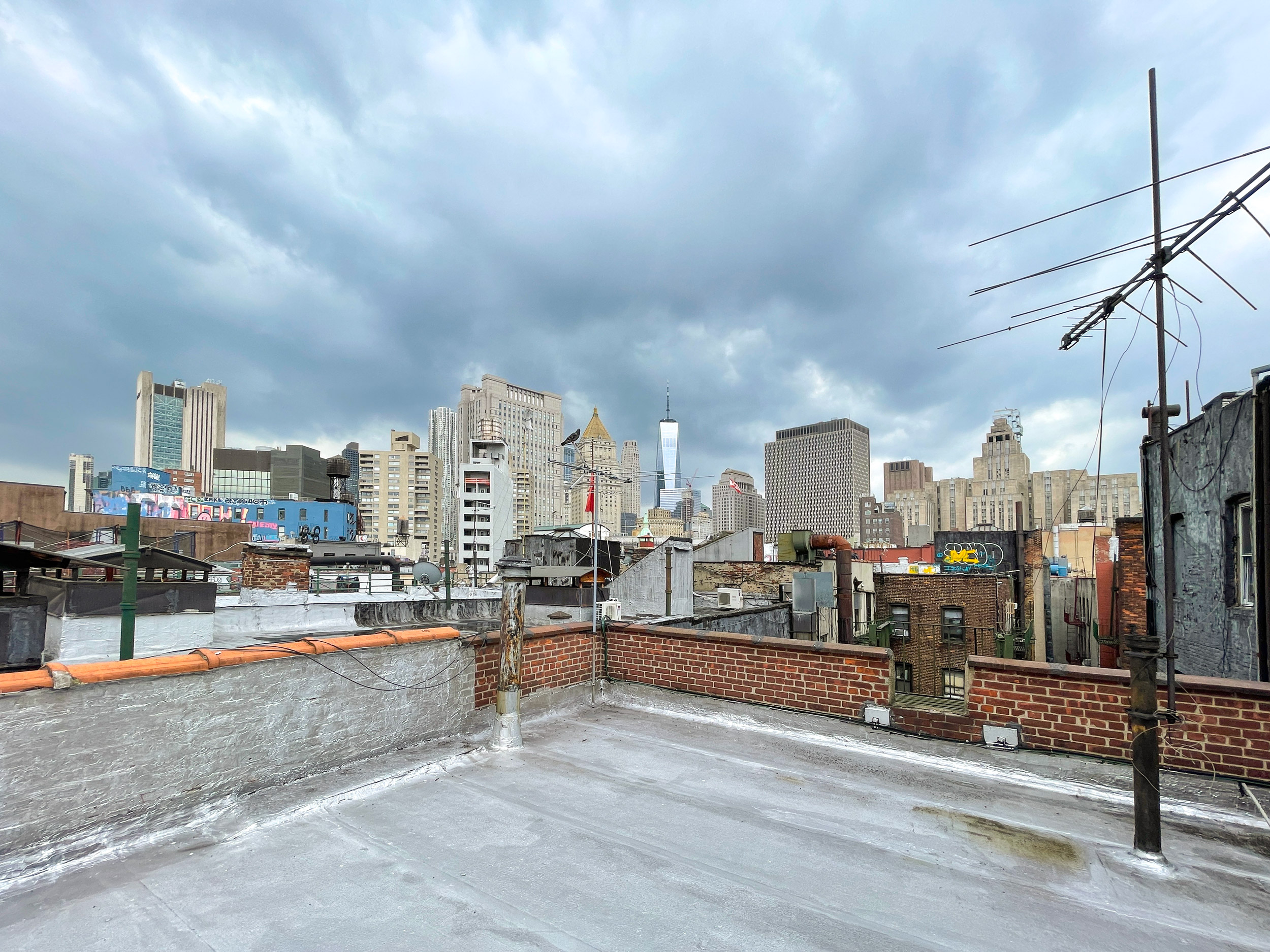
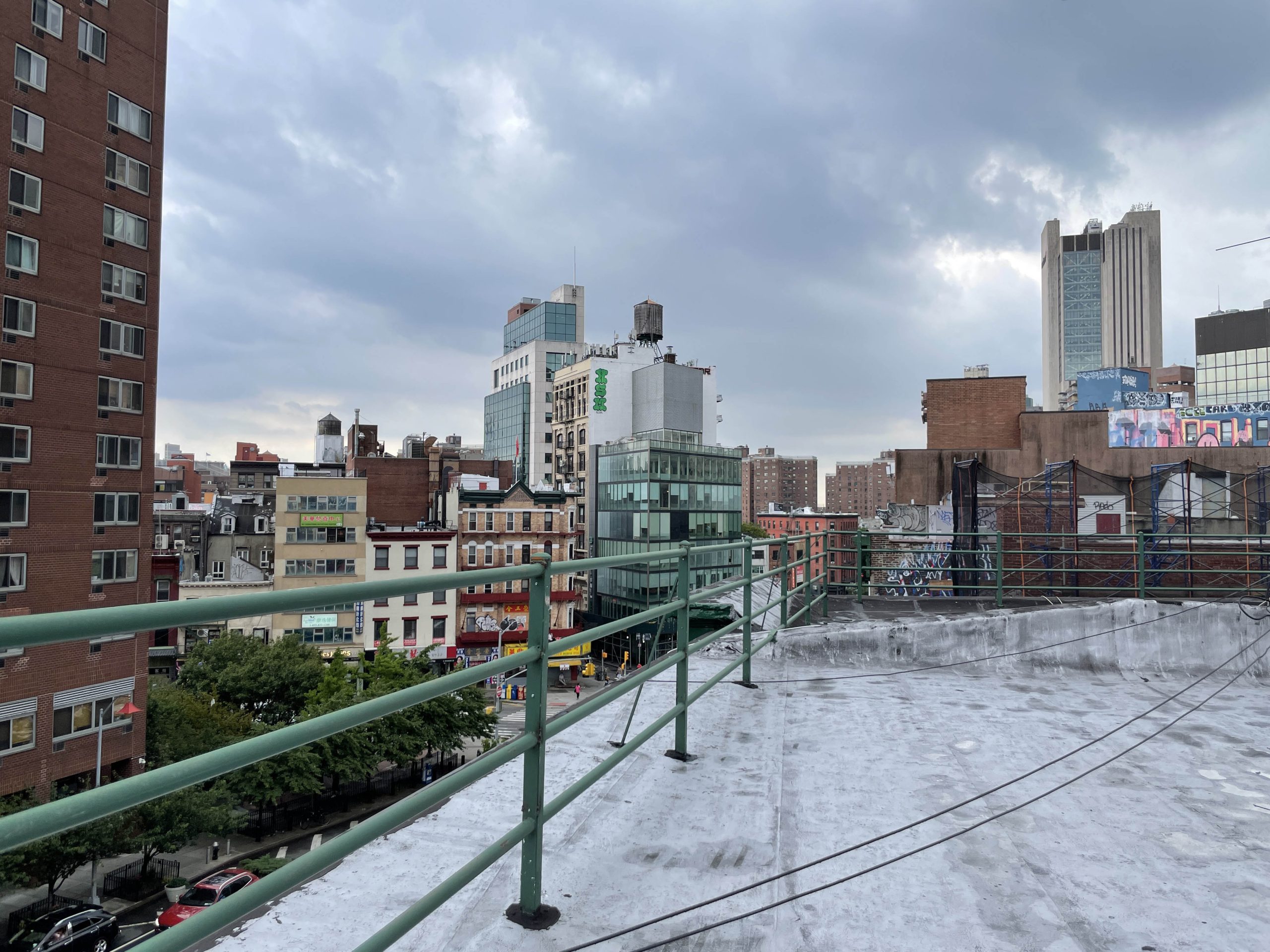
Fang on the rooftop of 24 Bowery, with view of Confucius Plaza to the east, July 2022.
+ Tell me about these Sundays.
Sunday was when most of the members who worked in the laundry business (press and wash) would have a day off. Restaurant workers are off on Mondays so they would come then. I remember on Sundays you would come down and see other families, whose families had immigrated at around the same time, or who had just had a new baby. We’d run into relatives because every Wong is a second cousin. You’re related somehow.
In the evening, there was one gentleman who would cook for 40-50 people. Tables would be set up banquet style and we’d have our dinner here. After that, the men would want to play a few rounds of mahjong or card games. We would leave around 11 o’ clock or midnight to go back to the laundromat and then start working for six more days.
When we would come down on Sunday, normally that would be early or late morning and the first thing we’d do is go to the grocery store. There were several big ones at that time. I remember my mother or father would go in and say, “I want that and that” and the guy would prepare for them the meat, the vegetables, the fish. He would take care of everything and you would leave with 2 big shopping bags. They’d put everything into a big walk-in refrigerator with your name on it, and you’d pay them.
Come 6 or 7 o’clock, you would go down there and pick up your bag and bring it back here [to the Wong Association building]. They would know each other, their hometown village, so they would go in and catch up. The neat thing about that, was that with two full shopping bags, $30 or $40 would probably cover it; normally $20 would definitely cover everything in those big bags. Now, with $20 you can’t even walk out of the store. There was a lot of cohesiveness back then; you worked with everybody and everyone knew everyone — and if anyone needed help (financially, finding work or a place to live), someone in the association would be willing to help. Everything spun off from here, the Wong Association. For most of the individuals or families, in a certain way, it was the center of the world.
This is where you went if you needed help or information. Here, we had people who spoke more English than others, and they would do translation / interpretation. Back then, my father would bring the Bell telephone bill and drop it off with some money to the secretary, and they would take care of it. Nowadays, there are so many more social workers and assistance groups and they took over those functions.
+ When was this building constructed? Who is the architect for this building?
Poy Gum Lee was the architect I believe. Back then, he was one of the more famous Chinese architects.
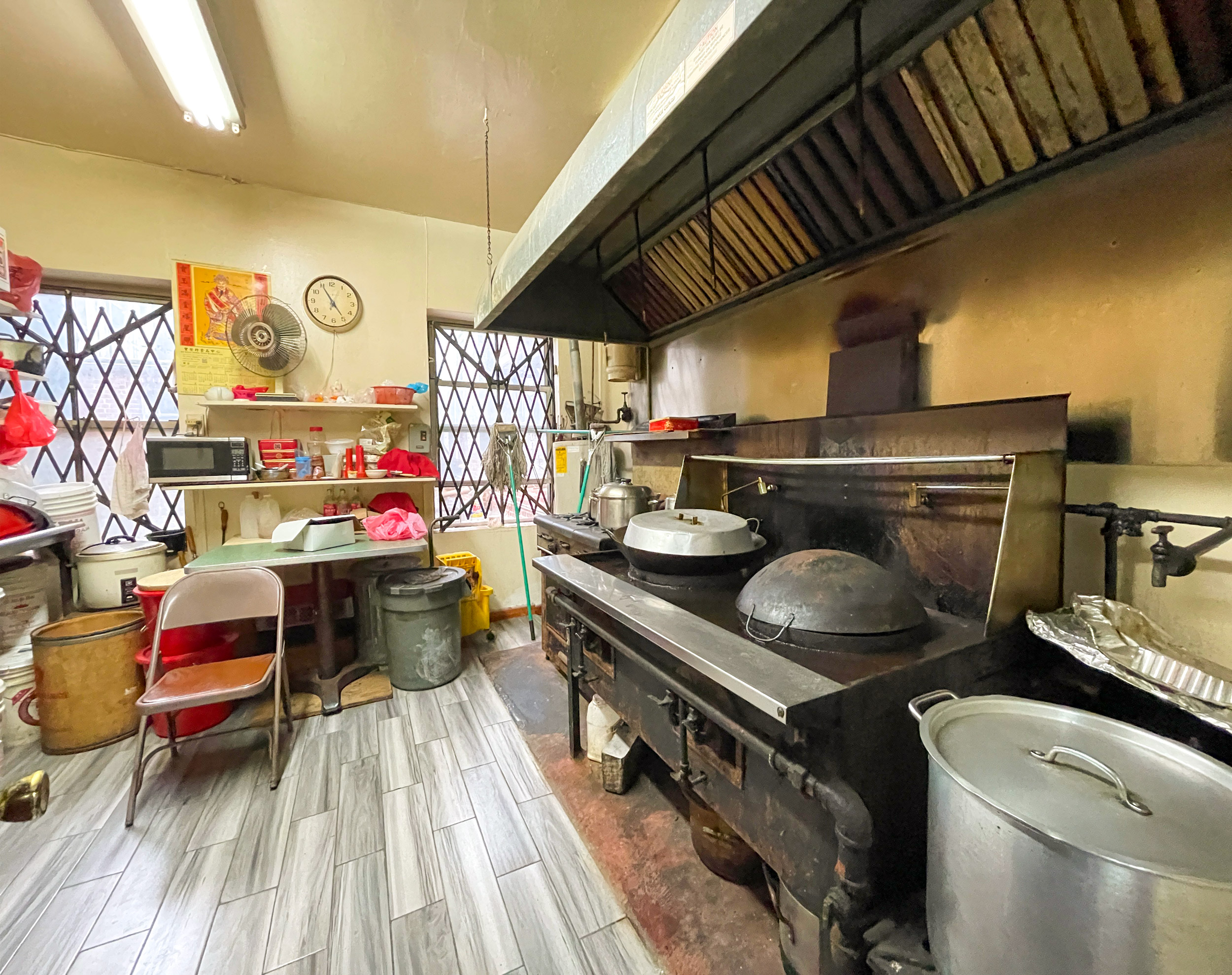
There are three stories and a basement. On the third floor, there is a kitchen.
+ Can you share any information about the building’s history, or its past lives?
Before [we bought the building], the association used to rent the whole building. Downstairs on the ground floor at that time was a uniform shop for the NYPD. As a matter of fact, on Bowery and Bayard, there were several NYPD uniform shops. All the cops used to get their uniforms here. When we started the renovation, they closed up shop.
Before the renovation, we were renting the whole upstairs (2nd, 3rd and 4th floor) — the entire building except the storefront. After we renovated, at the grand opening, I believe we had a liquor store downstairs named Chan’s Liquor. They were there a good 20-30 years from the 1960s before they closed the business and then a bakery took over. The bakery business has changed names and ownership several times since then.
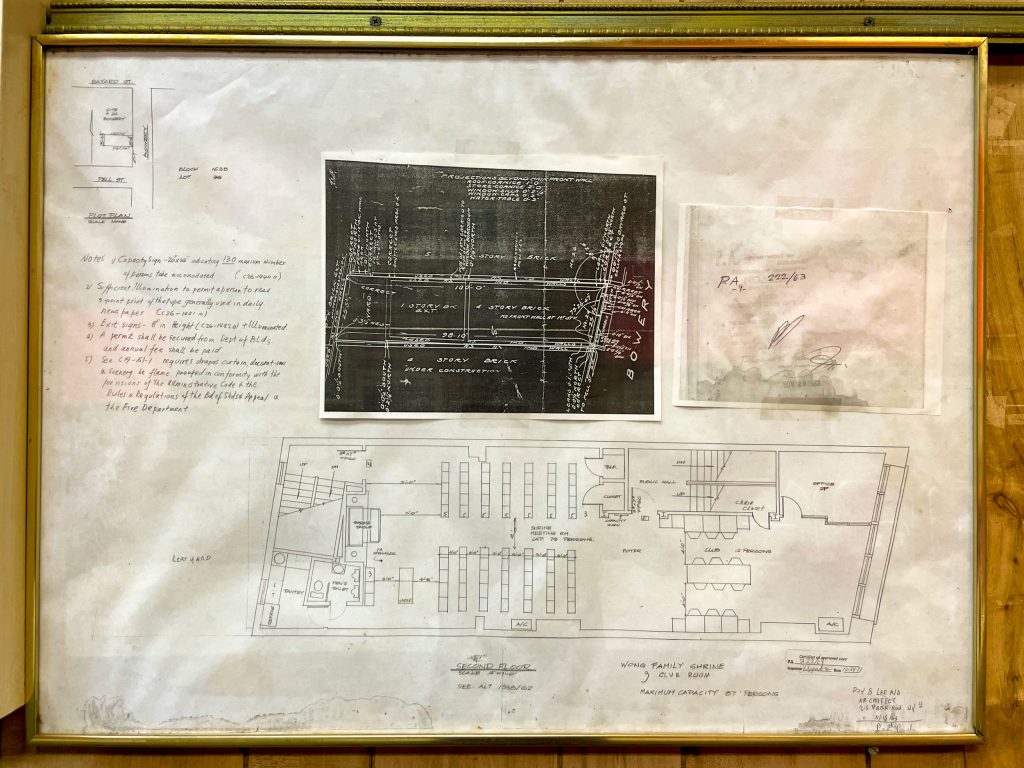
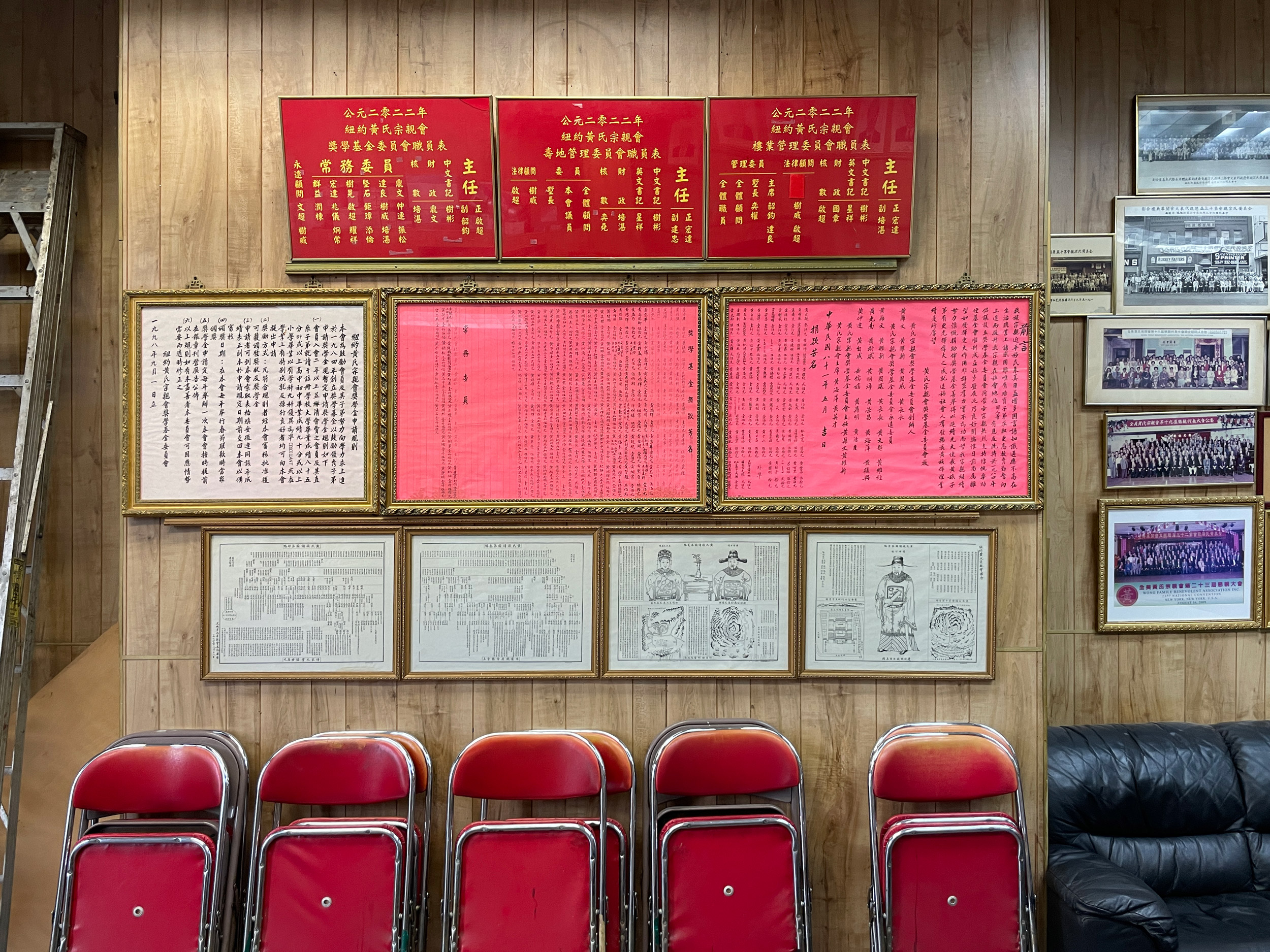
Hand-drafted floor plans drawn by Poy Gum Lee are framed and proudly displayed in the Wong Association building. Photographed in July 2022.
We have a basement and it was partitioned off. Part of it was a printer (who was a Wong elder) who published a Chinese language magazine at the time called 大華 (Dai Wah). It was a combination of local news, news from Taiwan and some stories. It wasn’t very popular, but it was one of the few in Chinatown. There weren’t that many. I’m not sure if it was weekly or monthly. I think they also partitioned off a part of the basement for a barber shop too. Now, they’re all gone. The magazine is long gone and the barber shop is gone too. The bakery now uses the basement and the first floor.
+ Do you know of any major renovations or changes to the building since it was first constructed?
The renovation process took about two years.
I don’t know much except that the building was fenced off and it was renovated… I was a little kid then.
They basically gutted the whole building, and redid the floors and the whole thing. It was a big job back then.
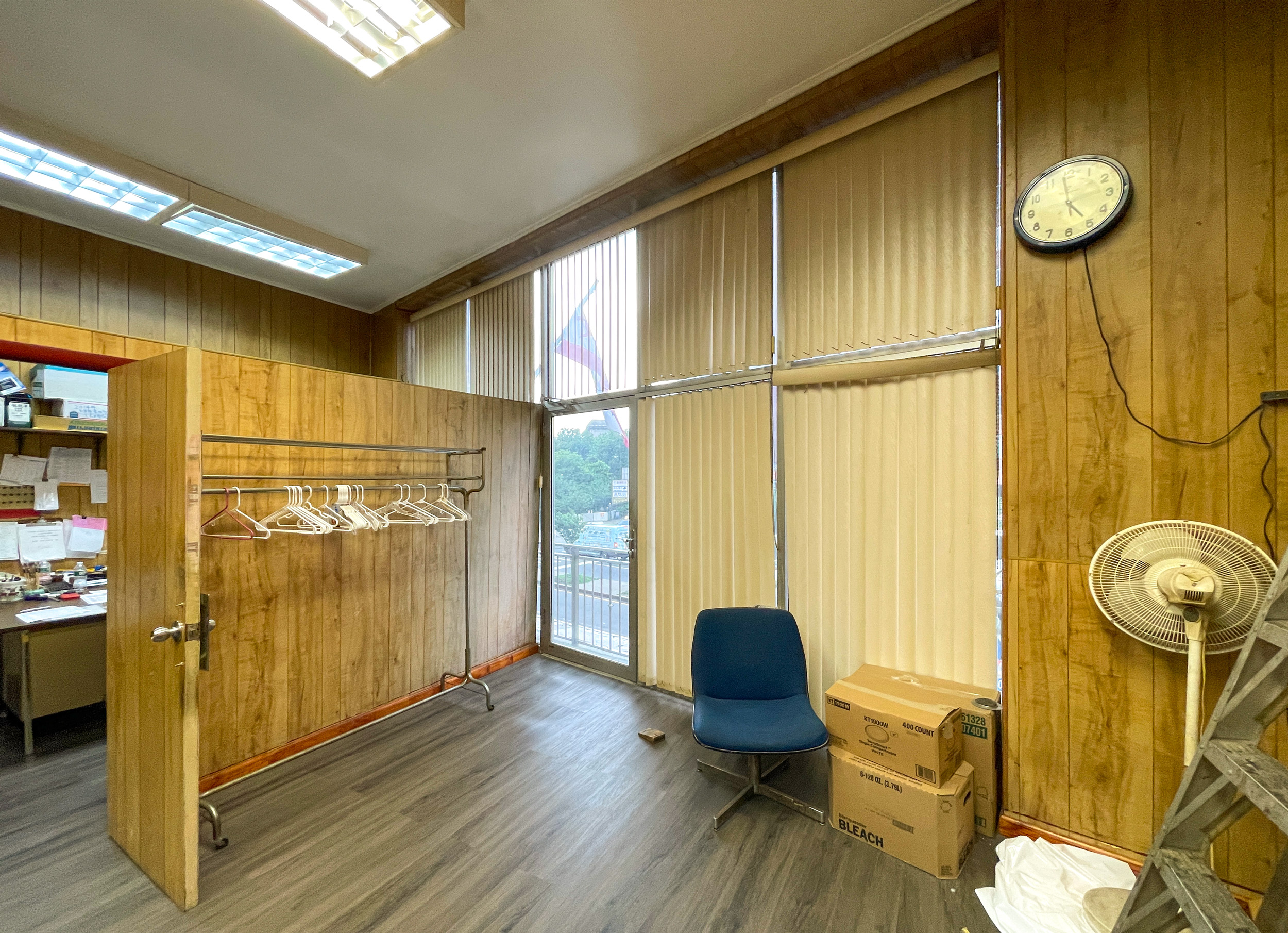
We put a new floor in on the 2nd floor right before the pandemic. Before, it was square linoleum tiles. I think we also waterproofed the roof a couple of times. Physically, I think they built some walls in the office, but I wasn’t around then. The wall paneling, as far as I can recall, seems the same… We’ve done regular maintenance for the building but nothing major.
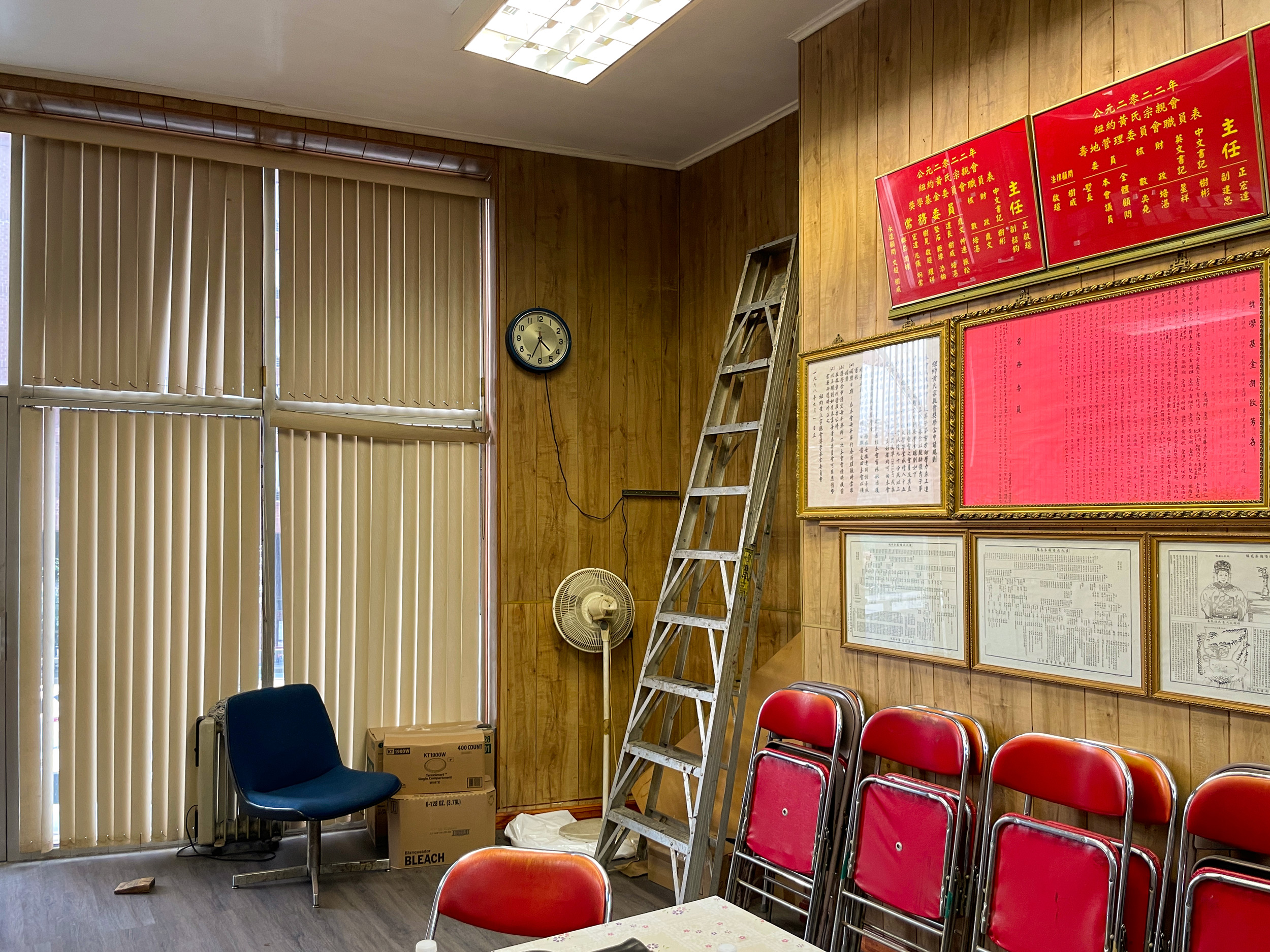
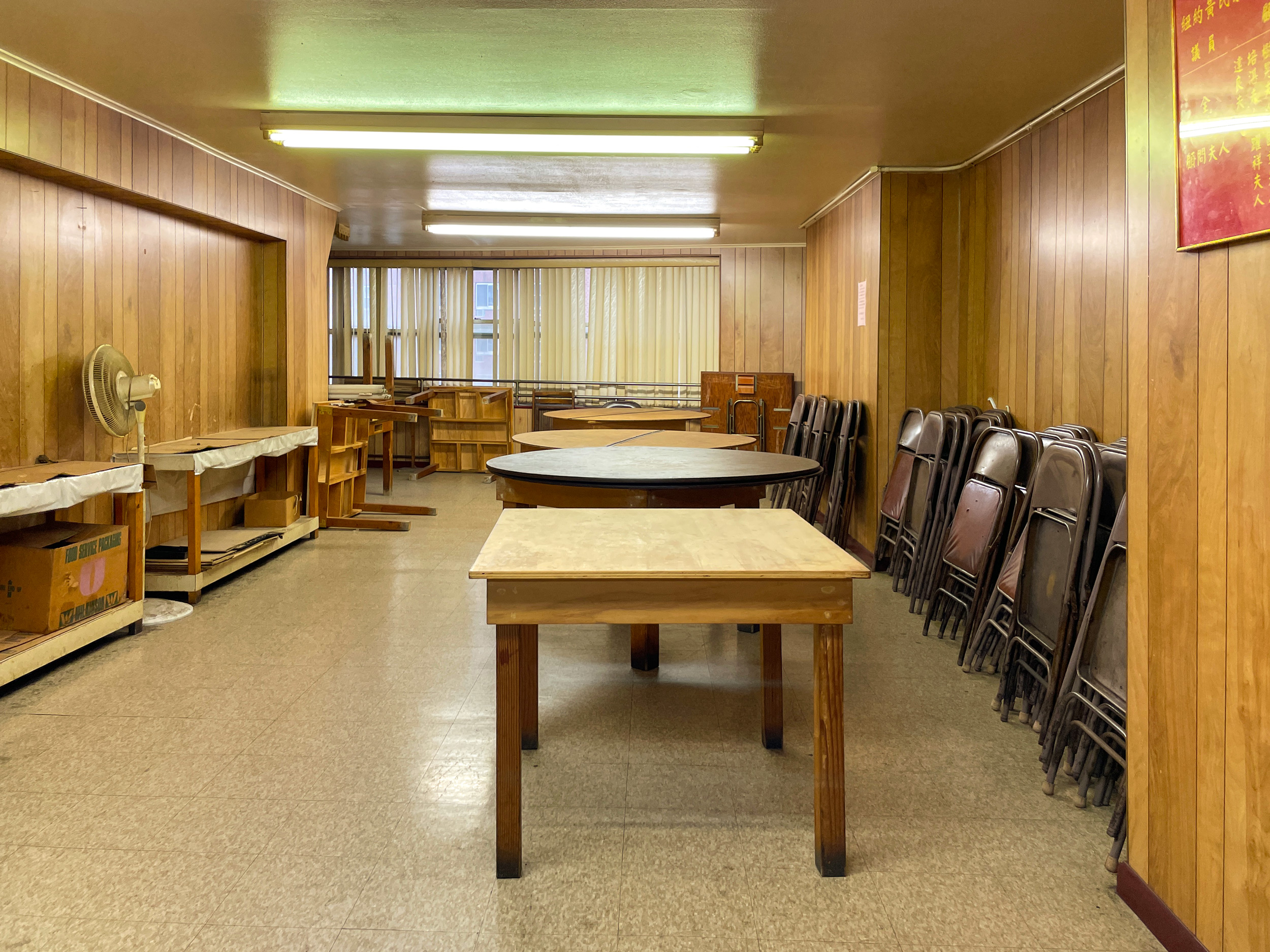
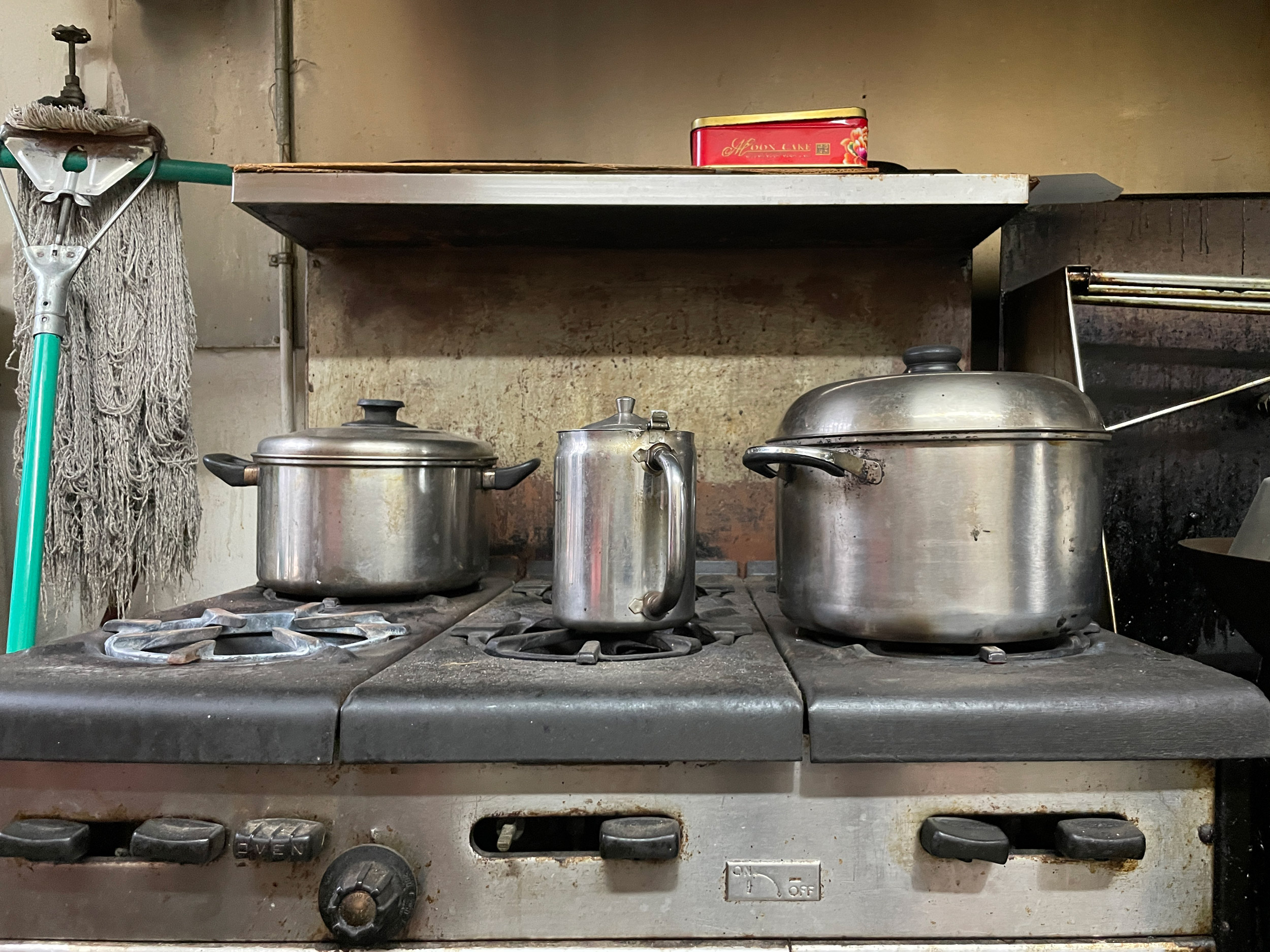
Wall in the central meeting room and industrial kitchen at the Wong Association building. Photograph taken in July 2022.
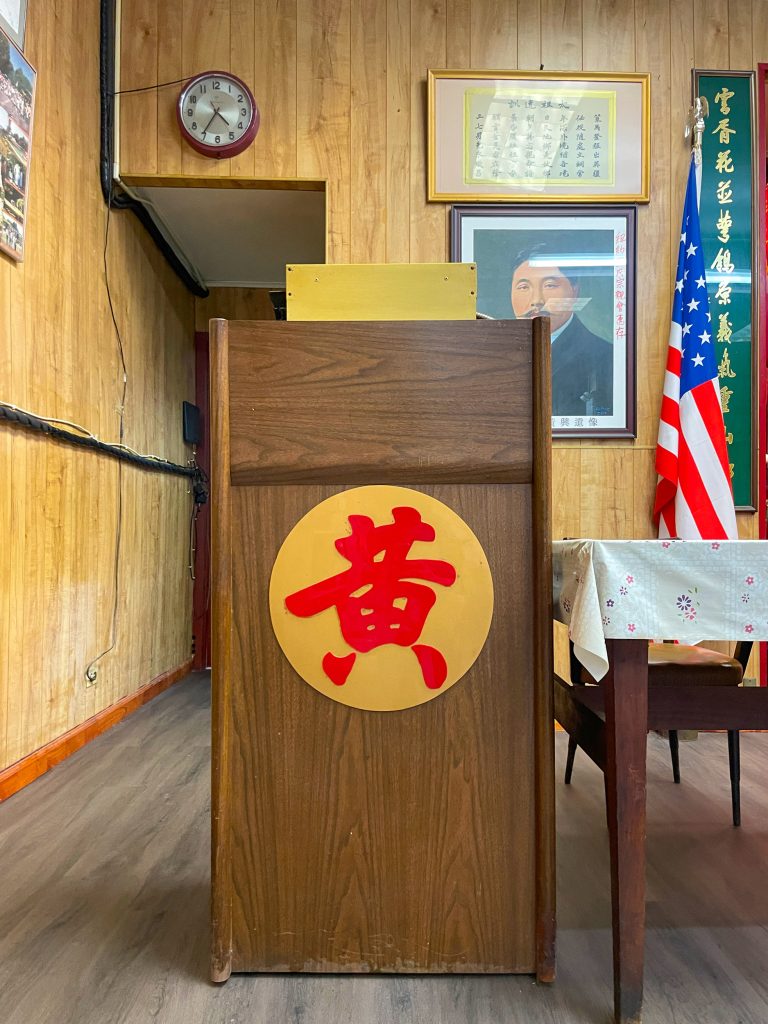
Podium, July 2022.
+ What are your fondest memories of the Association building?
I was here during my first ten years growing up as a teenager until I took off for the army. I didn’t really come back and get involved until after 40 years or so. I didn’t have time before as I was involved with a couple of other things. I didn’t really get back involved until about 10 years ago, when I finished doing what I was doing with the American Legion and all that – and when I was facing retirement and they said: We need help. Why don’t you come on up? I said, OK.
It was always in my heart, one of these days, to do so. Seeing my father, who spent pretty much all of his free time here – he served and took care of his cousins – and this was his home. He spent every day here after retiring and selling the laundry business. This was his second home, maybe it was his first home. My mother said that this must have been his first home for him! All of the male figures back then were attached to the association.
I really can’t think of anything off the top of my head… After a while, everything seems to be the same, over and over and over again. None [of the memories] make such an impact that they stand out from the others. We certainly had a lot of good times when I was growing up here and that leaves a lot of good memories in my heart and in my mind.
I mentioned that there’s a kitchen on the third floor. I called him “Sook Bak” [Uncle] and he would cook for 50-60 people on Sunday. He did that for several years… because he drafted me to help him do all the dishes afterward! I was 14, 15. He’s long gone, but I remember that he would always tip me a quarter. There was another girl and the two of us would normally help him. At the end, he’d give us a quarter. A quarter was a big deal back then!! That stands out.
But the commitments of the older generations to the association – we don’t see that anymore. That’s the sad part. Right now, members are more toward themself because they don’t have the need for support from the association. There are all of the other social organizations out there. Also, the members are more spread out. When I first started, you were pretty well-connected with everyone. If it’s not this generation, it was three generations ago. The majority were coming from the same village. Toishan? Toishan? Hai bin do? [Where in Toishan?] Then suddenly you would have something in common. Everybody was in it together. Now, with all the things going on back in Mainland China, Hong Kong, Taiwan or even Southeast Asia, there are a lot of Wongs that retire and come here, but they don’t necessarily come from the same village anymore. They come from a different part of the country. Many grow up speaking Mandarin. They don’t have the cohesiveness of real brothers. When you need something, you don’t find the willingness of people to jump in and help. That’s not just the Wongs. It happens all across… because our membership base is a lot wider. We’re no longer all from the same region or village, so we don’t have that sense of being all together. We might be brothers, but 20 generations ago instead of three generations ago.
Sometimes back in the old days, people would come here and rely on the association so much, plus everyone knew everyone. Everyone behaved because they didn’t want to get a bad name – to go back to the old country to disgrace their family. I know your mom, I know your dad – everyone tried to put their good foot forward. Now, no one really knows each other except that you’re also a Wong. That’s the only thing that kind of connects us. And many times, you think of yourself first instead of the organization. There’s nothing wrong with that – it’s human nature – but the only thing is that when you do that, you have less attachment. A lot of members say that they don’t need us or don’t need to be here. A lot of people who come here now, the first question out of their mouth is: What’s the benefit? What am I going to get? One lady came in and asked: How many free dinners will I get? Nickels and dimes.
+ You mentioned that women were allowed in as members a few years ago. Is that something most associations do or was this a Wong Association decision?
Membership opened up to women in 2018 at our last convention. I happened to be the chairman of the constitution and bylaw committee and we were tasked by the national convention in Boston to come up with revised bylaws. It’s been years since anyone looked at it. I looked at the things that needed to change. Not accepting females has to be outdated. It took three years to convince people and in the end, I had to compromise. We had a representative from each chapter there and some chapters decided they didn’t want to send somebody because they didn’t have that many people. So there were 12 of us scattered from east coast to west coast. It took almost to the end before I finally got the word of acceptance of females in writing.
I said – I don’t care if you guys accept or don’t accept, but I’m telling you, that New York has already passed a motion that we’re going to accept. Like it or not, it’s going to happen in New York. They were going to say, What are we going to do? I said: let’s do it this way. I know there are a lot of people who are not willing to accept – for whatever reason, obviously they can justify it to themselves – but why don’t we put it in there that we are at the stage in the 21st century that we need to accept females. In the event that you think your membership is ready, you go ahead and motion to get it approved at your chapter. For those of you who feel that you’re not ready and not comfortable with it, then you wait until you’re comfortable. You don’t have to do anything. It gave them a back door out.
So far, we’re still the only one.
Older members are so used to putting females on the auxiliary side and don’t want them to be a full member, where they could run for office. There was one guy in a meeting where we were working on the constitution and bylaws and he said: Oh I know! We could accept females and let them do secretarial and janitorial work… but just don’t elect them or allow them to run for president.

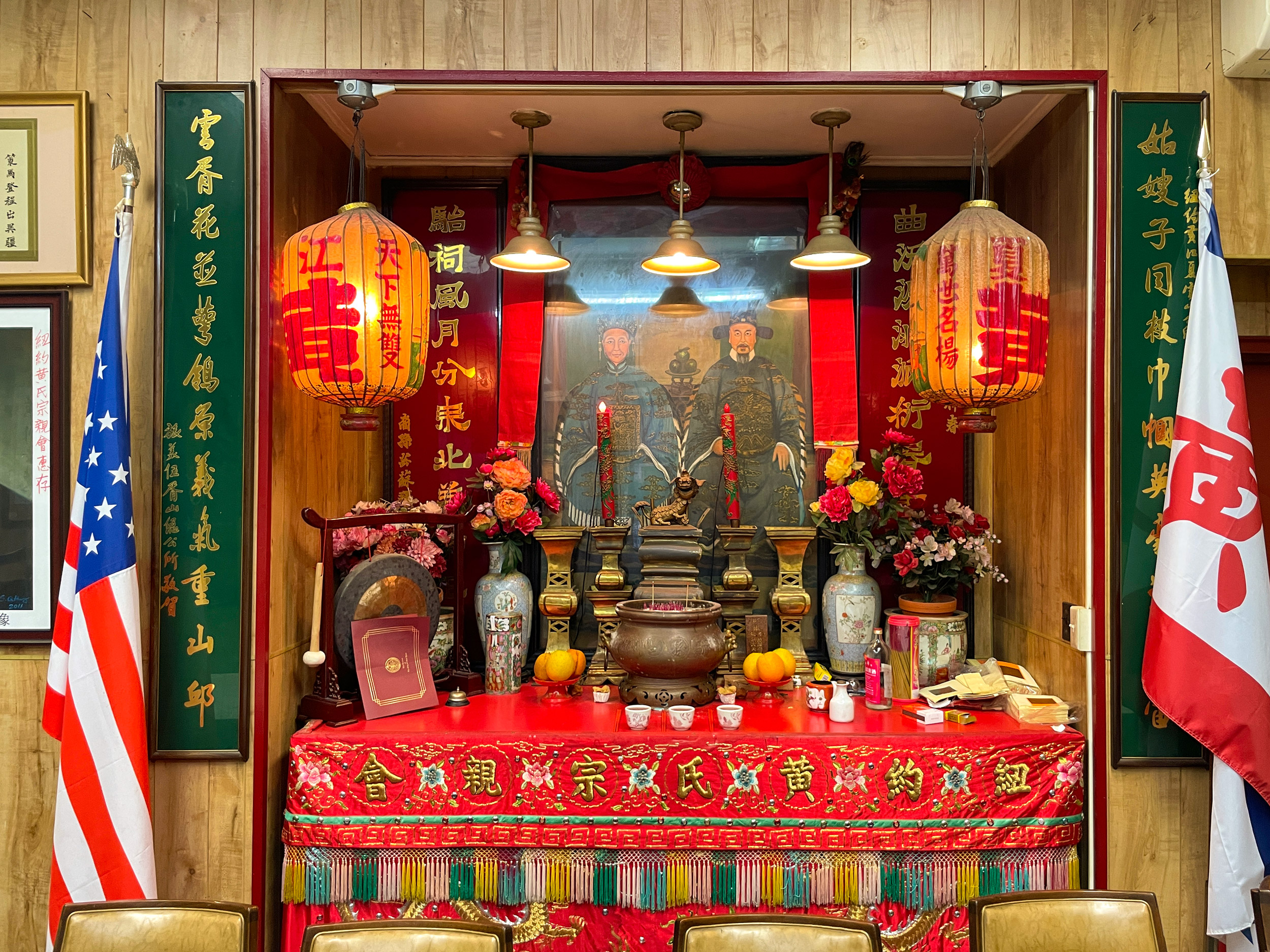
Shrine, November 2024.
I said: Are you kidding me? Where are you coming from? That’s the one time that he made the statement and everyone in the committee jumped on him. You’ve got to be kidding me!!
When we opened up membership to females, you have to have direct linkage to the Wong Family.
They [the associations] are actually very dependent on female work support; I see quite a few chapters held together by the ladies. A lot of people even today don’t get it right. They look at their wives, at their granddaughters… but they need to carry the last name Wong. We’re talking about the females that are part of the Wong family.
On paper, we have less than 20 females now.
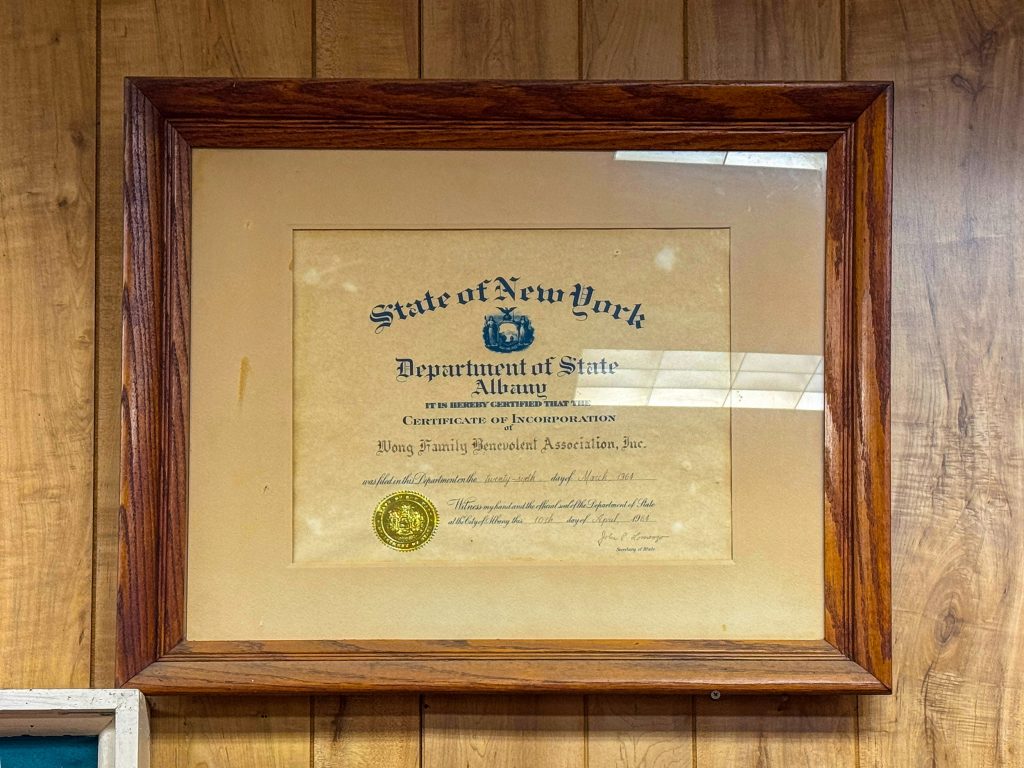
Certificate of Incorporation of the Wong Family Benevolent Association, dated March 1964. Photograph taken in November 2024.
+ Who are the association’s members? What members visit?
Most are older members. It’s hard to get younger members. Our problem is — what do you want younger members to do if they join? Are we ready for them to take over? What exactly do you want to do in the future? Right now, people are worried about the future. They said there is no future if we don’t get younger members in.
When I came back here 10 years ago, I was one of the youngest ones. But back then, I was already retired. How can you say that we’re younger if you’re looking at a 60-70 year old guy and thinking they’re young? We’re not. So we changed the bylaws; we need to get younger members but we need to open up and allow younger members to have their share of space to do whatever they feel works for them. The future is them, not us. I think more and more people do believe in it. A lot of older members are afraid… because it’s unknown.
Back in the old days, when you came to Gum San, Golden Mountain, the first thing you would do is go to the association and join. Nowadays, people join by word of mouth.
+ What activities take place at the association building?
We still have bimonthly meetings here.
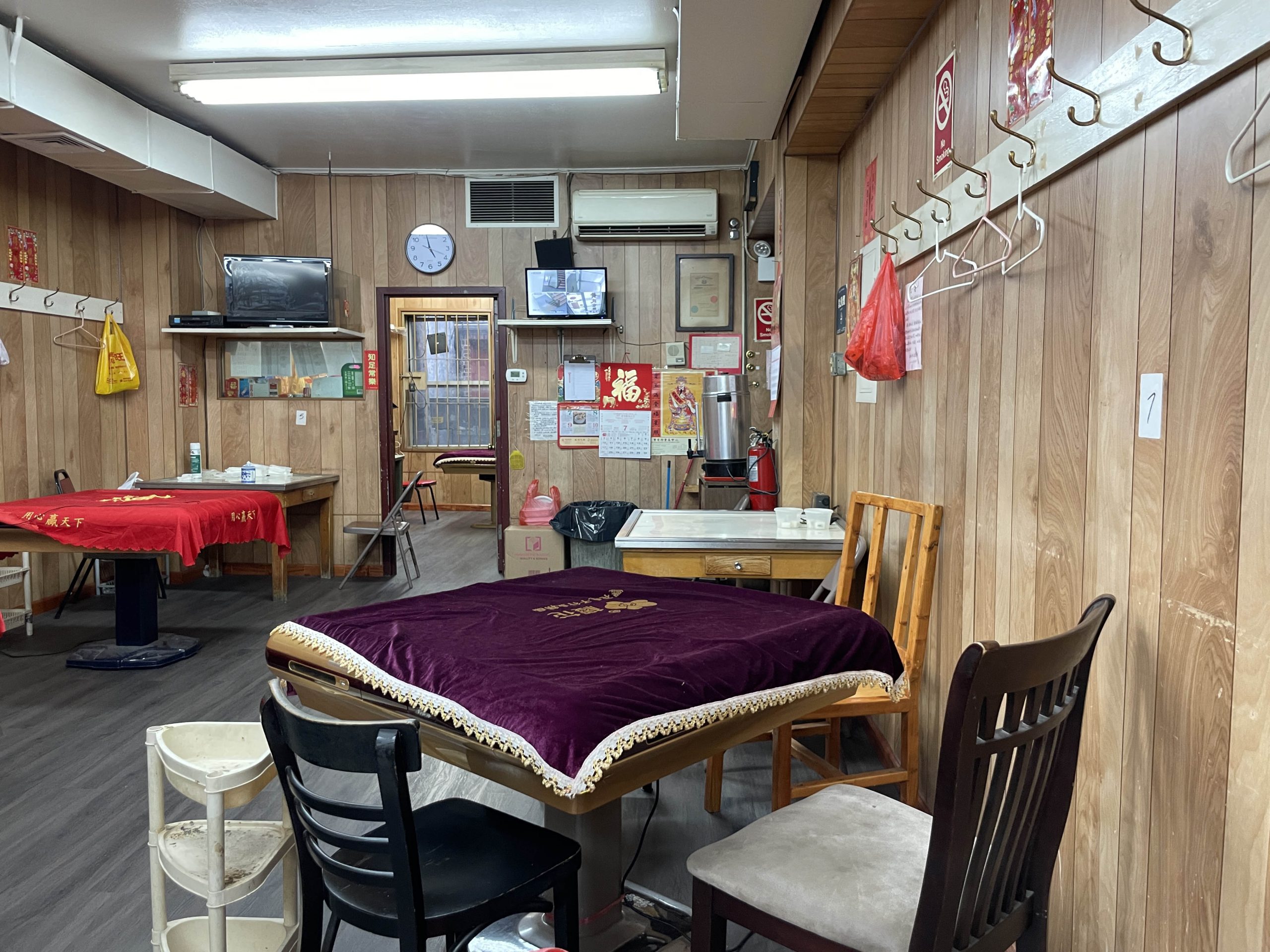
The 2nd floor is always open. People come to read papers and meet friends. Upstairs there are mahjong tables. Even now [post-pandemic] it’s not as populated as it used to be. People want to come and kill time. There are less and less members that come up during regular times because more people live outside of the Chinatown footprint. When they live in Brooklyn and Queens, many don’t want to travel here.
We try to have some luncheons set up to entice people to come more often. But the last few years [during the pandemic] there wasn’t much going on. We used to have a big banquet every year in a restaurant.
The kitchen hasn’t really been used for the last couple of years. Before that, they used the kitchen to prepare specialties like tong yin. Every year, there’s a festival and we would go out and buy mai fun, chicken, and make a big pot. We would celebrate with a big pot and try to organize some picnics to take some of the older members around. On New Year’s we order in and have a big dinner together.

Bimonthly meeting at the Wong Association building, July 2022.
+ What about lion dancing?
We don’t have enough young people!
Boston has a young group and they have a young teen group who do this lion dancing. They support each other.
You need young people. If we had some Wong teens interested in doing this, we would help them to organize and probably also allow others to join; you can’t have all Wongs when you go out and lion dance. You open it up to others. That’s how Boston does it. But… we’re not at the point where we have the manpower.
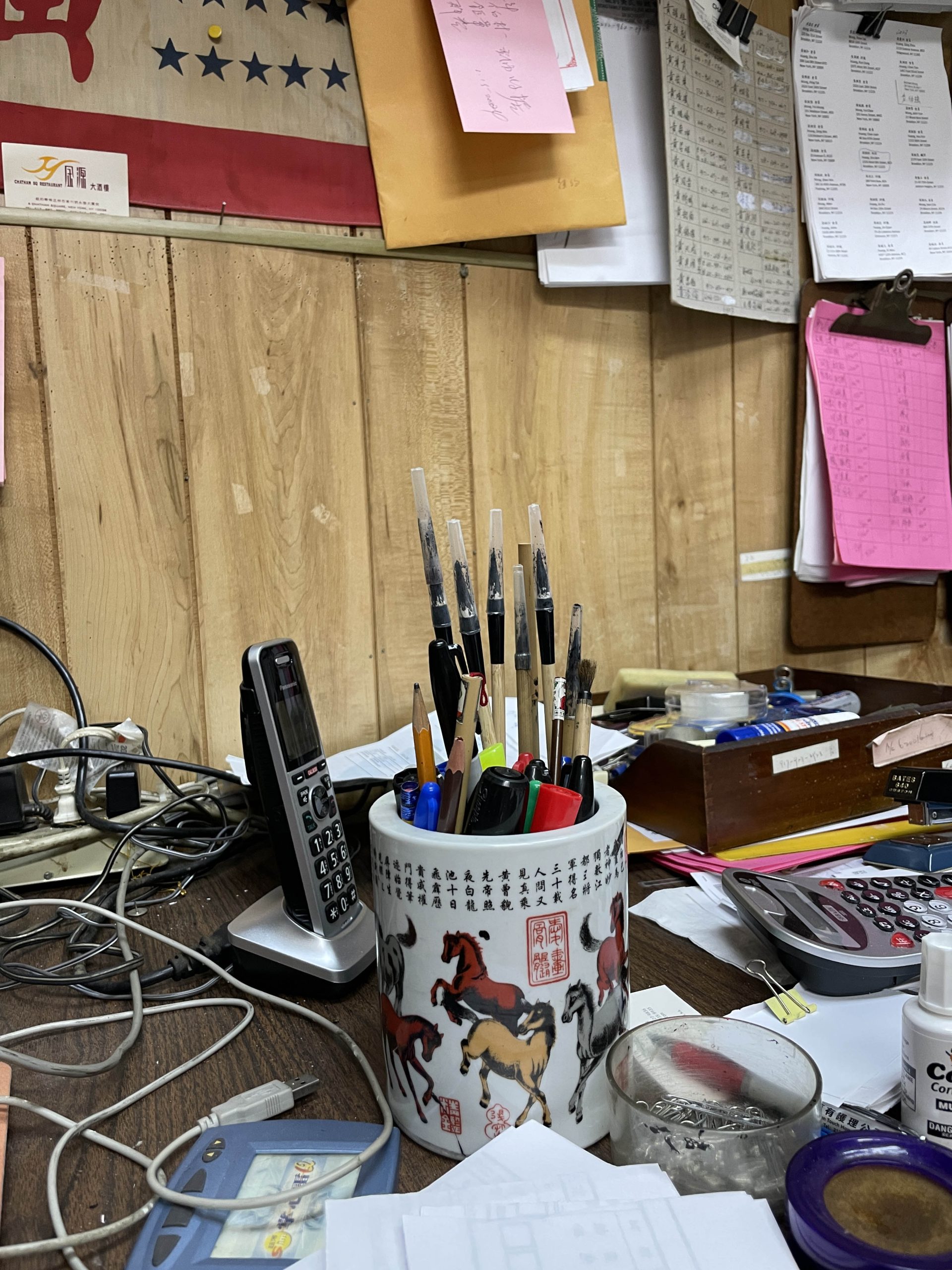
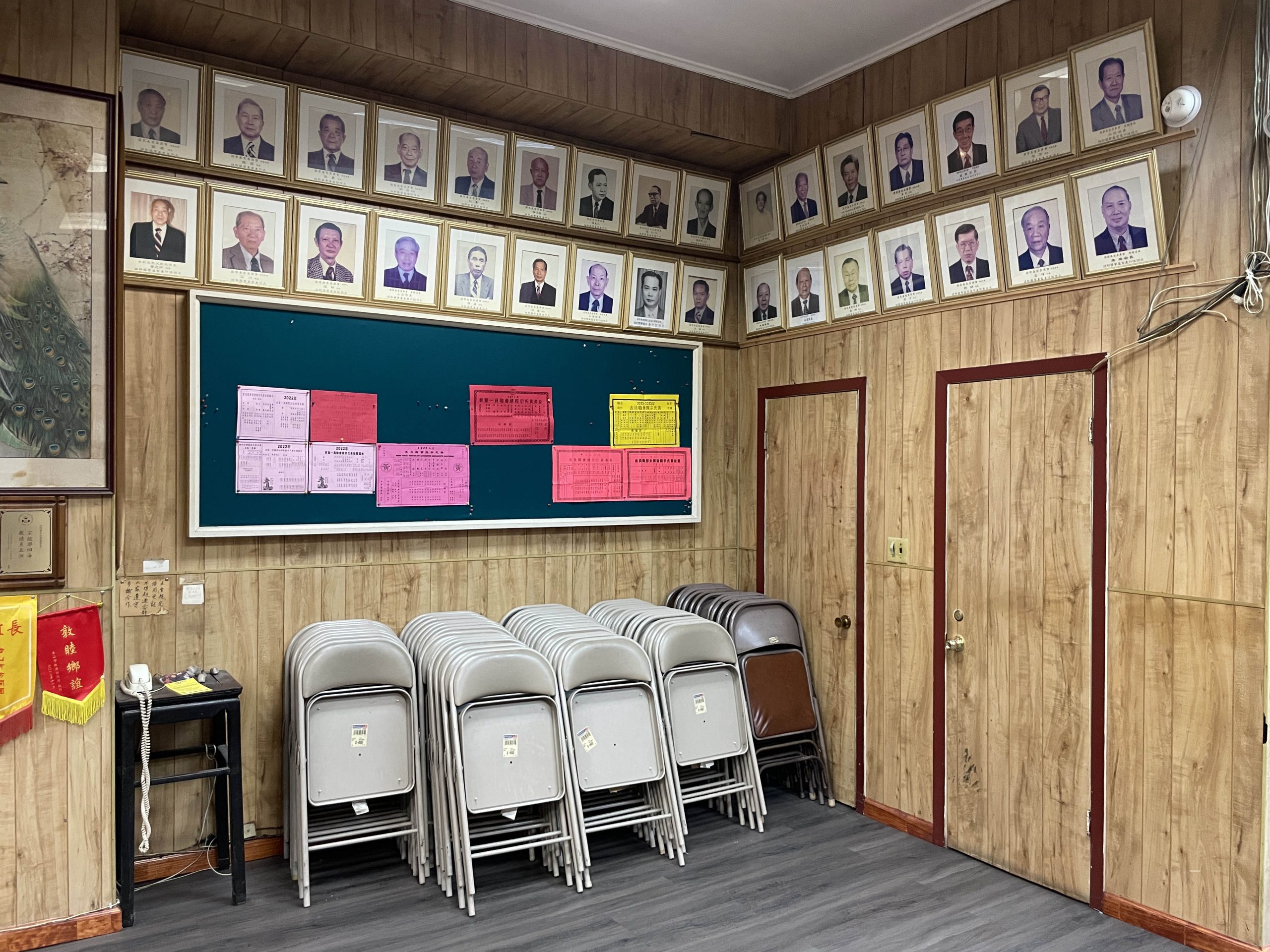
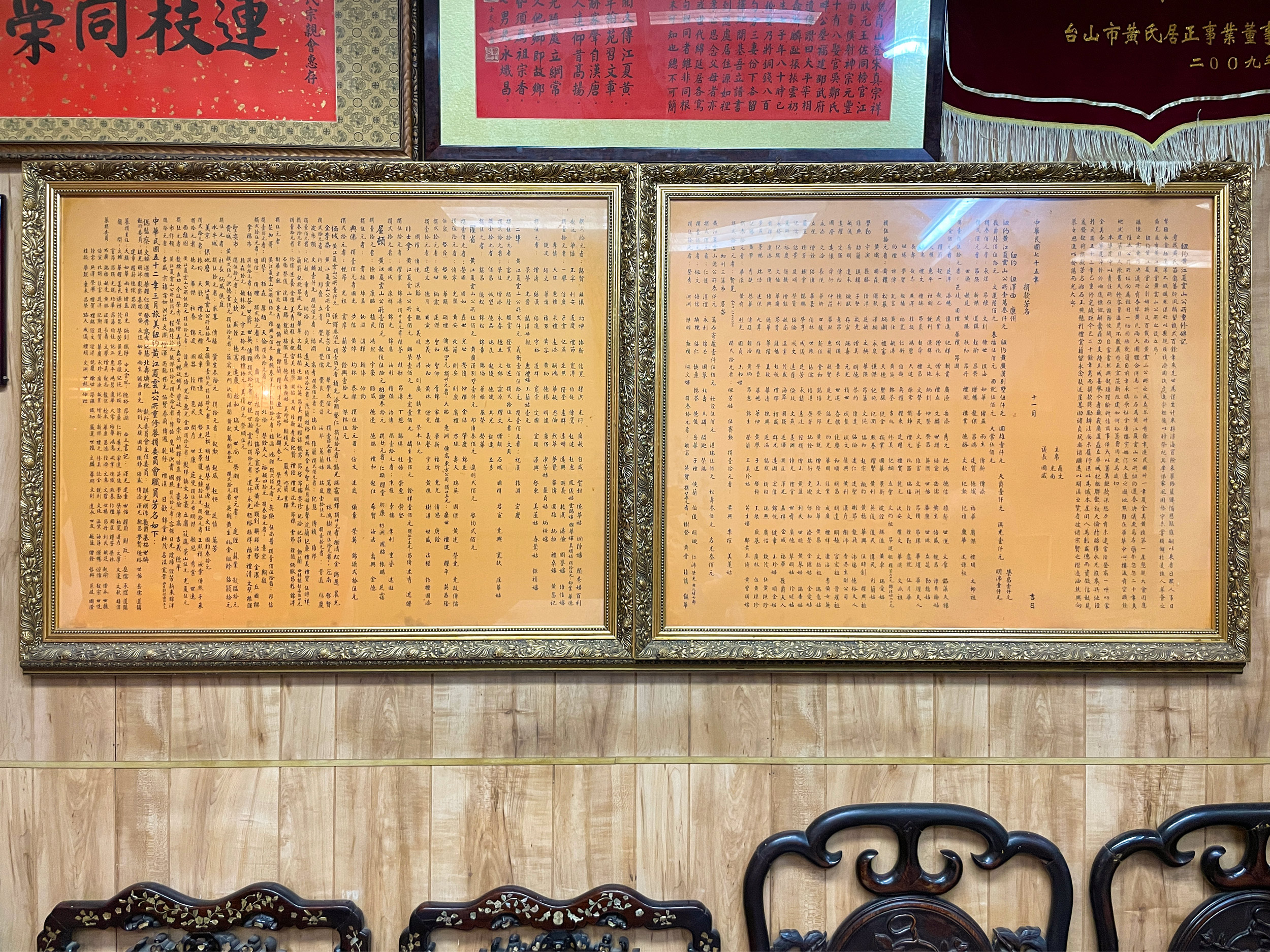
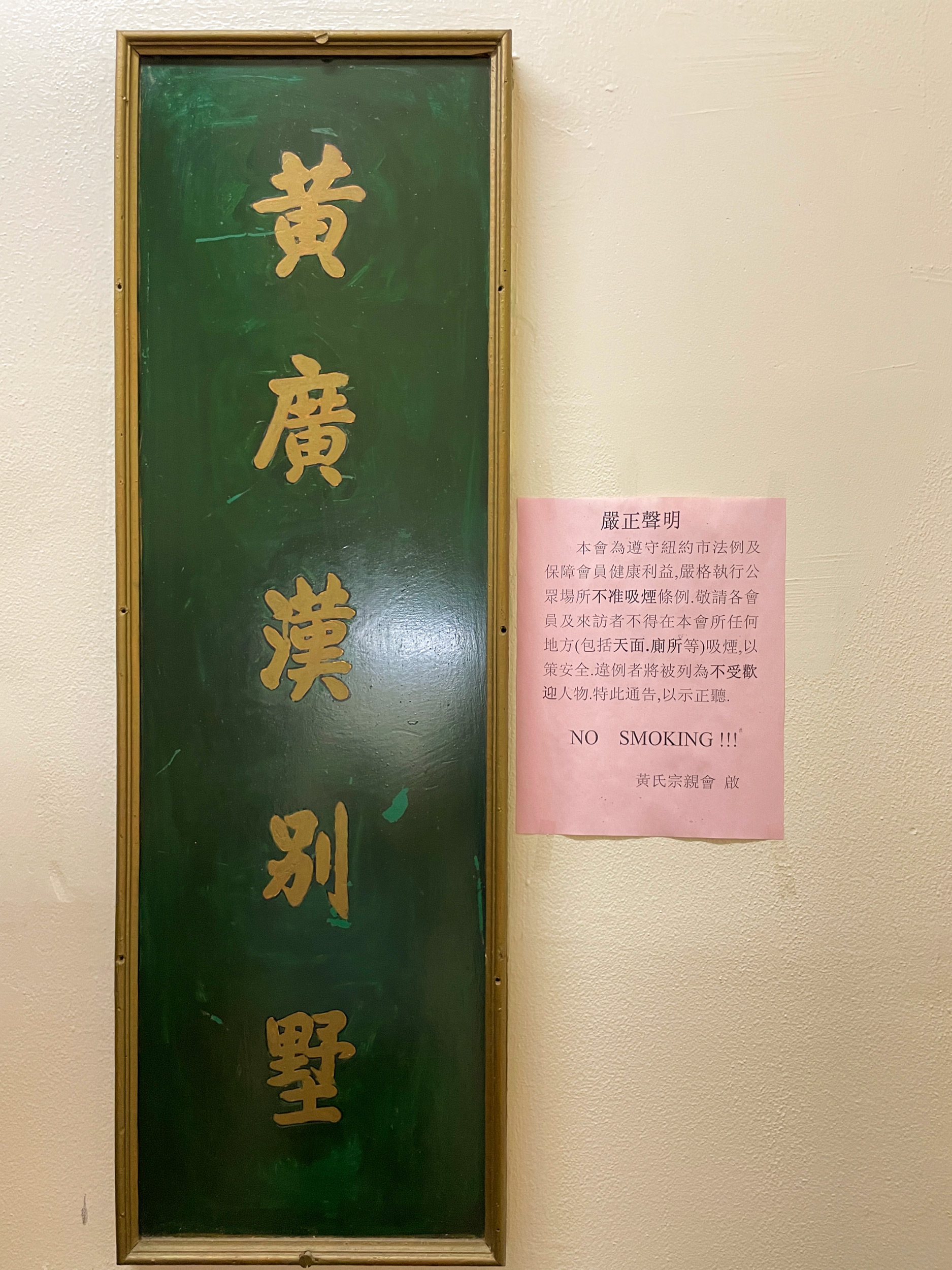
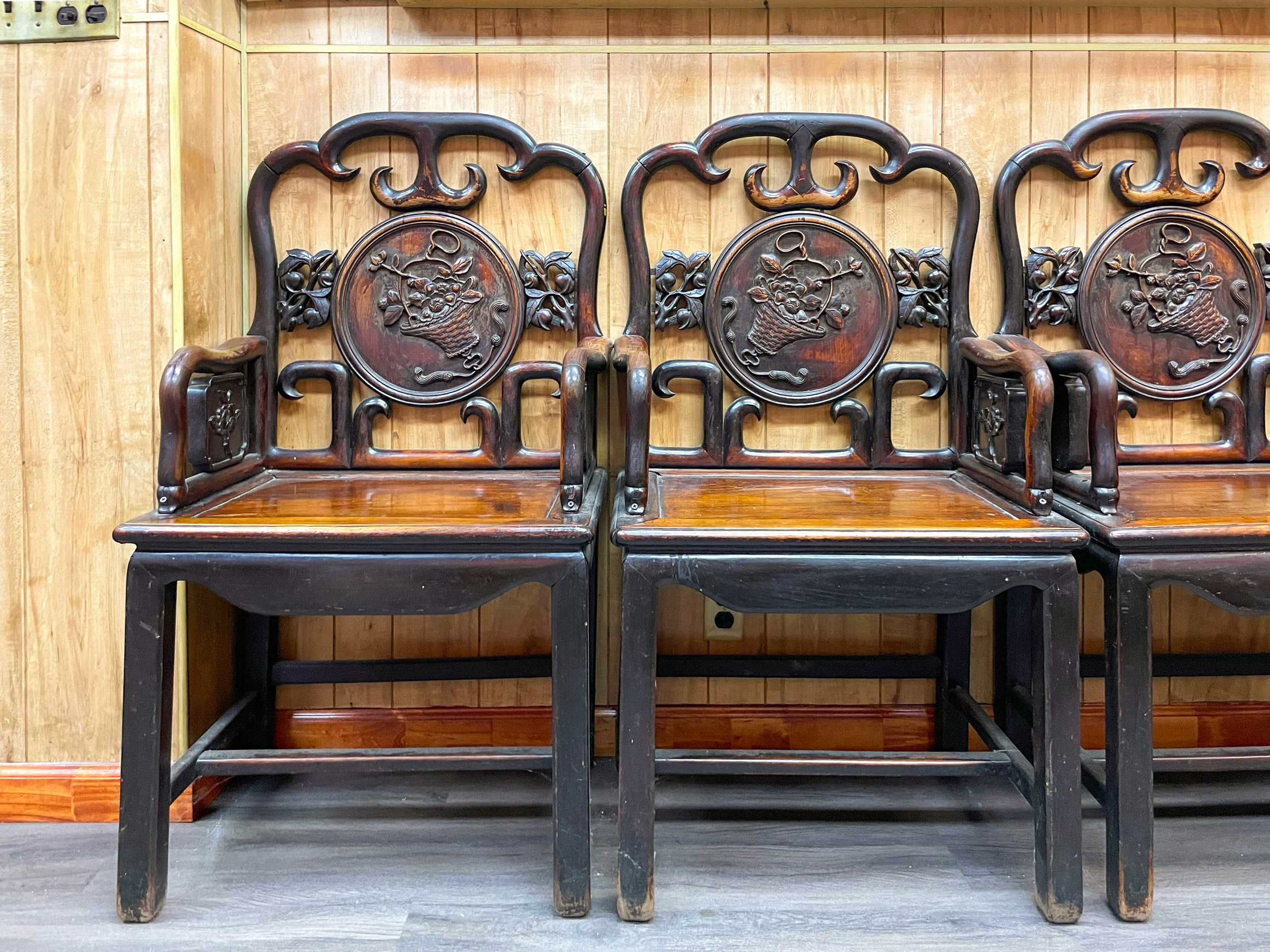
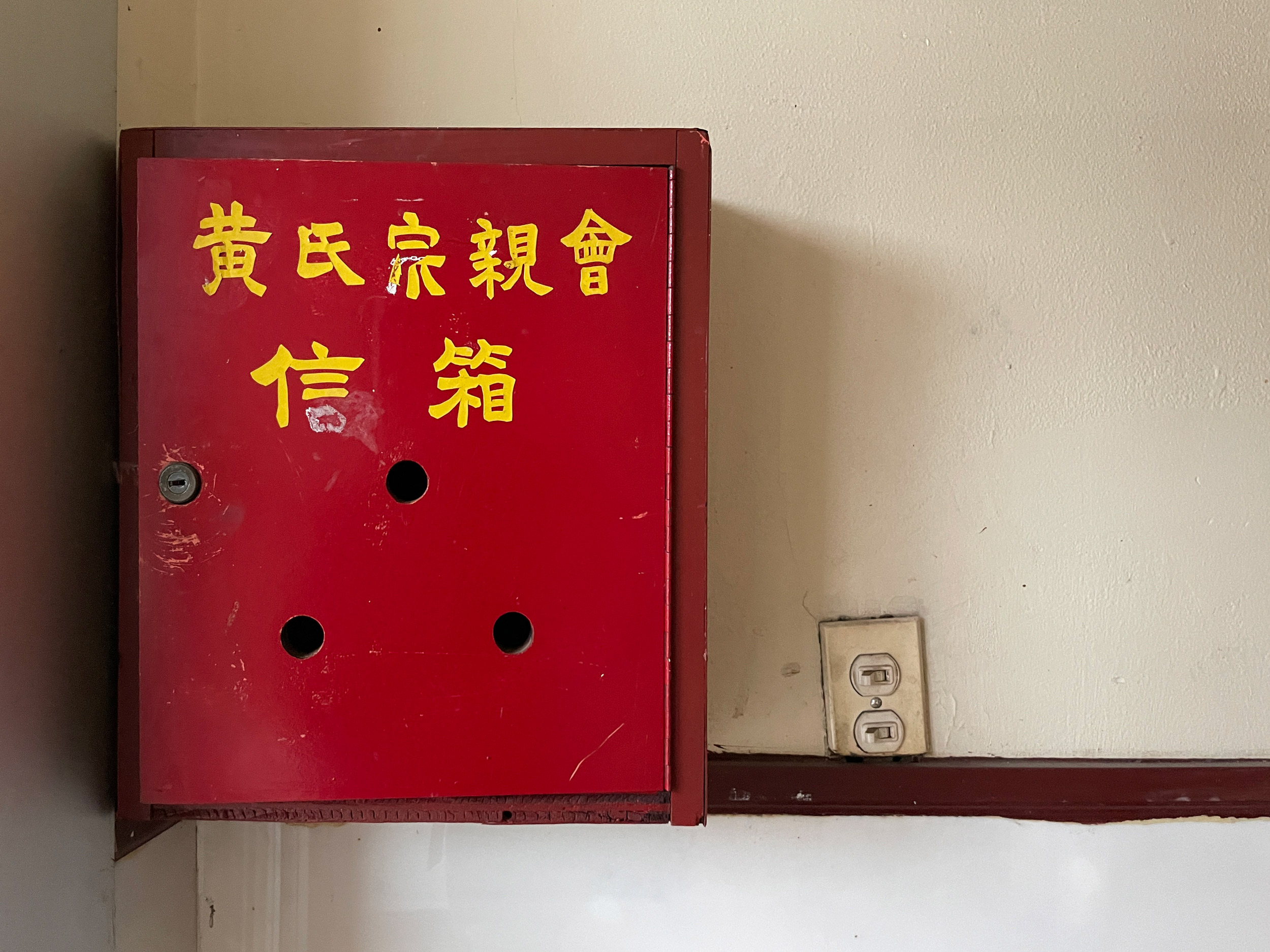
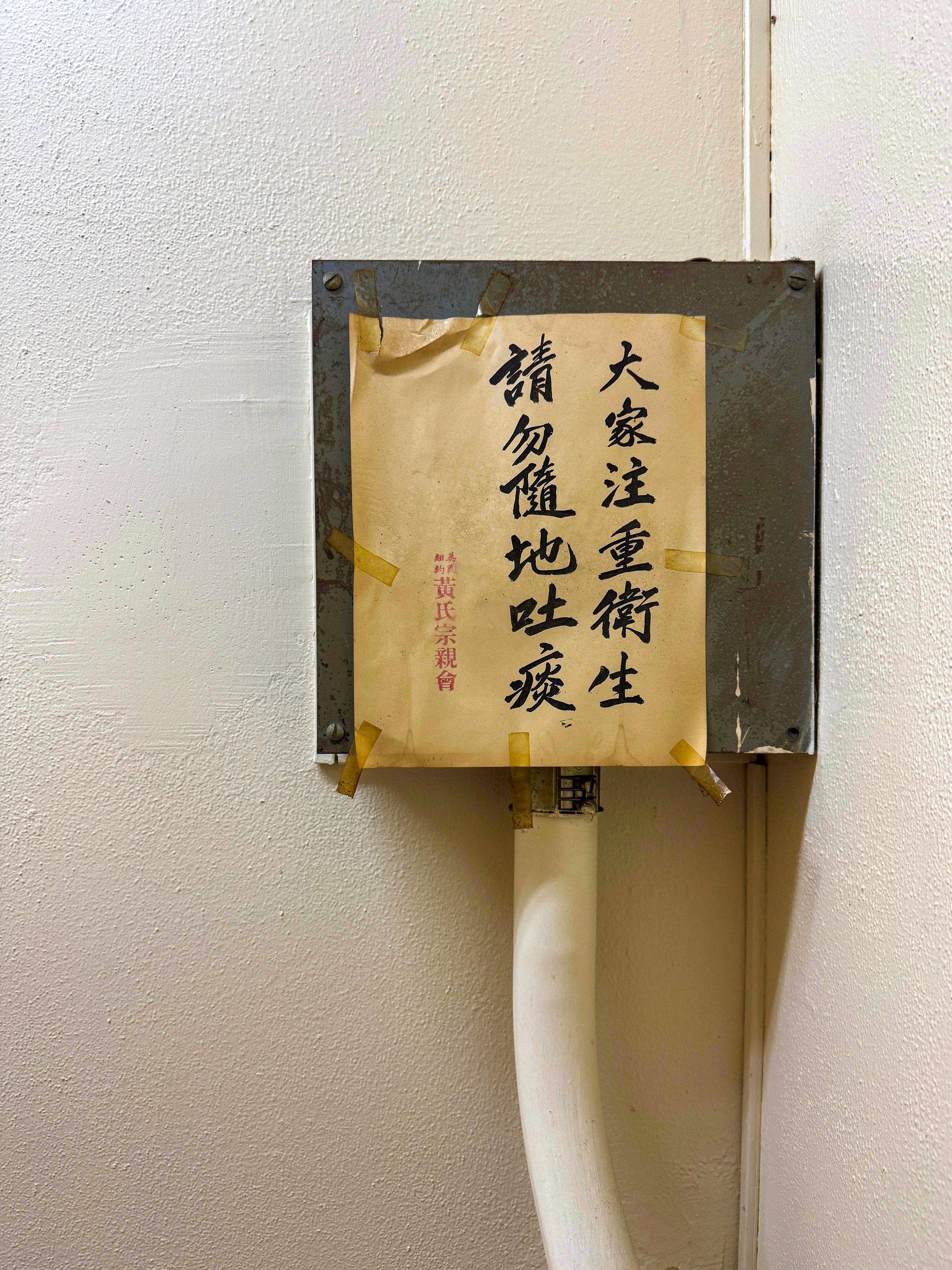
Walls, windows, furniture and objects at the Wong Association, July 2022.
+ How have you seen your association and Chinatown impacted since the pandemic started? How have you felt about this?
The president at the time made the decision to shut down during the pandemic (March 2020)… We’ve been in shutdown mode since and only in the last 6-7 months have we started opening on Fridays, Saturdays and Sundays. Still, many people aren’t coming out except for the guys who like playing mahjong. They were in fact the ones who demanded we allow them to come again.
It’s been hard in the sense that there are a lot of things we should be working on but can’t. It’s hard on the older members who we lost… there are so many, we can’t even keep track. We hope that gradually membership will come back up. I think it’s similar in many other associations.
+ Is there anything else about the building you would like to share?
In 2014, we celebrated the 50th anniversary of the renovation of this building. I put a journal together and I wrote this article to cover my understanding of the building and the association, and the transition I see from the old to the new, etc.
“我所認識的紐約黃氏宗親會過去、現在與未來” -黃宏達
Read in Chinese here.
“Our Past, Present and Future” by Fang A. Wong
Read in English here.