
1-9 Bowery
Confucius Plaza
Architect: Horowitz & Chun / Built in 1973-1975
2024

1-9 Bowery
Manhattan Bridge Colonnade & Arch and blocks south of the bridge (Schematic render of the buildings that stood here, according to the footprints indicated on the 1930 fire insurance maps)
Architects: Carrère and Hastings / 1912-1915 (Bridge opened in 1909)
1930

1-9 Bowery
(Schematic render of the buildings that stood here, according to the footprints indicated on the 1905 fire insurance maps)
1905
Interview
WITH CHLOE CHAN (FOUNDER OF "MOTT STREET GIRLS")
Interview conducted in April 2022.
All photographs included in this interview are courtesy of Chloe Chan, unless otherwise noted.
+ Please give me a brief introduction of yourself.
I’m Chloe, I’m a second-generation Chinese-American raised in New Jersey. My parents came over from Hong Kong in the early 1990s after getting married there. My dad came over to work and my mom to study. It was more skill-based immigration.
My parents brought us to Chinatown because they wanted a connection to Chinese culture. When I was seven, my whole family moved back to Hong Kong because Chinatown wasn’t enough — they wanted me to learn Chinese. [I was there] from second to fifth grade.
[Today] I work with Chinese immigrants in public health with my day job.

Chloe Chan outside of Rome Piano, photographed during our interview session. Photograph by Cheryl Wing-Zi Wong, April 2022.
+ How did you come to be connected to Chinatown?
I came to Chinatown every weekend. It was always something I really looked forward to; the town I grew up in had few Chinese or Asian people. Going to Chinatown was exciting; I had the experience in Hong Kong, so the language and foods were familiar to me. And [in Chinatown, there were] people who looked like me.
We always got food in Chinatown, so I looked forward to picking the restaurant we would go to.
Chloe as a child with her mother and father.
+ What Chinatown buildings do you have a special relationship with?
I started going to Roma Piano when I was five or six… and that was another reason we had to go to Chinatown too. I didn’t really love it — I’m not a great pianist. I didn’t look forward to it, but nonetheless I was there until I was a high school senior. It was a pretty big part of my life.
We also went to another place called Yardley’s in Confucius Plaza to get passport photos done.
I also remember I really looked forward to getting the Chinese newspapers in Chinatown; they had free newspapers at the salon or bakery (with a bun and milk tea, you got a Sing Tao newspaper). There was a gossip magazine on Hong Kong celebrities that I looked forward to.
Childhood photographs of Chloe with her grandmother.
+ How long has Roma Piano been in this building?
Definitely before my time! It’s been in the community for a long time.
+ Describe the building.
It’s one of the commercial units on the ground floor [of the Confucius Plaza] to the left.
It’s a very old school inside — very crammed. Lots of actual pianos on display. Always students sitting outside waiting to go in with their parents. There were at least eight rooms in the space with two aunties with glasses who were always there… My parents recently went back to go say hi to the staff and they were still the same!
I don’t love piano, so it was always a dread to go. I remember at Chinese New Year time there was always free candy they had out.
There was a counter and some pianos for sale, but then rehearsal rooms gathered around the store. There were tile floors.
It was a small room with a piano and a stool and you had to slide on the stool to get in. The teacher was waiting on one end of the stool. There wasn’t a lot of space — real estate is expensive.
I switched teachers; they were music school students. I think I had three to four different teachers there. I remember some of the teachers were super strict, but the younger teachers were often nicer. One of my teachers used to bake things for me.
It was all Chinese kids — either from Jersey or Long Island or who lived in Chinatown. Our family friend’s daughter also went there. It was relatively affordable.
+ Do you know of any major renovations or changes to the building since it was first constructed?
I feel like the interior was relatively the same for all those years. The stores around changed; I think there are new community centers on the ground floor that changed, but otherwise it’s been the same.
+ What are your most impressionable memories of this building?
It felt so routine, so it brought a sense of comfort. Waiting for my lesson, I would read my Chinese newspaper and knew I would be able to look forward to a meal in Chinatown.
We always went to Big Wong… We went there a lot. When my parents came to America, it was one of the first places they always went to. (Big Wong has been here since the 1970s). We always got the beef chow fun, the congee, the roast duck and roast pork.
We also always went to Nam Son, a Vietnamese restaurant.
It was always there — this is what we were doing every weekend — and it brought a sense of security.

Chloe with her father, December 2000.
Dim sum throughout the years.
+ How have you seen Chinatown change over the past decades?
I think the biggest changes are that the businesses I grew up with have closed.
For example, one which was shocking to me: a bakery on Mulberry, Lung Moon Bakery the (storefront is still there). We always got our mooncakes there. It’s been there since the 1960s/1970s and was a place you take for granted. When it closed during the pandemic, it was really sad. It was super old school; trays of egg tarts by the entrance. My parents would always get mooncakes there because they cost less than the imported Hong Kong cakes. We also got egg tarts there. It felt old, that they’d been there a long time.
There’s been many phases of me and Chinatown. When I was a kid, it was my parents showing me around. When I was in college at NYU, I lived close by and would go discovering on my own. During college, I went to Lanzhou Hand-Pulled Noodle on East Broadway. This also closed down during the pandemic.

Lunar New Year festivities.
+ How do you see the work you’re doing today in Chinatown as culturally significant and building community?
I first got involved in July 2019 when I was volunteering at MOCA (Museum of the Chinese in the Americas). My impetus to volunteer there was that I always wanted to learn more about Chinese-American culture and didn’t really have the opportunity – they don’t really teach it in school! It was mostly white history and I wanted to learn more about Asian history.
I came upon the opportunity to be a museum tour guide. I stopped in February 2020, when the pandemic struck. It was a life-changing experience; I heard bits and pieces of why the Chinese came here – they were tricked into coming for Gum San… I didn’t really understand until I worked at the museum and pieced the history together. I didn’t hear before about present-day struggles, like Vincent Chin.
In February of 2020, the museum closed down. My friend Anna and I had had the opportunity to become licensed walking tour guides for the museum… We missed giving tours so we had an idea in March 2020 when we were staying at home and had more time — and this was Mott Street Girls.
We submitted our application to Airbnb Experiences. It was October 2020 when we gave our first tour. It used to be just about the tours, but then slowly with social media it became a platform to speak out about issues. Seeing the bakery close down, we wanted to amplify small business owners and their stories. We wanted to be a platform to advocate for and build relationships with small business owners. We continue to lead tours and even Chinatown locals have been booking our tours. This history isn’t taught in our schools — people may have walked these streets but they don’t know the history behind the business or the landmarks.
I actually met my current boyfriend through my third tour!
+ What are the most important landmarks on your tour?
The small businesses — it’s important to tell their stories for future generations to hear. These are Ting’s Gift Shop, open since 1957 [closed as of spring 2024] and Wing On Wo, open since 1890.
… Also understanding that the 1882 Chinese Exclusion Act and today’s current climate is not that different. How we were treated back then — I’ve heard stories about Chinatowns being destroyed and people lynched — it’s not that different from today, with us not feeling safe.
Interview
WITH DICK LEE (CURRENT RESIDENT OF CONFUCIUS PLAZA)
+ Tell me about yourself and your journey to the United States.
I was born in China. At that time, the Communists came a week before I left my hometown, Hoisan [Taishan]. Then in the early 1950s, I left Hong Kong. I was about 13, 14 years old at the time. I went first to Ontario, Canada with some friends who had arranged the trip and was there for about four years, then moved to Detroit. I came down to New York to visit for vacation and happened to meet one of my same villagers, who had also just gotten out of China, and they invited me to stay in their apartment for a week. We hadn’t seen each other for so long, but this “uncle” was really nice. He treated me like family, so at times, I would come and stay for a week. In the same building, there was a guy who said, “We need help in my restaurant…”
So I moved to New York City in 1956 and started working at a restaurant called “The New Deal” in Brighton Beach. I got myself an apartment around the Lower East Side with a group of friends from Detroit.
In 1959, I went to beauty culture school for six months to train as a beautician around 42nd Street in Midtown, at Hollywood Academy Cosmetics. From 1960 to 1966, I was the first man working as a beautician in Chinatown.
A friend asked me to help at a restaurant in Virginia, so then I went there for about two years and then came back to New York City.
Those days, to me, it was fun to move from one occupation to another – I could learn different things and see what I liked.
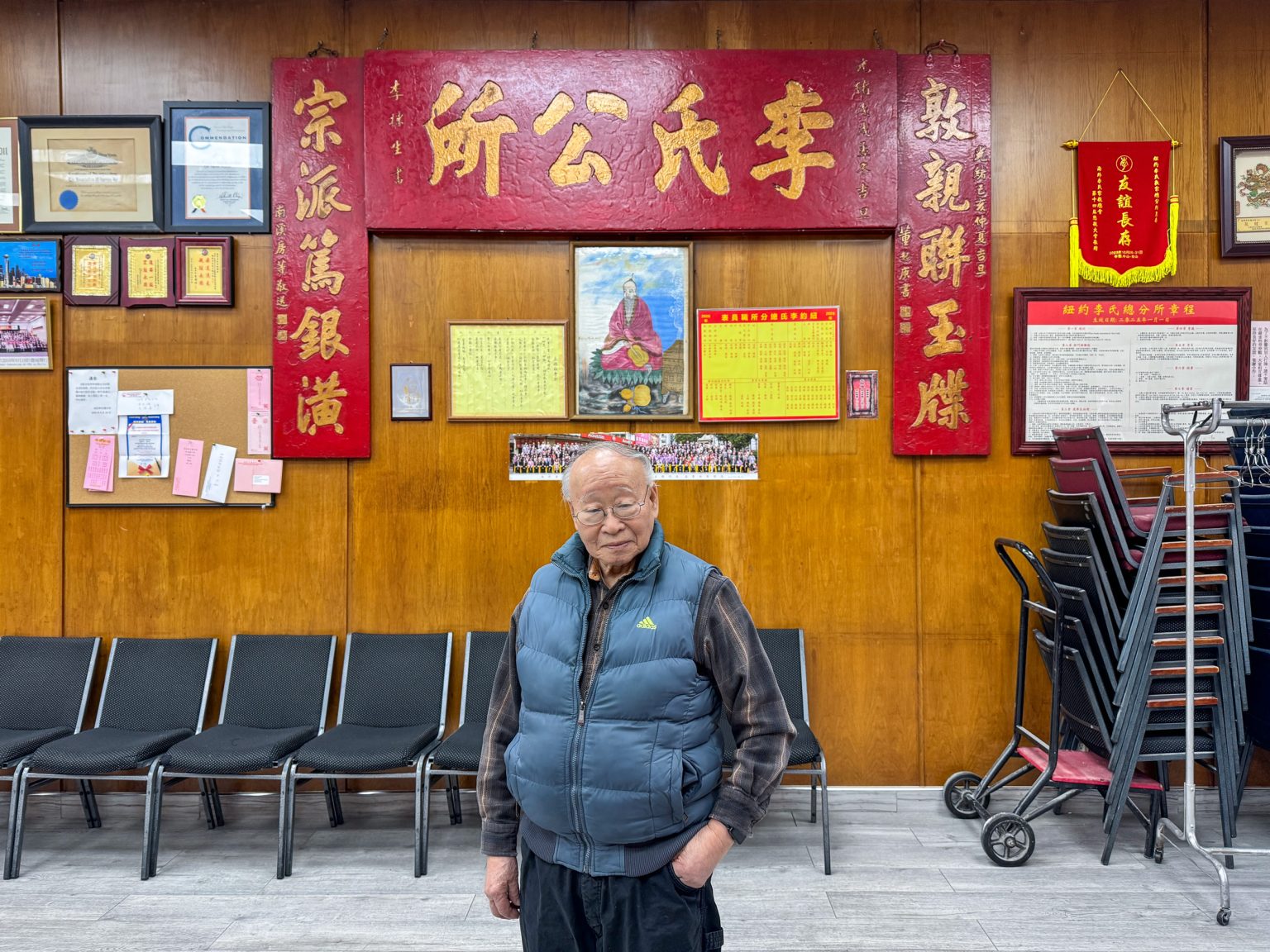
Dick Lee, photographed at The Lee Association at 41 Mott Street during our interview session, February 2026.
+ How did you come to be connected to Chinatown?
In 1968-1969, I went back to Hong Kong because my mom was sick. She passed away and I spent almost a year there. After I took care of my mother’s funeral, I tried to go back to the U.S., but my uncle wouldn’t let me go unless I got married. So during that time after I lost my mother, I finally met a girl and got married in 1969. I got back to the U.S. in 1970. My wife came a year later and we settled down in Chinatown.
I worked in a Chinese restaurant in midtown for a few years. In the 1970s, I left the restaurant business and worked for a real estate company. In 1972, a bunch of friends and I opened a restaurant on 20 Elizabeth Street – Mon Hung, a seafood restaurant. At the same time, I worked as a salesman for a real estate company.
Later in the 1970s, I sold the restaurant and started working for a Chinatown real estate company. The boss had a connection with the owner of the development called Chung Pak, at Walker, Baxter and Center Streets. Before that, it was planned as a commercial and residential development. In 1983, Mayor Koch rented that space for a jailhouse… and all of Chinatown protested! We didn’t want the jail! But the city had the right to take the property to build the jailhouse. I spent a year rounding up the tenants to protest. I was upset. Then I left the real estate business.
Afterwards, I had a little flower shop in Chinatown at 33-35 Pell Street, but it didn’t make any money because the rent was so high. The post office had an opening, so I applied to be a postman in 1986! I worked there until I retired in 2006. Most of the time I was on Canal Street station, serving Chinatown.
I have two sons, who also grew up in Chinatown.
+ What was Chinatown of the past like?
During the 1960s, immigration opened up and more people from Hong Kong came. Before that, it was mostly men. You had more families and women coming in. During those days, Chinatown was really busy, especially at night. All neighborhoods were closed, but Chinatown restaurants were open 24 hours… At least until the 1990s, when gangs came in and changed Chinatown.
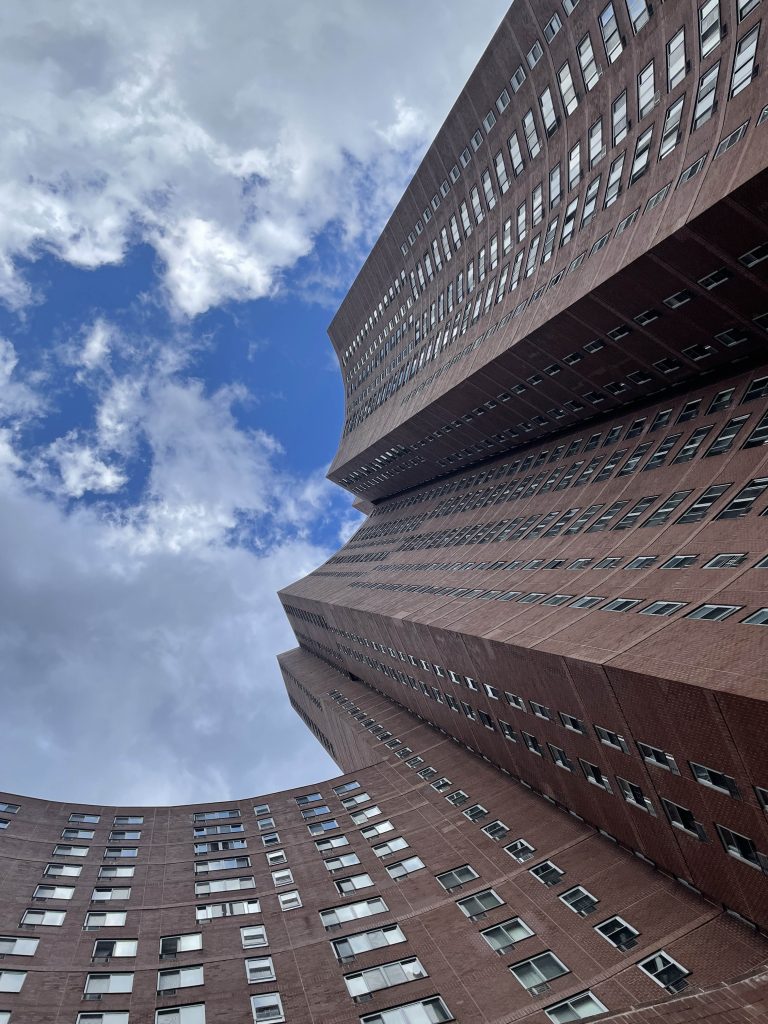
A slice of sky, April 2022.
+ Where have you lived in Chinatown?
When Confucius Plaza opened in 1976, I moved in. I have lived there ever since.
+ How long have you lived here?
In 1976, I moved in with my wife and two kids. Since the kids were growing up, we needed more space. In those days, the rent was really reasonable – like $200 or $300. Year after year, it has kept going up.
+ Who are your neighbors?
In the 1970s, moving in, you didn’t know each other. Only one Italian family lived there, but most were Chinese. Right now, we have quite a few Indians, African Americans and it is more mixed. At the time, I was one of the younger groups… After fifty years, people have gotten older and it’s more and more like senior housing!
+ Describe the interior of the building to me – walk me through it.
When we moved in in 1975-76, New York City almost went bankrupt trying to finish the job. We were supposed to have ventilation access fans, but they didn’t have money for it, so they cut down on materials. The doors were cheaper products than what the design was supposed to be. They didn’t have the money to finish the taller building. They only finished one of the buildings.
The building is part of the Mitchel-Lama program. The ground floor belonged to the City. Part of the funding was supposed to come from the City, but they didn’t have it, so there were delays.
Even a year after we moved in, the courtyard was not done. Supposedly they didn’t have the funds. Good thing that the tenants gave deposits and the interest rate was good – that helped to pay building expenses.
During that time, they had made cuts and used cheaper materials, so the bathrooms and other spaces were supposed to be of different quality. They just barely qualified as decent living conditions. After that, we did a lot of renovations ourselves.
Right now, the building still owes money for repairs and loans.
+ Do you see this building as an important part of the Chinatown community?
Yes, because during the 1970s, they had just opened up immigration and people had no place to go. It was hard to find a place to live in Chinatown. When the building opened, it helped out.
+ What are your fondest memories of this building?
It has always been convenient for me. I work in the Chinatown area, so I never had to take public transportation to get to work. I would walk wherever I needed to go. This is why I gave up my car. In Chinatown, you don’t really need it!
When I look at the building – it’s tall – I say, “this is my home!”
1-9 BOWERY - HISTORIC IMAGES

Photograph of crowd on Bayard taken January 1976. Confucius Plaza can be seen under construction in the background.
Photograph by Emile Bocian. Courtesy of the Museum of Chinese in America (MOCA) Collection.
1-9 BOWERY - BUILDING PHOTOGRAPHS
Photographs taken between 2022 – 2024.