
96 Baxter / 124-125 White / 100 Centre
(Right) Chung Pak Complex
(Center) Site of demolished Manhattan Detention Complex and future site of jail tower
(Left) New York City Criminal Courthouse
2025

96 Baxter / 124-125 White / 100 Centre
(Right) Chung Pak Complex
(Center) Site of demolished Manhattan Detention Complex North Tower and future site of jail tower
(Left) New York City Criminal Courthouse
2024

96 Baxter / 124-125 White / 100 Centre
(Right) Chung Pak complex
Architect: Retail base designed by Anschuetz, Christidis & Lauster, residential tower designed by Edelman Partnership / Built in 1992
(Center right) Manhattan Detention Complex
1992-2023

96 Baxter / 124-125 White / 100 Centre
(Center right) North Tower of the Manhattan Detention Complex
Architect: Harvey Wiley Corbett and Charles B. Meyers / Built in 1983-1989
(Left) New York City Criminal Courthouse
1989

96 Baxter / 124-125 White / 100 Centre
(Left) Three towers of the New York City Criminal Courts Buildings & South Tower of the Manhattan House of Detention
Architect: Harvey Wiley Corbett and Charles B. Meyers / Built in 1941
1940s

96 Baxter / 124-125 White / 100 Centre
(Schematic render of the buildings that stood here, according to the footprints indicated on the 1894 fire insurance maps)
1894
Interview
WITH BEATRICE CHEN (EXECUTIVE DIRECTOR, IMMIGRANT SOCIAL SERVICES)
Interview conducted in June 2026.
+ How did you come to be connected to Chinatown?
I’ve been working in Chinatown since 2003.
My first connection to Manhattan’s Chinatown was through the Museum of Chinese in the Americas, now known as the MOCA, when it was still located at 70 Mulberry Street. I joined the museum as its Education Curator, and across two stints ended up working at MOCA for over ten years.
My background is in urban planning, education, and history. When I saw the job posting and learned about the museum, it felt like the perfect intersection of community development, culture, and neighborhood history—all things that deeply interested me. I had also read Jack Tchen’s article, “Creating a Dialogic Museum: The Chinatown History Museum Experiment” that really resonated with me. To this day, I still believe strongly in the guiding principles established by Jack Tchen and Charlie Lai when they co-founded the Chinatown History Project.
Throughout my time at MOCA, I witnessed tremendous changes, both within the organization and within Chinatown itself. Because I worked in education, I developed and led programs and tours for K-12 and college students, as well as adults about Chinese American history and the history of Chinatown. That’s really the lens through which I understand the neighborhood.
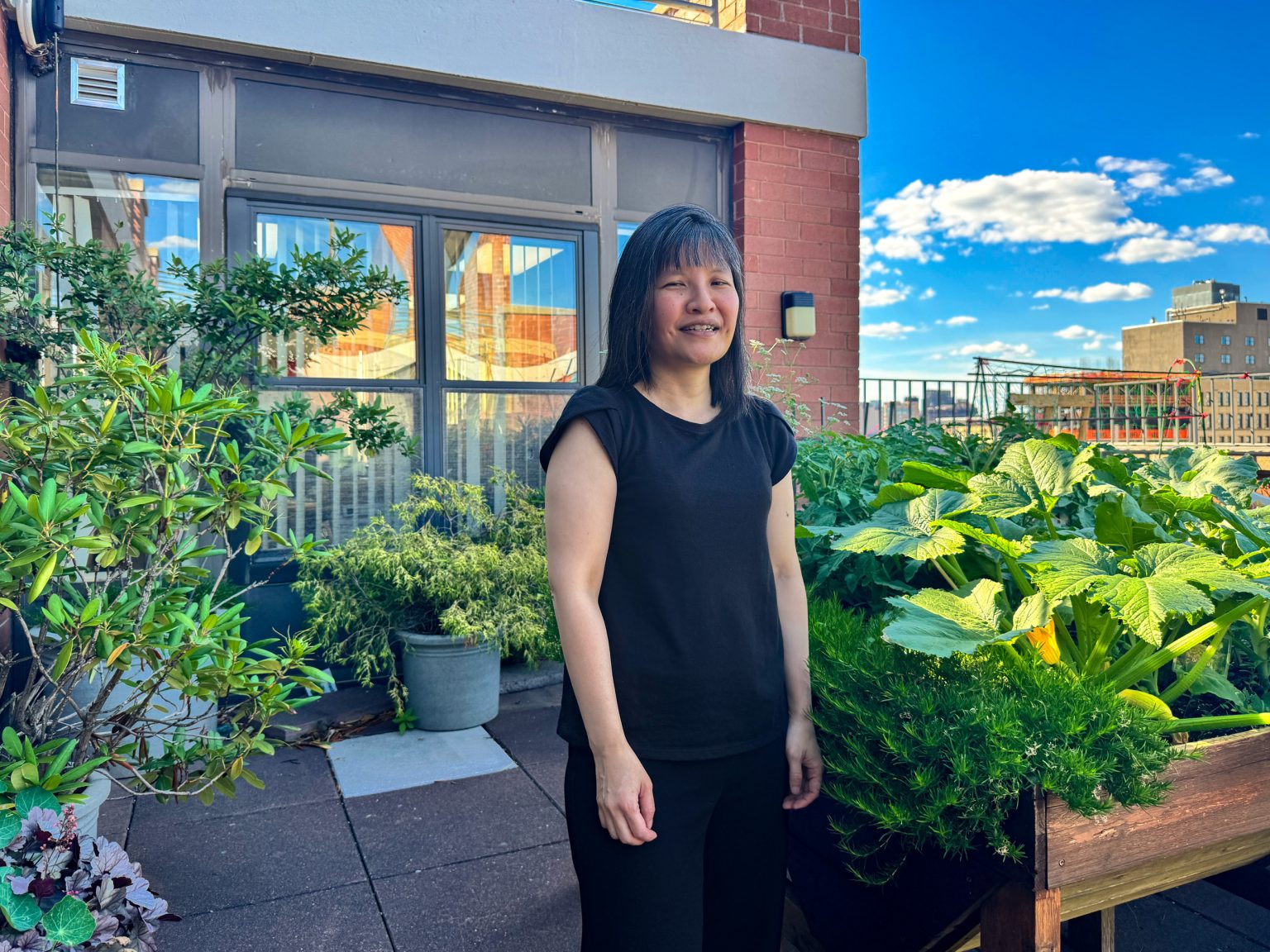
Beatrice at Chung Pak’s rooftop garden. Photograph taken during our interview session, June 2026.
I was born in Taiwan and grew up in Hong Kong. My family spent periods of time in the United States while my father was pursuing his PhD. I’ve always considered myself somewhat transnational. In Taiwan, everyone around me spoke Chinese and I rarely used English. In the United States, it was often the opposite. Chinatown is probably the only place where I regularly use both languages at the same time. I understand Cantonese because I grew up in Hong Kong, but Mandarin is my first language. For a period of time, I was actually an ESL [English as a Second Language] student myself.
For the past seven or eight years, I’ve worked at Immigrant Social Services (ISS), a community-based organization founded in 1972. ISS is based on the Lower East Side near Henry Street and serves both the Lower East Side and the Chinese communities connected to Chinatown. Through my work at ISS, we became connected with Chung Pak Senior Housing at 96 Baxter Street, where we began providing programs and services for senior residents.
+ How old were you when you moved to the United States?
The first time I came to the United States, I was about two years old, so I barely remember it. The next time I came, I was in second grade and lived in Connecticut for a semester. My mother tried to teach me some basic English before we left Taiwan, but I wasn’t interested. I still vividly remember arriving in second grade and not even being able to spell my own name in English. Since I couldn’t communicate with my teachers or classmates, I spent much of my time drawing. My teacher was very kind and would let me sit and draw, and once a day I had one-on-one ESL instruction.
That’s actually why I have an American accent – I learned English here.
I returned again in eighth grade for another semester and then later came back for college. I’ve lived in the United States ever since.
+ What were your first impressions of New York Chinatown?
I had visited before and had friends show me around Chinatown, but I didn’t really understand its geography. I remember being on Mott Street and Doyers Street without fully appreciating where I was. It wasn’t until I moved here and began researching Chinatown for my work that I realized the historical significance of these places.
Coming from Asia, Chinatown can feel frozen in time. Asian cities have modernized incredibly quickly over the past few decades. When I was younger, many parts of Asia still felt relatively undeveloped. Today they’re highly modernized, and so visitors from Asia can often see Manhattan’s Chinatown as something from an earlier era. Many people from Asia imagine America as modern and futuristic… but Lower Manhattan is also a historic place, and in the United States there is often a greater emphasis on preserving historic buildings and cultural heritage. Chinatown reflects that combination of history, preservation, and community memory.
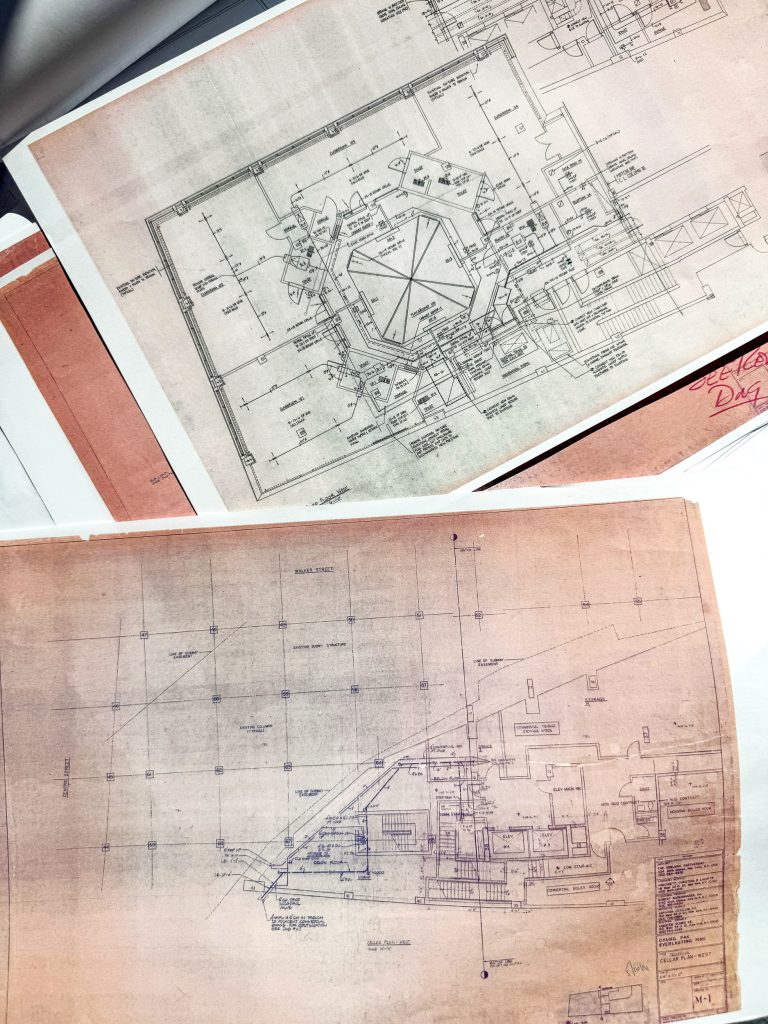
Structural drawings of 96 Baxter, June 2026.
+ How long have you been working at Immigrant Social Services and what is the relationship to the Chung Pak Center?
ISS was founded in response to the growing number of Chinese immigrant families settling on the Lower East Side, particularly around Henry Street. One of our co-founders had been a pastor at St. Teresa’s Church and noticed that many newly arrived immigrant families were working long hours in the garment industry and restaurant industry. What they desperately needed was childcare.
As a result, after-school programs became our core service. For decades, we’ve operated programs directly within public schools so that children could remain at school after classes ended while their parents were still at work. That model has remained central to our mission. Today, most of the families we serve are monolingual Chinese-speaking immigrants. Our work focuses on helping children and families navigate schools, government systems, and daily life in New York.
Our connection to Chung Pak came through Charlie Lai. After co-founding MOCA, Charlie later became Executive Director of ISS. Around 2018, Chung Pak was involved in discussions related to the proposed jail redevelopment project, and there was interest in bringing more programming to residents.
The Chair of the Board at Chung Pak also serves as Chair of the Board at ISS, which created a natural partnership. Through that relationship, we began providing activities and services for seniors living at Chung Pak.
Before then, there were very few resident programs. We started offering exercise classes, chair yoga, dance, strength training, arts programs, tea appreciation workshops, translation assistance, benefits enrollment support, voter education, and civic engagement programming.
During the pandemic, many residents became extremely isolated and rarely left their apartments. Because everyone lived in the same building, we were able to check in regularly, provide support, and help build a stronger sense of community.
One of the biggest changes was making the 13th-floor community space more accessible and welcoming to residents. Before that, many seniors rarely used it. Now it’s an active gathering space where people can participate in programs and spend time together.
+ Can you describe the layout of the building?
Chung Pak contains 88 units of senior housing across thirteen floors.
The building is mixed-use. The ground floor contains commercial tenants, including a bakery and a small Japanese market. The second and third floors are community spaces occupied by organizations such as the Charles B. Wang Community Health Center and Chinatown Planning Council’s (CPC) daycare program.
The residential portion begins above those floors. Most units are studios, though there are some one-bedroom apartments for couples. Altogether, there are approximately 125 residents.
The building has a lobby, residential hallways, two elevator banks, a laundry room, offices, and a multipurpose community room on the thirteenth floor. There’s also rooftop access from that level.
Although it serves seniors, it looks much like a typical New York apartment building when you walk inside.
+ Who are the current residents?
Most residents are monolingual Chinese speakers, primarily Cantonese- and Toisanese-speaking seniors. Residents must generally be at least sixty-five years old, but in practice many are over seventy-five.
Last year we had six or seven residents who were over one hundred years old. Many have lived in the building for decades. There are both single residents and couples, although there are more women than men. We are also beginning to hear more Mandarin spoken, which reflects broader demographic changes within Chinatown.
Because it is subsidized housing, rents remain very affordable. Along with Hong Ning Housing, it is one of the few low-income senior housing options in Chinatown. People rarely move out. Apartments usually become available only when a resident passes away. There’s currently a waiting list of roughly five thousand people!
+ Can you tell me about the history of the building or any stories about its construction?
The building was created as part of the community concessions associated with the first expansion of the Manhattan Detention Complex during the 1980s. Construction was completed around 1989. Originally, the building shared a wall directly with the jail. Today that’s harder to visualize because the detention complex has since been demolished, but the two structures were physically adjacent.
From the street, many people don’t realize that this building contains senior housing. They notice the storefronts at ground level, but don’t necessarily know what exists above them.
Federal HUD funding helped make the project possible, and CPC played a major role because it was one of the few nonprofit organizations capable of administering that type of housing funding. That’s why CPC became involved. There’s a whole organizational history that’s really interesting and quite complex to unpack. There was a lot of internal history—and, honestly, a fair amount of drama—but CPC was able to take on the project because it had the capacity to administer the large federal HUD funding.
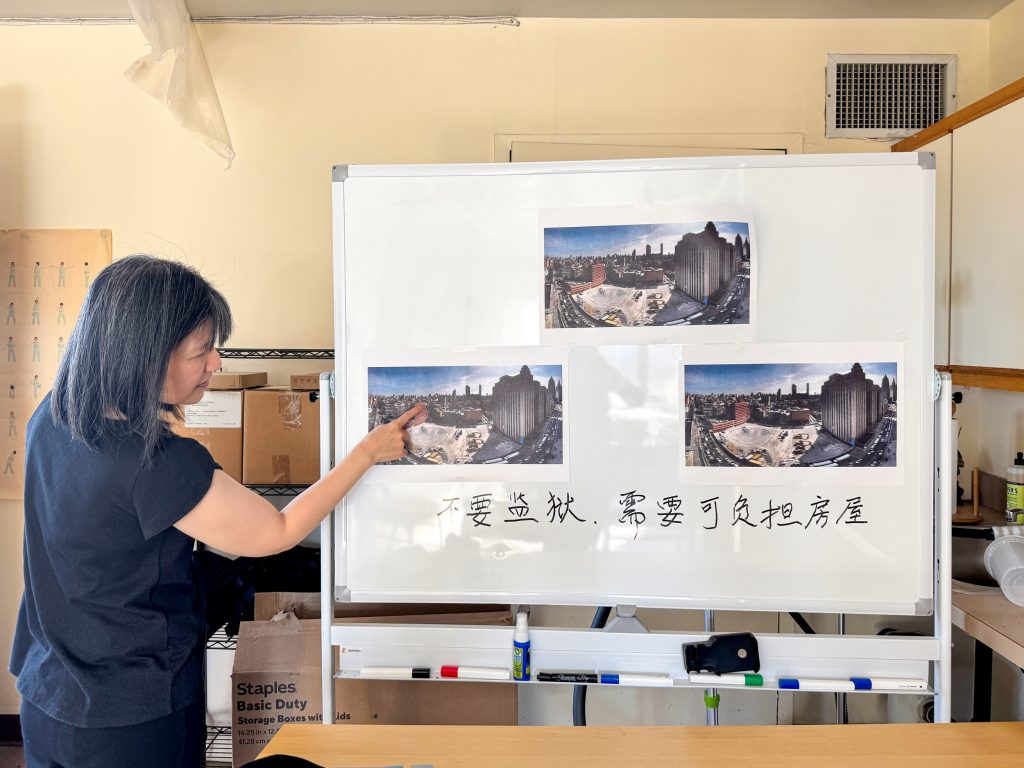
Beatrice with photographs of the adjacent construction site, June 2026.
I don’t know all the details of the construction process itself, but a local development corporation was established to manage both the senior housing and the commercial spaces. Since it was a major development project, there were a lot of different organizations, funding sources, board members, and stakeholders involved.
A lot of that history is really about how the organization was managed and how those decisions affected residents’ daily lives. I was reading one of the other interviews in your project, and it talked about maintenance problems that often weren’t addressed. From what I’ve heard, that reflected the culture of the organization at the time.
+ Who / how was this culture created? Is this an issue of the past, or is this still ongoing?
It really came down to how the building was managed at the time. I’ve heard from residents that they hesitated to report problems or request repairs.That’s long gone. It’s changed dramatically. But imagine living somewhere with a leak and being afraid to report it because the superintendent might yell at you. Many immigrants simply tolerated those conditions because they felt they had no other choice. Ironically, that didn’t help the building either, because maintenance issues just went unaddressed. Some of the problems the building faces today probably stem from years of deferred maintenance.
Things really changed with new leadership as they helped create a much stronger sense of community and decisions are made with the residents in mind.
+ Has the building undergone any major renovations or changes?
Yes. The current renovations are directly tied to the new jail project.
Because Chung Pak shares a wall with the former Manhattan Detention Complex, there were extensive negotiations about how the jail redevelopment would affect the building. Chung Pak also sits on city-leased land, so we have to be mindful that we don’t actually own the property.
When plans for the borough-based jail first moved forward, the biggest concerns were noise, air quality, and the direct impacts of demolition and construction. Residents advocated for things like double-glazed windows, HVAC upgrades, and other improvements to mitigate those impacts.
Those negotiations took years. Only now, in 2026, are those improvements finally being installed. The double-glazed windows are going in, and the HVAC system is being upgraded. Much of the construction you’re seeing inside the building now is connected to those long-delayed commitments.
Vacant apartments are also being renovated, and I think much of that work is tied to the jail project as well.
+ When did demolition of the Manhattan Detention Complex begin?
I remember most of it happening in 2024 and 2025. What struck me was how quickly the demolition happened.
+ This site is currently a hotbed of community discord and controversy – it’s undergoing construction as plans for the tallest correctional facility in the world take shape.
What was the demolition like for the residents? What is the current site context?
Demolition was incredibly loud. There was constant jackhammering throughout the day.
Later we learned there were mitigation measures that probably should have been in place but weren’t. Beyond the noise, there were concerns about air quality and constant vibrations.
The vibrations were especially frightening for seniors. There was no warning—it would just suddenly begin. Residents often described it as feeling like an earthquake.
One particularly alarming incident happened last year when contractors cracked one of Chung Pak’s walls. Because the building shared a wall with the jail, work was supposed to stay a certain distance away, but somehow they damaged one of the fire stairwell walls. Standing inside, you could actually see daylight through the crack. Fortunately, it was repaired, but it highlighted how much worse the situation could have been.
Even after demolition ended, debris remained on the site for quite some time. More recently they’ve begun preparing the foundation, including work related to groundwater beneath the site. That has meant another round of noise and disruption.
The Charles B. Wang Community Health Center had dental offices in this building, and the vibration became so severe that they eventually relocated those services because it wasn’t safe to perform dental procedures during the demolition. Other professional offices also had to move because the conditions became unbearable.
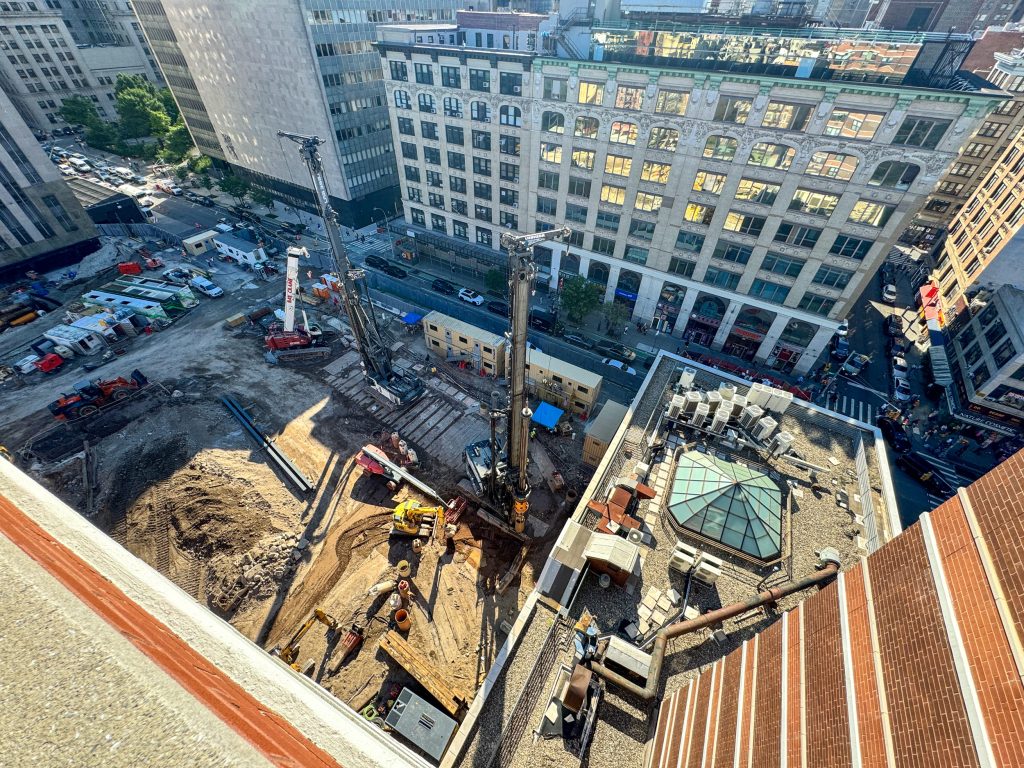
Bird’s eye view of the jail tower construction site, as seen from Chung Pak, June 2026.
Now construction is ramping up again. Residents receive weekly construction notices, and one recent notice proposed work from 6:00AM until midnight. That’s a dramatic extension beyond what had originally been described in the environmental review. From our perspective, changing the construction schedule significantly should require additional environmental review.
The newest concern involves construction traffic. Large trucks are now expected to enter through Baxter Street, creating additional safety and quality-of-life issues for residents. Many will likely idle directly outside the building.
The seniors experience these impacts every single day. They can’t simply leave the construction site—they live next to it.
Sometimes people argue that the measured decibel levels are technically within legal limits. But listening to construction noise for six or eight continuous hours is very different from briefly walking past a construction site.
+ What are the concerns of the seniors who reside here?
For decades it was simply the Manhattan Detention Complex. Interestingly, many people in Chinatown didn’t even realize there was a jail there. What surprises people even more is learning that low-income senior housing sits immediately beside it.
For many residents, the larger question is why Chinatown continues to absorb projects that other neighborhoods don’t want. The argument has always been that the jail needs to remain here because the courts are nearby.
Now the old jail has been demolished, leaving an enormous construction site. We’ve all seen the renderings for the new facility—forty stories tall. My first thought whenever I see those renderings is that much of historic Chinatown, especially Columbus Park, will be cast into shadow.
You also start wondering about practical issues: What happens in an emergency? Have all of those impacts really been considered?
The seniors aren’t necessarily opposed to having a jail. Many aren’t approaching this from an abolitionist perspective. Their concern is much more immediate: there’s an enormous construction project next door, and they don’t feel the city is adequately protecting the people who live here.
The city has promised mitigation measures, but residents often feel those promises haven’t been fully carried out.
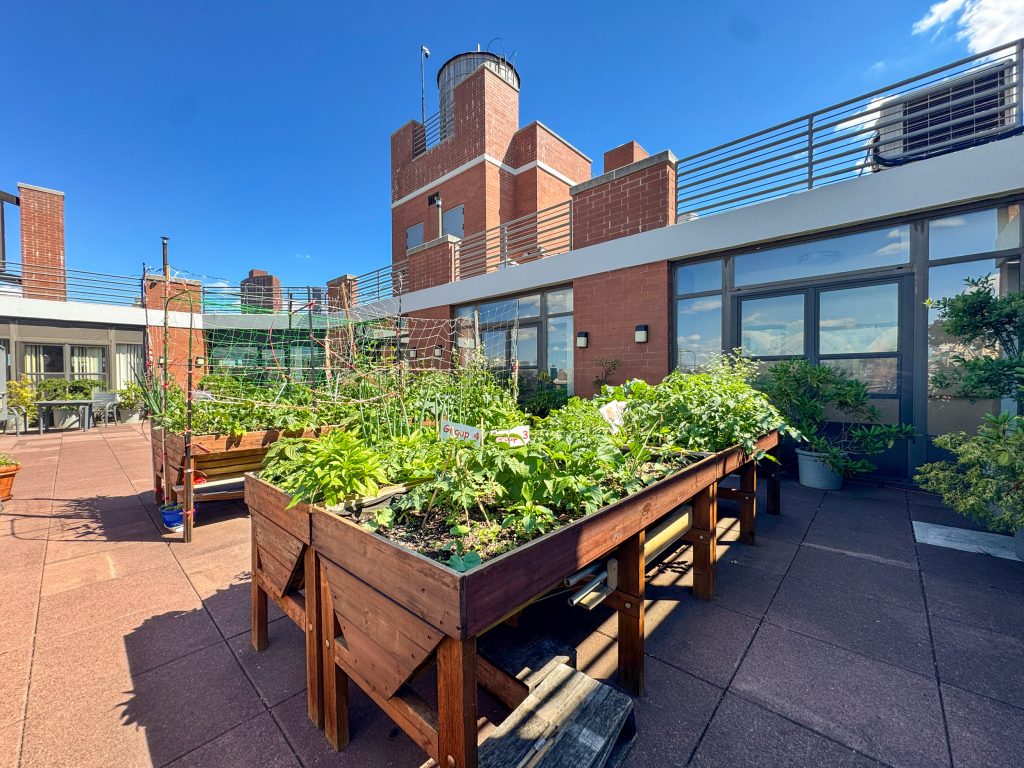
Senior residents’ community garden plots on the building’s rooftop, June 2026.
+ What are some of your favorite memories of 96 Baxter?
Because most of my experiences here are fairly recent, my strongest memories are really about getting to know the residents. One of the most rewarding parts of this work is simply being recognized. Over time, residents begin to know you, stop to talk, and check in with you.
There’s one resident who’s incredibly active and participates in nearly every program we offer. We’ve been doing a lot of civic engagement and voter education, and just yesterday I saw her out helping with a campaign. That was incredibly meaningful because it showed me that our work is having a real impact.
Historically, many Chinese-speaking immigrants haven’t felt empowered to participate in American politics, often because of language barriers. Seeing residents become more engaged has been very encouraging.
Another thing I’ve noticed is that many residents who have lived on the same floor for years barely knew one another until we started organizing activities. Now they’re talking, socializing, and building relationships.
+ How do you see Chung Pak as being important to the Chinatown community?
First and foremost, it’s an important source of affordable housing for seniors who often have very few alternatives.
Symbolically, though, it’s impossible to separate the building from the jail next door. It has become a very visible reminder of the history of jail expansion in Chinatown and of the broader ways the neighborhood has been asked to accommodate city infrastructure.
When I look at the site plans, I sometimes think about how tiny this building is compared to the surrounding jail complex. It almost feels as though they carved out a small piece of that larger development and repurposed it as senior housing.
+ Do you see it as a symbol of resilience, or more as a reminder of what Chinatown has had to accept?
I think it’s both.
The fact that the community secured these 88 affordable senior apartments through negotiations represents an important victory, but it’s also a reminder that the concession was relatively small. It raises the question of what communities should continue asking for in the future.
It’s both a symbol of resilience and a reminder that there’s always more work to do.
Interview
With REGINA CHAN (FOUNDER OF 'UNITE TO SAVE CHINATOWN')
Interview conducted in April 2022.
+ Give me a brief introduction of yourself.
I’m the founder of ‘Unite to Save Chinatown’, which I started in February 2022.
When my grandmother passed, I was down in Chinatown for a week. I went to MOCA (my grand-uncle’s story about paper sons is part of the permanent exhibition there) and found out about the jail protests.
Part of my fight to save Chinatown is that I was too late to say goodbye to my grandmother. I’m fighting for my memories. It’s also for the future, for the kids I’ll have one day. All of these emotions are a lot — so I’ve been working to make an impact before it’s too late. I’m afraid with the shelters and the jails, these Chinese property owners might not be able to hold out anymore.

Regina Chan in the lobby of the Chung Pak building, April 2022.
+ How did you come to be connected to Chinatown?
I grew up in Brooklyn in Bay Ridge, but I came to Chinatown all the time because my grandmother lived here. I went to summer day camp at the Overseas Chinese Mission (on Elizabeth and Hester) and my grandmother would pick me up. My parents did grocery shopping here. They helped me to learn how to pick out good produce on Mott Street. There was Po Wing Hong and Gum Moon on Canal Street… and the Hong Kong Supermarket [on Hester Street] used to be the Dynasty Supermarket.
(Left) Regina at her Chinese School graduation, Chinese Consolidated Benevolent Association.
(Right) Regina with her mother and grandmother. Photographs courtesy of Regina Chan.
+ What buildings are you connected with in Chinatown?
How long did your grandmother live in this building?
I’m connected to Chung Pak at 96 Baxter Street, which is also where the Chinatown Health Clinic is. Chung Pak is one of the few government subsidized low-income housing buildings. My grandmother moved in around 1995/1996 and she passed away earlier this year. My grandmother came to the U.S. in the early 1980s from Guangzhou (she was originally from Toishan) to live with her sister after my grandfather died, maybe when he was around 50 or 60.
In the 1980s, the Chinatown community protested against the jail. They negotiated, so as part of the deal, they had to build this low-income housing. There’s physical areas where the two buildings [the jail and the Chung Pak building] are actually connected.
My grandmother lived on the fifth floor on the southern side, which is close to where the vents are. There’s a gravel area just a short distance below and the jail cells were really close to my grandmother’s window. I used to be afraid — as a three, four and five-year old, it felt frightening.
+ Describe the building.
The building itself feels like it hasn’t had any investment or any renovation for 25 years.
I’ve been going there for over 20 years.
I remember when I first went there, I loved taking baths, because everything was new, for the most part. In Bay Ridge where I grew up, I couldn’t take a bath there because of the roaches.

Regina outside the door of what used to be her grandmother’s apartment, April 2022.
Over time, because there was no investment, my grandma’s place became roach-infested and you couldn’t take a bath anymore. You could see the toilets and sink start to break down. Sometimes the lights weren’t properly fixed so it became really dim. The elevators were slow. It seemed to fall apart. It didn’t look nice anymore.
It became dark and depressing and it was sad to see her live in this state… I remember where the A/C was, she taped it up so there was no draft there. I was the one who made an effort every week to see her.
There was a certain, distinct smell when walking in the building — it’s hard to describe. It used to be a clean, sort of a hospital, sterile smell, but then it shifted in later years and it smelled depressing.
The walls and doors are orangey-red on the fifth floor. I think the different floors had different colors; like another floor was blue. It was never repainted, so it started to chip away.
As she got older, she fell and couldn’t get up and the fire department had to knock down the door. Her door was replaced several times. You could see the evidence of the force on the door.
My uncle was taking care of her at the time during the pandemic; so I didn’t visit her then. My uncle wouldn’t let anyone see her.
+ What was your grandmother’s apartment like?
It was a studio apartment. The bathroom was on the right of the entry. Then there was the stove and the sink in the kitchen. There was a long corridor to get into the main room with closets on the left.
Throughout the different phases, she always had a big foldable table, the color of jade. She had chairs on the side of it and a TV next to it. The bed was up against the back wall and there was a desk in the opposite corner with a dresser (where she kept her phone) and a couch along that wall.
She did play mahjong with friends in the building.
Regina Chan at Columbus Park, (top row) May 24, 1992, (bottom row), January 13, 1992 (bottom row, right-most photo), date unknown. Photographs courtesy of Regina Chan.
+ When was this building constructed? Who is the architect for this building? Can you tell me a little bit about the history behind its design and/or construction?
When I last spoke to the maintenance staff, there are about 80-something units, with about 120 senior citizens who live there.
According to my online research:
Construction ended in 1991.The residential tower was designed by Edelman Partnership and the retail base was designed by Anschuetz, Christidis & Lauster. Link for more info here.
The housing project was completed in 1992 with 88 units serving roughly 105 residents. The majority of the seniors are aged between 85-100. Link for more info here.
I don’t really have this information but I do know that this was one of the main community concessions as a result of the city wanting to build a jail in Chinatown. According to the Chung Pak website here:
In the 1980’s, former Mayor Ed Koch planned to build a detention center in Chinatown due to its proximity to the court area and NYPD headquarters. However, the proposal triggered a series of community protests and rallies with the apprehension of deteriorating security and quality of life. Although the effort to revoke the plan was unsuccessful, through community advocacy and a united front, Chinatown was able to negotiate with the City for a parcel of the land next to the detention center to build the Chung Pak complex.
Today, the Chung Pak complex consists of two non-profit organizations that provide 88 senior citizen affordable housing units, 15,000 square feet community facility spaces as well as many retail establishments serving the working families in the Manhattan Downtown area.
+ Can you share any information about the building’s past lives?
I remember, at the beginning, even if it was shiny and new, you still faced the jail, which was a downer. I slept over and at night, the lights of the jail were really bright and on all the time It made me wonder what was going on inside the cells.
+ What are your most impressionable memories of this building?
I was sick a lot as a kid. There were two times when I remember being sick at my grandma’s place. One time, when I was 4 years old, was less fun when I had a stomach bug and was told by my doctor to fast. My mother told me to take a shower first. I lost strength in the shower when standing up and I fainted. My mom took me to Gouverneur Hospital…
Another time, maybe when I was 3 or 4, my aunt was taking care of me and she had trouble booking an appointment for me. I remembered I half woke-up when she was leaving to go make an appointment. I fell asleep again and when I woke up, I didn’t recall that she had left. I woke up by myself in a panic. I took a blanket and a stuffed animal – a plush Dalmation dog from San Gennaro’s – and walked over to a sweatshop where my grandmother worked. Two adults stopped me and escorted me to my grandmother’s work. I remember going up the elevator, with metal grates, and going to her sewing machine station. She was really surprised to see me. She took me back to the apartment.
+ How have you seen Chinatown change over the past decades?
For one thing, the sweatshops seem mostly gone.
I remember Chinatown being a ghost town after 9/11… I still went because that’s where my church was, but it was sad.
I remember a blackout in August, in the summer of 2003 or 2004. I was teaching at the summer day camp at the Overseas Chinese Mission and the lights just went out. I remember going up to my grandmother’s place as a place of refuge during the blackout. The pumps to get water up were electric, so we ran out of water. I spent the night there.

Regina Chan’s diagrammatic floor plan of her grandmother’s apartment, sketched from memory, 2022.
96 BAXTER - CHUNG PAK BUILDING PHOTOGRAPHS
Photographs of the interior of the Chung Pak Building were taken in April 2022.
Photographs of the building site with the adjacent jail under demolition were captured between 2022-2024.
100 CENTRE STREET / 124-125 WHITE STREET - JAIL SITE + CRIMINAL COURT BUILDING PHOTOGRAPHS
Photographs taken between 2022-2024.