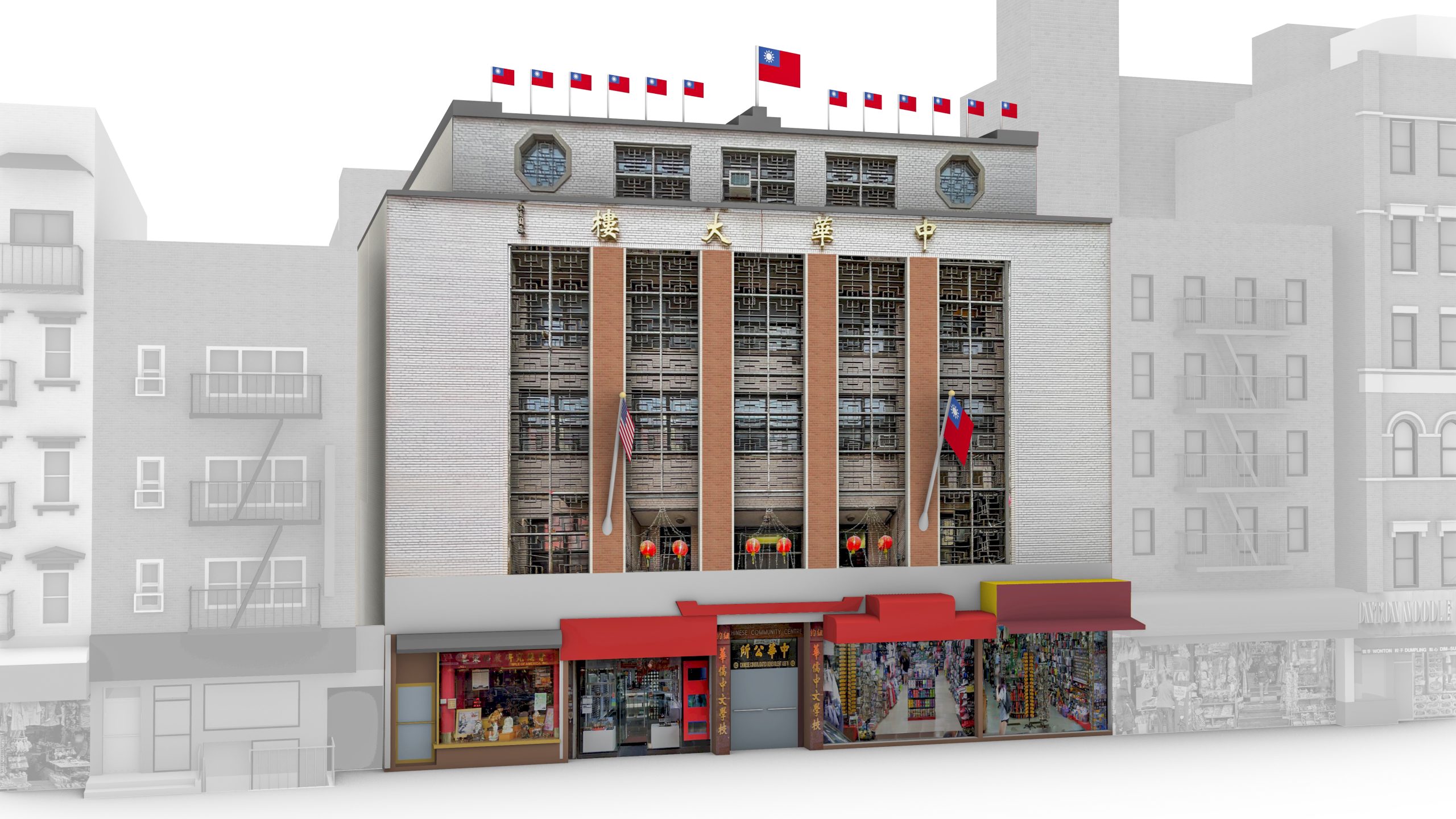
60-62-64 Mott
Chinese Consolidated Benevolent Association
Architect: Poy Gum Lee and Ben Ronis / Andrew S. Yuen & Associates
Built in 1959
2024
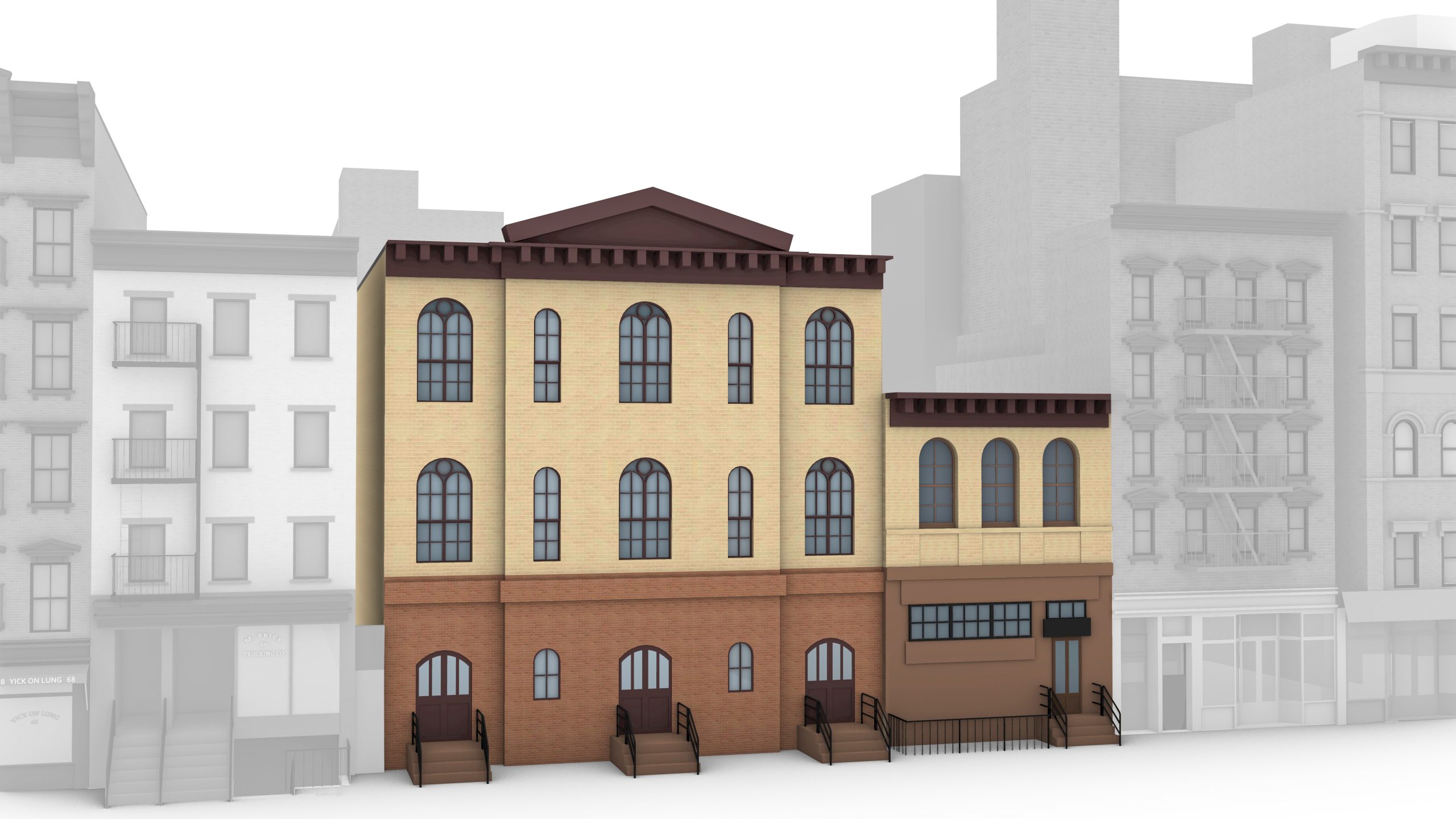
60-62-64 Mott
Former P.S. 108
1940s
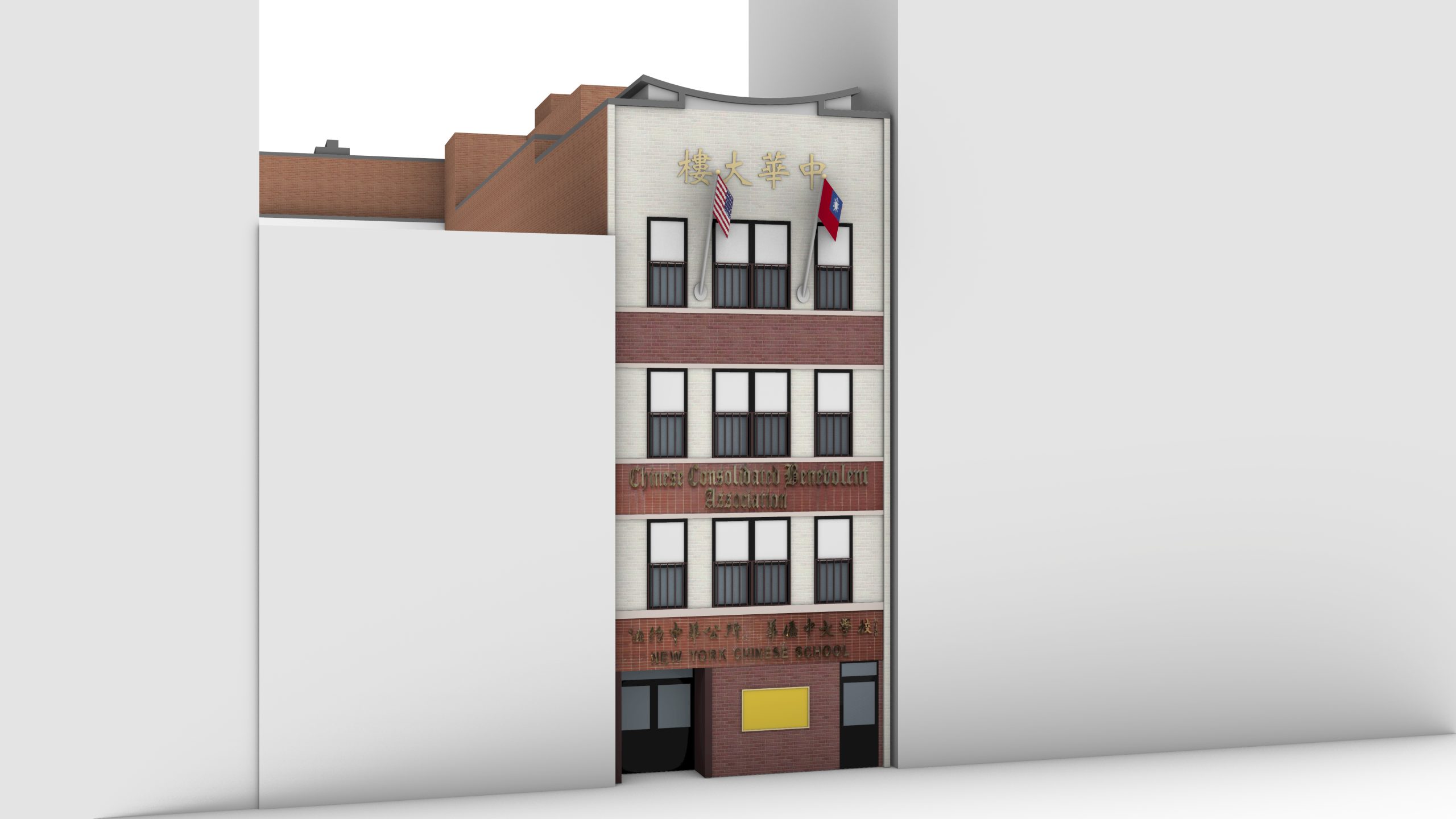
11 Elizabeth
Chinese Consolidated Benevolent Association - New York Chinese School
Architect: Poy Gum Lee and Ben Ronis / Andrew S. Yuen & Associates Built in 1959
2024
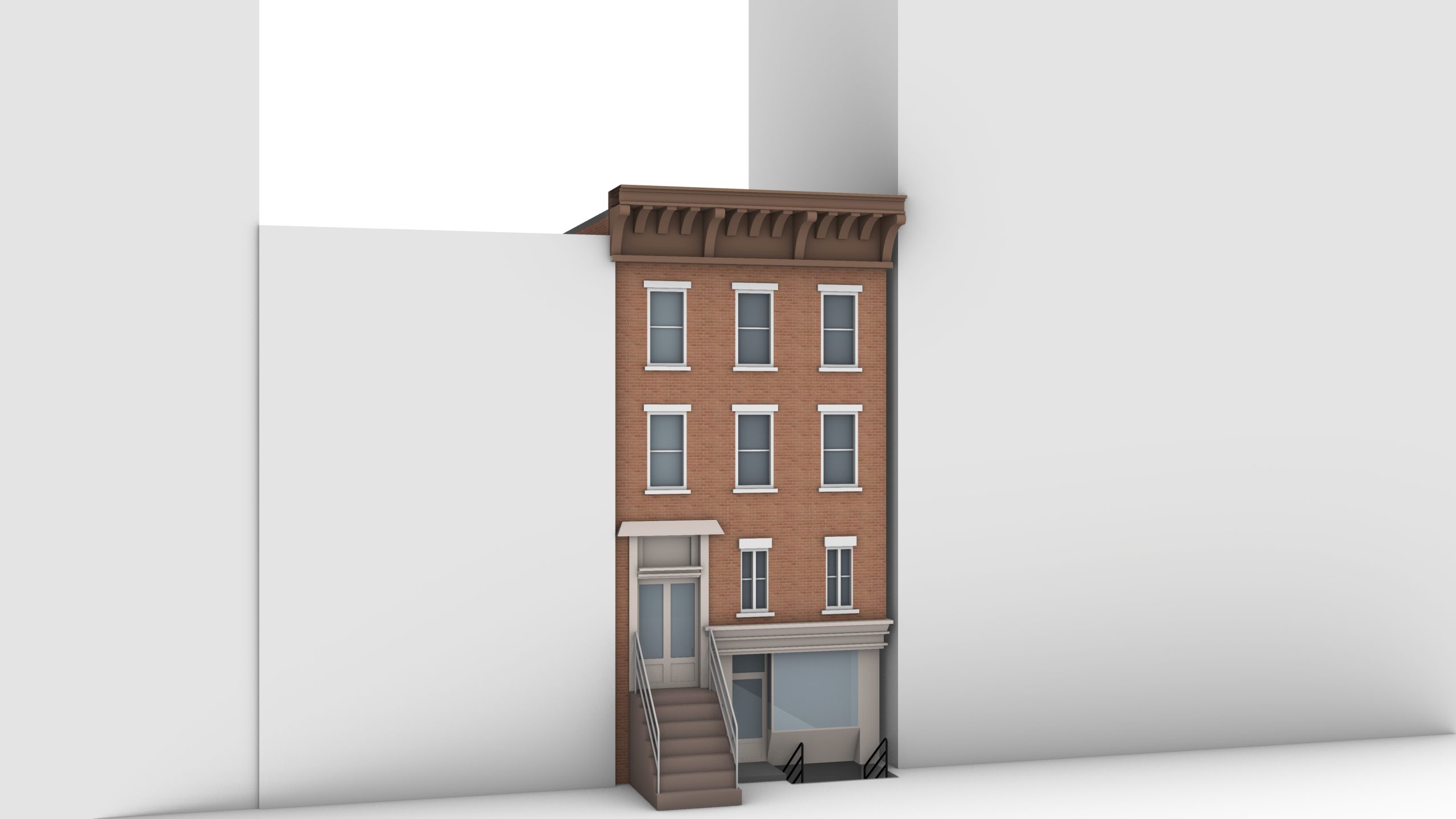
11 Elizabeth
1940s
Interview
WITH ERIC NG (FORMER PRESIDENT OF THE CHINESE CONSOLIDATED BENEVOLENT ASSOCIATION)
Interview conducted in June and July 2022.
+ Tell me about your past tenures as president. When were you president of the Chinese Consolidated Benevolent Association (CCBA)?
In 1994-1995, I became the president of the Eng Family Association.
In 1996 to 1997, I was the president of Hip Sing Association.
From 1998 – 1999, I became the president of the Chinese Freemasons Association.
From 2000 to 2004, I became the president of the Hoy Sun Ning Yung Association.
I became the president of the Tak Ming Alumni Association from 2002 to 2011. I held the title for too long.
From 2004-2007, I became the (international) president of the Eng Family Association.
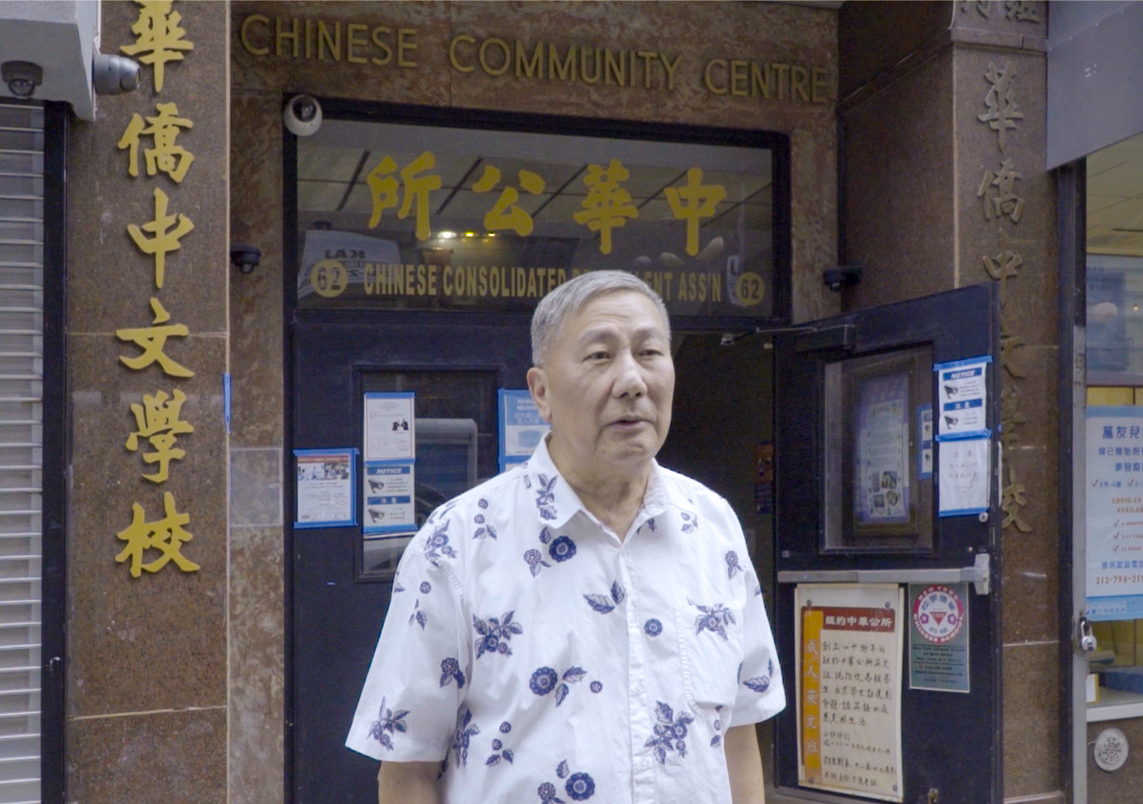
Eric Ng outside the CCBA building during our second interview session, July 2022.
From 2006-2008, I became the first president of the CCBA. By that time, I had become the president of many associations already. Then, from 2014 – 2016, I held the second term of being president of the CCBA.
From 2012-2013, I was the national president of the Eng Family Association.
From 2016 to 2020, I became the national president of the Hip Sing Association.
From 2018 to 2020, I held a third term as the CCBA president.
So, I’m the guy who’s been involved in community business since I stepped in in 1994. I never stopped. I like to use whatever formula we use. I don’t want to change it because when a new president comes in and uses a new rule, this mixes up all the associations. I hate it. That’s why I talk to everybody: Follow the rules. When you follow the rules, no one complains about you. That’s why we call this the traditional association.
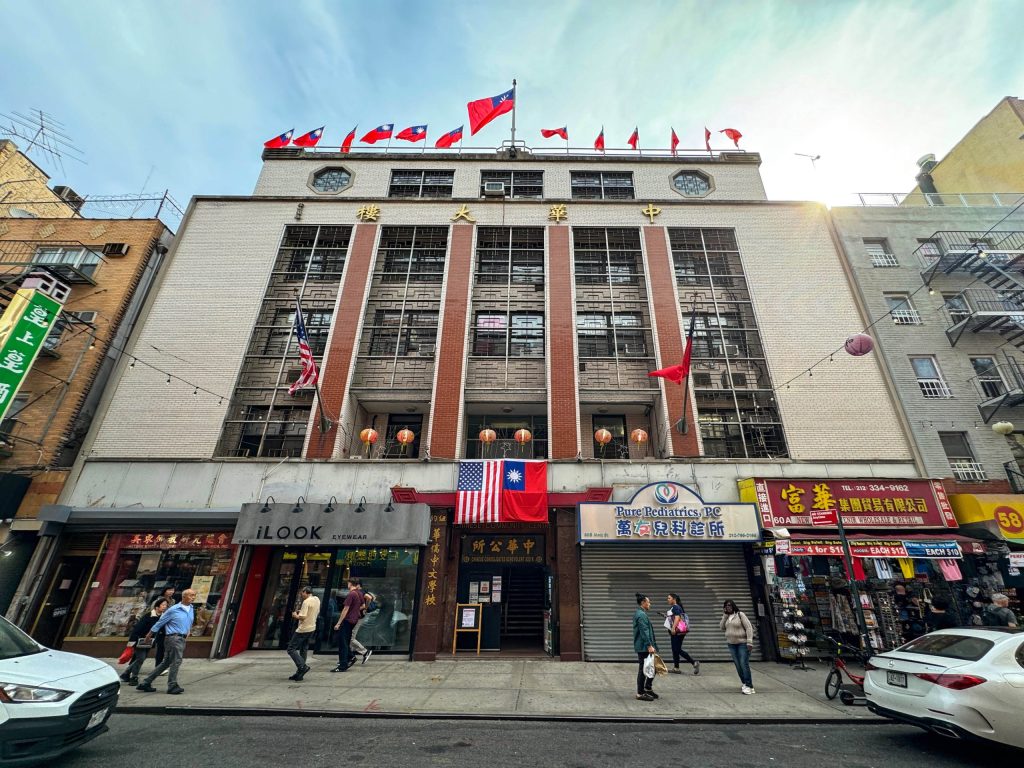
The CCBA building at 62 Mott Street, October 2024.
+ What do you think are the most important things that you accomplished during your three terms as president of the CCBA?
During my first term:
I improved the accounting system. Usually, when the president asks about the expenses, they say – let me ask the accountant and I’ll let you know next week. Next week?!? When I started the board meetings, I said: Are there any questions? Let me report my accounting to you first. After the meeting, I asked again and there were no questions.
I also started this program collecting photos of past presidents for archival purposes.
During my second term:
At the time, the Second World War had ended 70 years ago already, so I made up a memorial [publication]. In one week, I collected the photos.
In 2005, I started a volunteer program to help people with applications for citizenship, applications for senior housing, affordable housing, rent-control, passport applications, reading English letters, social security, applying for free cell phones, applying for food stamps, etc.. Ms. Wong worked in social security before, so she would come every Wednesday to help answer questions.
Every month, we have a police conference here, starting from 2005.
During my third and last term:
I made a process for handling ancestry research when people pass away. We match up stories.
In 1994, Evergreen Cemetery wrote a letter to the CCBA, saying we still have around 150 bodies in the warehouse. By that time, they were bones already. They were supposed to be returned to China.
We put [the word] out in the newspaper and some were taken, but the remaining 100 we buried here. Every Ching Ming, we go there.
Most importantly – in 2019 – the major successful thing was putting up the statue of Dr. Sun Yat Sen in Columbus Park!! Before I stepped down, I finished the project.
Super important! This is the most important. In 2012, we set up the statue already and it was originally supposed to be put on Canal Street (this was done by another Eng president, not me). But later, the Parks Department didn’t want it to be in the triangle on Canal Street. They said that they could temporarily allow us to put it in Columbus Park.
In 2014, during my second term as president, the City wrote a letter to the CCBA. Gary and I went to Community Board 3 to fight for it – and CB3 approved for the statue to be safely placed in Columbus Park, but only temporarily. Since then, we kept fighting…
By 2018, we were against the prison going up in Chinatown. All of Chinatown has been against that since 2018. The mayor [Di Blasio] asked Margaret Chin, I want to come to Chinatown. Is anyone against me? She said: No problem – because on Chinese New Year Day we only say good words, no bad words! He came and announced on March 5, 2019 that the statue could be kept in the park.
Later on, step by step, we had to do all of the foundations. Finally, we donated $100,000 to the memorial fund to keep up the maintenance [of the sculpture].
+ Can you share any information about the building’s history, or its past lives? Where was the CCBA located before constructing this building? When was this building constructed and what was the previous building like?
Originally, the CCBA owned the building at 16 Mott Street. This was the office of the CCBA before they moved to 62 Mott.
This CCBA Building at 60-62-64 Mott used to be P.S. 23 (Public School 23). Then the school moved to 70 Mulberry Street and after 1976, they moved to Confucius Plaza. After the public school left for Mulberry Street, this building then became a Chinese school. Then they put the building up on auction and we bought it. Around 1930, the building was sold for $91,500 to the CCBA / Chinese Community Center. Later on we combined the Chinese School with the CCBA to become the Chinese Community Center.
Around 1952, they were fundraising for the new Chinese Community Center building. Then, it was the youngest president at 30 years old. His last name was Leung and he started this program fundraising for the new Chinese School / Community Center building.
I think they moved in around 1962.
Between the 1950s and early 1960s, they demolished the building, designed and rebuilt the new building.
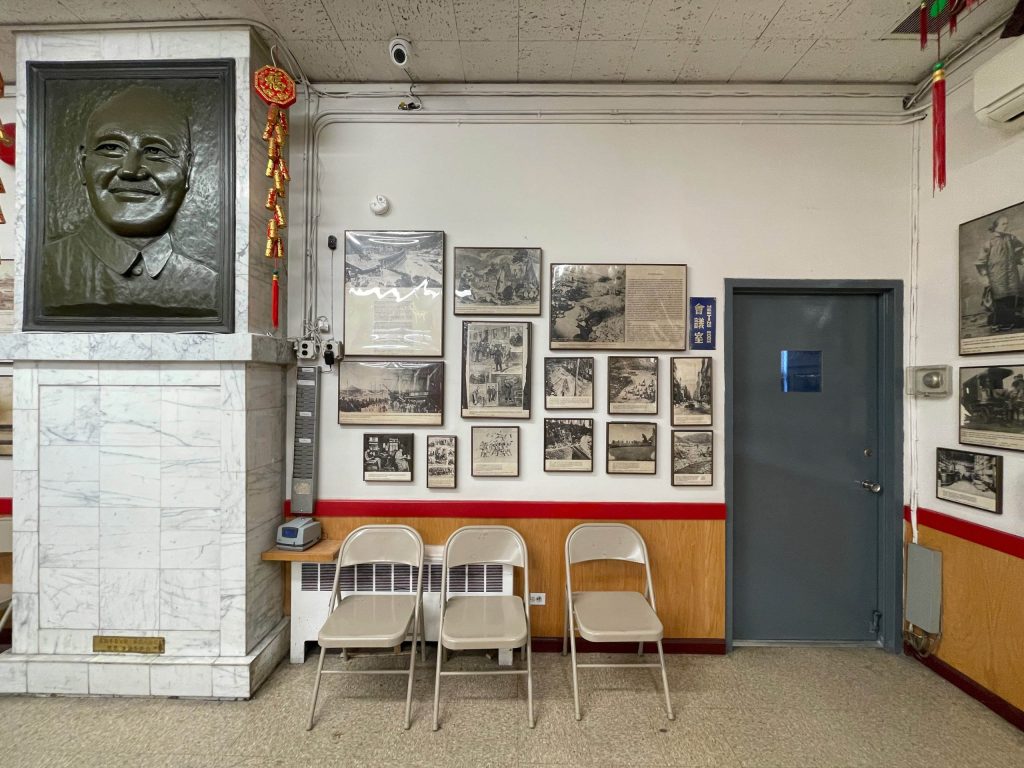
Public exhibition on Manhattan Chinatown history at the CCBA building, July 2022.
+ Would you give me a brief introduction of yourself? When did you come to New York?
I left China when I was 4 years old. I came here to New York City in 1970 at 20 years old. The day I remember I stepped down, my relatives took me to the apartment – I first lived at 56 Henry Street.
I came with my mother and my brother because I’m the fourth and the first generation (born out of the U.S). With the fourth generation, I mean that my great-grandfather, grandfather, father & I were all here in New York City at the same time. Being the fourth and first generation is why I know a lot of history from my parents.
From 1970-1973 I worked at Chemical Bank, which is now Chase Manhattan Bank.
From 1973-1976, I worked at Deloitte (Huskin & Sells), a CPA firm.
In 1976, I started to make fortune cookies.
Twenty five years ago, I took care of the Eng Family [Eng Suey Sun Association]. And then later on, step by step, I started to take care of this building [Hoy Sun Ning Yung Association] and then the Chinese Consolidated Benevolent Association (CCBA) building.
In 1922, over a hundred years ago, the CCBA of Newark bought a plot in a cemetery to bury the Chinese in Newark. It was managed by the Eng family in the 1970s. Around 1980, the Eng Family [Association] gave authority to New York’s Eng Family [Association] to handle it. Around 2010, we tried to sell all of the space and we bought another 100 plots.
When I came in 1970, my grandfather had already passed away. Every year I go to ching ming [sweep the tomb for the Ching Ming Festival], so when I see these stones, I know the history. The CCBA owns spaces in Evergreen (Staten Island).
I’m also a collector. I always traveled to a lot of cities for stamp shows & auctions. This is my hobby.
+ How long have you been working in Chinatown? How did you come to be connected to Chinatown?
My parents never brought me to Chinatown [when I was a child.]
When I came in 1970, I had a lot of alumni from Hong Kong. We had alumni associations in Hong Kong and in 1971, we rented a space to establish the alumni. This space [for the Tak Ming Association] still exists at 16 Mott Street. The Chinese Consolidated Benevolent Association (CCBA) is the property owner. That was my first step into Chinatown. Alumni business is different from community business.
Every Saturday and Sunday, we hung out in Chinatown with the alumni. We learned a little bit of knowledge from Chinatown but we were not really involved in the community. I became involved later on because I started my business.
I started a business making fortune cookies in 1976-1977. Along with another alumni member, we took over the business from the previous owner. I sold it to him in late 1978. It was at 6 Chatham Square. Before, it used to have a liquor store in the storefront and we made fortune cookies in the back. I started another fortune cookie business, with fully automatic machines, in 1978 at 53 Chrystie. I sold the business to Wonton Foods in 1983. I was too busy and had no breaks as the machines were going seven days and seven nights a week. By then I was also doing wholesale, which I started in 1982. Major products sold were eggs and coffee. Martinson Coffee, which is famous in Hong Kong — I sold that product. At the time, all the cafes drank this coffee. By 1991, I had gotten a younger partner. I left this partner the business, minus the eggs and coffee. We split the company into two companies at 7-11 Ludlow and 23-25 Ludlow.
+ What was Chinatown like when you first arrived in the 1970s?
I went to work and my connection was mostly with the alumni. Every Saturday or Sunday we had meetings together. We didn’t go outside to do new things. Then, it was different. I was too busy.
In 1973, it felt like the situation was getting worse in Chinatown with the gangs… though they didn’t bother me with my business, and my store was outside Chinatown.
+ How have you seen the Chinatown community change over the past decades?
A lot has changed.
In 1975, the Vietnamese came here and the size of Chinatown boomed. My wife was Chinese-Vietnamese (she passed away in 2005). Between 1970 and 1980, a lot of Taiwanese came here. Around 1985, a lot of Malaysians and Singaporeans came here. At the end of the 1980s to the early 1990s, a lot of Fuzhounese came here.
Chinatown is changing — during that time, we expanded to the north, but we couldn’t expand westward because of the jail. We also expanded in the east. To the south, there were the projects, so we didn’t expand there. Hester, Grand Street – boom – Chinatown moved up north.
But around 2010-2015, from the north, the Americans pushed back.
+ What are your feelings about what Chinatown has been impacted since the pandemic started?
When the pandemic started, I had an appendicitis emergency. I stayed two months in the hospital and three months in a rehab center, four months resting at home and last year in January, I went back to the hospital for surgery again and then was doing better and better… It was a two-year experience.
I have nothing to say because Justin Yu, the former president of the CCBA, was the public face of COVID. He was famous because he first stepped into this title in this month. Everything shut down in Chinatown and he handled it.
Interview
WITH FAY LOO (DIRECTOR OF THE CHINATOWN ENGLISH LANGUAGE CENTER and english educator in chinatown)
A message from Leslie Kuo, Fay Loo’s daughter-in-law, who suggested Fay to be a participant of this project in 2022:
I just visited with Fay Loo, who was the first (and only) director of an English learning program housed at the [Chinese Consolidated] Benevolent Society on Mott Street in 1971. Irving Chin (a lawyer and uncle of Rocky Chin) had requested funding from the State for the program, and according to her it was the first time funding for Chinatown had been requested from the State. The program employed 14 part-time teachers who could accommodate the schedules of those employed in Chinatown, e.g. restaurant workers and seamstresses of the sweatshops. The funding was also supported by the federal government and at the end of the one year funding cycle, officials from the city (including Percy Sutton, then borough president), state, and federal agencies all came to see a demonstration of the program. They increased the funding from $60k to $100k for the second year.
Unfortunately, the program didn’t continue.
At that point, the D.O.E. (Fay had been an elementary school teacher at P.S. 75 for many years before being tapped to start the English learning program) asked Fay where she’d like to be placed next and she requested a placement that would allow her to help Chinese students. She was placed at Seward Park as a grader, which led her to realize that many of the high school students were failing; they couldn’t read and write English. She applied for her first grant to start an English learning program. Up to that point, the school had only ever been granted $10k in funding. Fay’s proposal secured $380k (a lot even by today’s standards!), placing her in a position to lead a team of seven teachers and her own office.
And that’s the story of how English courses came to be taught in Chinatown.
Interview conducted in June 2022.
Thanks to Leslie Kuo for facilitating this connection.
+ Would you give me a brief introduction of yourself and your connection to Chinatown?
I’m 93. I came [to New York] in 1947. I was 17 and I went to school at the University of Rochester to major in English literature. I knew nothing; I had three years of college credits at St. John’s University in Shanghai, which I entered at 15. During the war, lots of people lost their papers and had no proof that they went to high school. St John’s University at the time was run by an episcopalian church and they accepted you if you could pass their math and English tests. I was a homeschooled child. From kindergarten to 12th grade, I only attended in-person school for about 1.5 years. I really didn’t study anything — I had a lovely childhood not going to school at all. I passed those classes and entered the university.
From age 10-17 I was in Shanghai, but grew up between Shanghai and Hong Kong.
My maiden name is Yung. The school on Division Street (P.S. 124) is named after my great-grandfather, Yung Wing. His picture was, in fact, under the Statue of Liberty. He was the first Chinese to graduate college in America (from Yale University). There are books written about him. He came under missionary guidance in high school.
My father and stepmother had been here in Manhattan, New York City for a year already.
So actually, by accident, I ended up in education.
I lived up in Rochester in the dormitory for two years and for holiday, I would come down to see my father in Manhattan.
I have two sisters and one brother. Because he was my father’s good friend and my father was in the insurance business, C.V. Starr’s private plane brought my second sister and brother. C.V. Starr was really the big founder of AIG. I came by slow boat from Shanghai. My first stop was in Honolulu, which looked like absolute paradise, right after the second World War, when everything else was very gray. Then we got to San Francisco — my father came to meet me and we flew back to New York City.
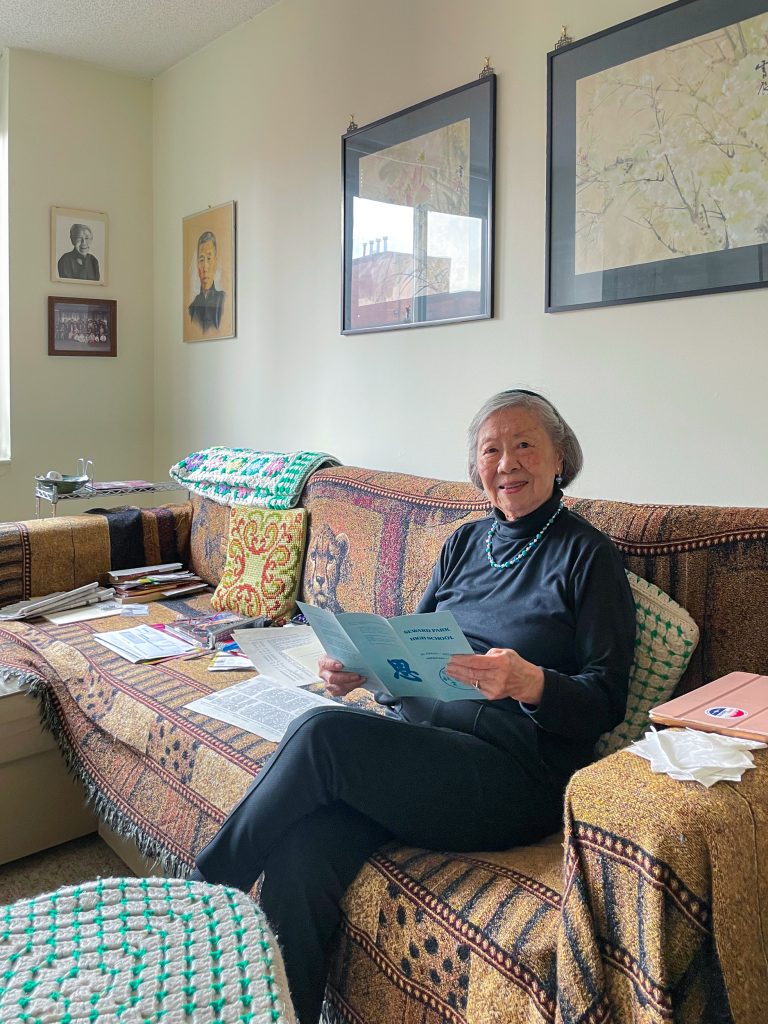
Fay Loo at our interview session, with memorabilia from the English language program she led, June 2022.
From school I didn’t know what to do. My father put me into Katherine Gibbs secretarial school. I got married and had two children, one boy and one girl. Four years later, I had another one and two years later, I had another one. Finally, I separated from my husband when my youngest was 2.5 years old. I went to the school where I lived nearby (several of my children attended it) and went to the principal to ask if he needed a secretary. I was a single mom and needed to support my kids. He said he needed a secretary from the Board of Education. Then he said, “why don’t you become a teacher?” And so I became a teacher, then a coordinator of first, second, third grade, and then afterward, acting principal. From 1961 – 1970, I was in that one school, P.S. 75 at West End Avenue.
I moved to a 1-bedroom with three kids and went on to teach at elementary school to support myself.
+ What building(s) are you connected to in Chinatown?
Chinese Consolidated Benevolent Association Building.
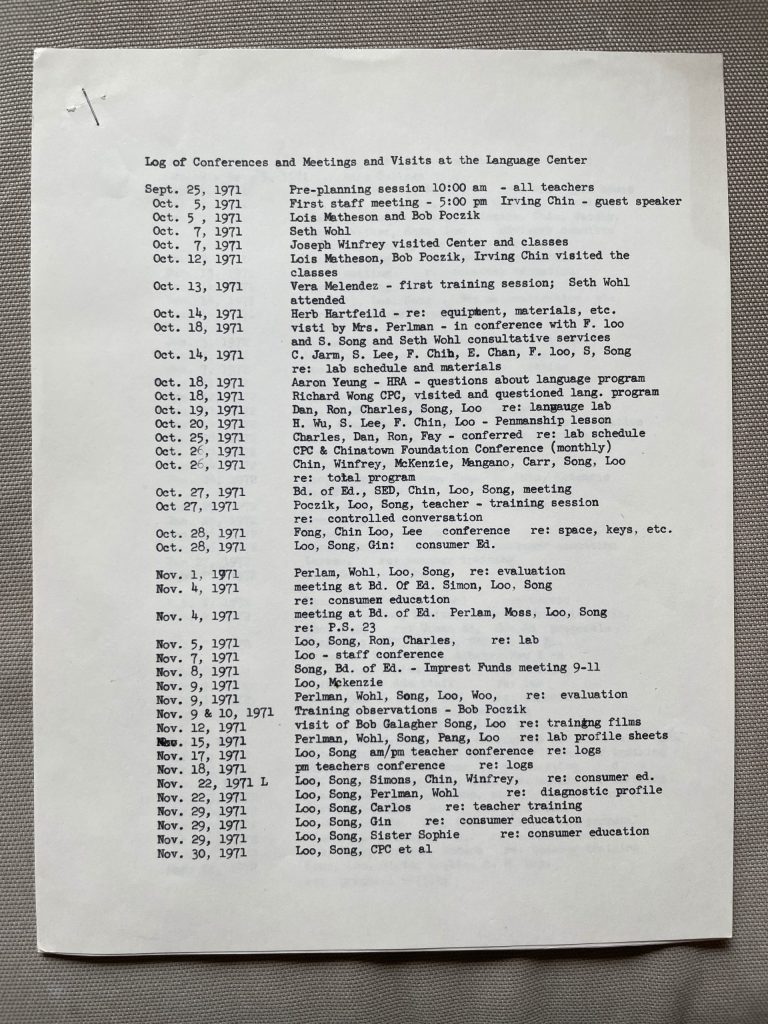
Log of conferences, meetings and visits at the Chinatown English Language Center. Typewritten document, courtesy of Fay Loo, photographed during our interview in June 2022.
+ How did you start working at the CCBA building on Mott Street? How did that job come about?
My cousin from my mother’s side is a Yale alumni and an architect and also worked for a short time for I.M. Pei. (My father and my mother were really good friends with I.M. Pei’s first wife, because they knew the family already. They were next-door neighbors in Hong Kong.) We came together on the same boat from Shanghai. At Yale, there was a guy by the name of Irving Chin, a lawyer, who I got to know in 1969-1970. He was quite active in Chinatown. At the time, there was Chinatown Council and Irving was a member of this. He had disagreements with them, so he came out by himself and wrote a proposal to New York State to help Chinatown and got $60,000, which was a lot at the time. They discussed: we’ll give you $60k and you look for an executive director for this sum of money and the executive director will help the organization to branch out. Let’s start with English as a Second Language program. So it was funded through the New York Department of Education as an ESL program in Chinatown.
It so happened, my cousin Billy Lee and him knew each other and Billy came to me and in 1971, he asked me if I wanted to direct the program. I said OK — it was a challenge, but I accepted. All of this federal money gave a certain sum to me and I’m very bad with money, so I said: I can organize and you can decide what to do with the money.
Henry Chung arranged to use the classrooms at the CCBA building for free. On the second floor, there’s a Sun Yat Sen picture in the hallway. There’s a big room on this floor and they gave me that room. I hired all of these teachers. I tried to hire Chinese/English-speaking teachers with a license. I couldn’t find enough at the time, so I also hired teachers without the license. I don’t remember at the time, so let’s put it at around $12.00/hour for the teachers.
There was Lilly Din, who may have retired, but for many years was the principal of the elementary school at Baxter Street. At the time that I hired her, she had just graduated from college. There were lots of volunteers.
We started in September. I hired teachers in two sessions: one in the morning, who taught from 9 – 11AM for cooks and waiters, and at night from 7 – 9PM mostly to seamstresses. At the time, sewing factories were still in Chinatown.
In the meantime, the big room was what we used as the office. I arranged so that anyone could come in throughout the whole day to listen to English language tapes.
I myself arrived at 8AM (school started at 9AM) and I left at 10PM. We ran four days of the week, Monday through Thursday.
+ Who were your students?
The cooks and waiters, mostly men, in the morning. In the evening, it was mostly women. And anyone else could come in. The time was just facilitated to accommodate those people. We had about 15-20 [students] in a class and there were around 12 teachers, 12 classes.
I only remember that there were a lot of cooks and waiters.
We wanted to tell them they needed to vote, and they should unionize and vote, which we did in the classroom… but then I got a nasty letter about this — that if I continued to do that, I would find myself in a dark alley.
The president, Henry Chung, was very cooperative. The CCBA had their own board, all Chinese members, which was separate from our organization. Irving Chin put himself on the board, but all this time he should have hired an executive director but never hired an executive director, who would have been my boss (top of the umbrella).
I hired an assistant, Simone Song, and a dear friend Peter Lum, an engineer and marine.who would come every day after work at 5PM and stay to work with us. The last class was at 9PM and the three of us would come back home at 10PM at night.
Come Christmas (1969?), we had a picture that all of the teachers signed as a thank-you gift for Peter Lum. We left space for Irving Chin to sign too. We were always grateful to him for helping Chinatown – I really put all of my heart into doing this. He signed himself ‘Emperor Chin’. Simone said that he was neurotic after that… Slowly, slowly, I found out she was right.
I was told that I didn’t ask him to get permission to buy paper clips and paper pads for the office and students.
At the time, we were trained by New York State about English as a Second Language and ways to teach it. They also gave lessons on how to run the school. This was all paid for with the money the State gave us… They had a meeting in Washington which I was supposed to attend. Irving was unhappy that I didn’t tell him I was going to Washington for this meeting. In the meantime, the State representatives would drop in periodically to see how our classes were run. Even ESL representatives from Washington would come and drop in. I imagine some would come to write up what we were doing with all of this money.
Irving had a board for the program of around ten people. Betty Lee Sung, a writer, was on this board. There was only one Westerner, a Jewish lawyer in Chinatown named Sam Bock I believe. None of them came to visit us except one.
He [Irving] had many complaints about me not asking him for things. With each complaint, Irving sent a Telex message to the Board, complaining I don’t do this, I don’t do that…. I didn’t even know about this. One day, this lawyer friend Sam Bock came to inspect… but after a few times, he became our friend. He saw what we were doing was excellent. We just ignored Irving Chin after a while.
Then the end of the year came. We asked Henry Chung to use his big auditorium downstairs for the graduation. But he got a letter from Irving Chin that told him to not let us use the auditorium. He wrote to everyone who funded this to not attend the graduation… We used the auditorium anyway!
Percy Sutton at the time was the Manhattan borough president. We invited him to come. They all came and knew what a good job we were doing.
So… he didn’t know if they were going to come or not. Our presentation was to see how an ESL class was taught. Anyway, Irving Chin sits across the street at a hole-in-the-wall restaurant — (close to Big Wong) watching who was coming in until he saw Percy Sutton came in… and then slowly followed him in, like a dog, he followed him in.
I told Simone to put him on stage also. So he came and we didn’t say anything.
At the end of the year, Irving and I got a letter from the Washington people saying that they would fund us $100,000 over their $60,000 if Fay Loo would become the director. Irving couldn’t fire me because I was under the Department of Education payroll. He wrote a letter to me and to his own board saying that he wasn’t firing me nor re-hiring me… Even with the money that Washington offered, he would rather refuse it. The program ended. The school dissolved because of him not wanting to accept me as the director. The funding immediately all went away. He didn’t think about it as being nice to the community. He just wanted glory. In the end, the Chinatown Council didn’t want him back, so he was an outcast. Later on, his own law firm fired him. Simone was so mad about this… and because of this, she went to Columbia and became a lawyer.
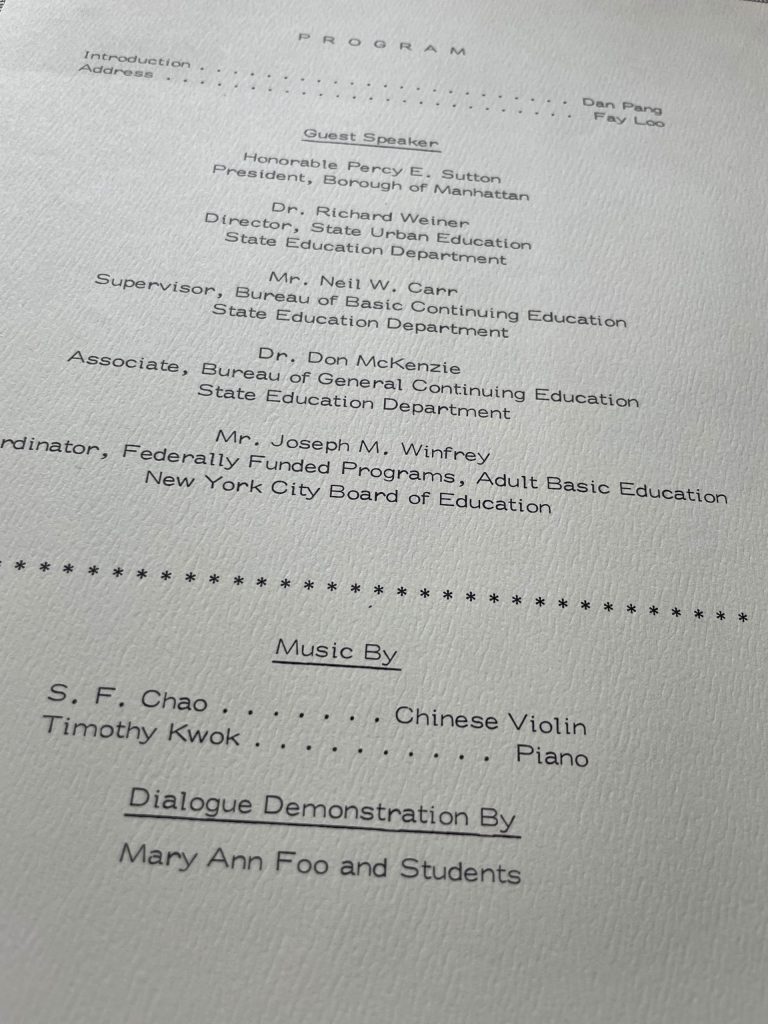
Program of the Center’s graduation ceremony. Original document courtesy of Fay Loo, photographed at our interview session, June 2022.
Program of the Center’s graduation ceremony in English and Chinese. Original document courtesy of Fay Loo, photographed at our interview session, June 2022.
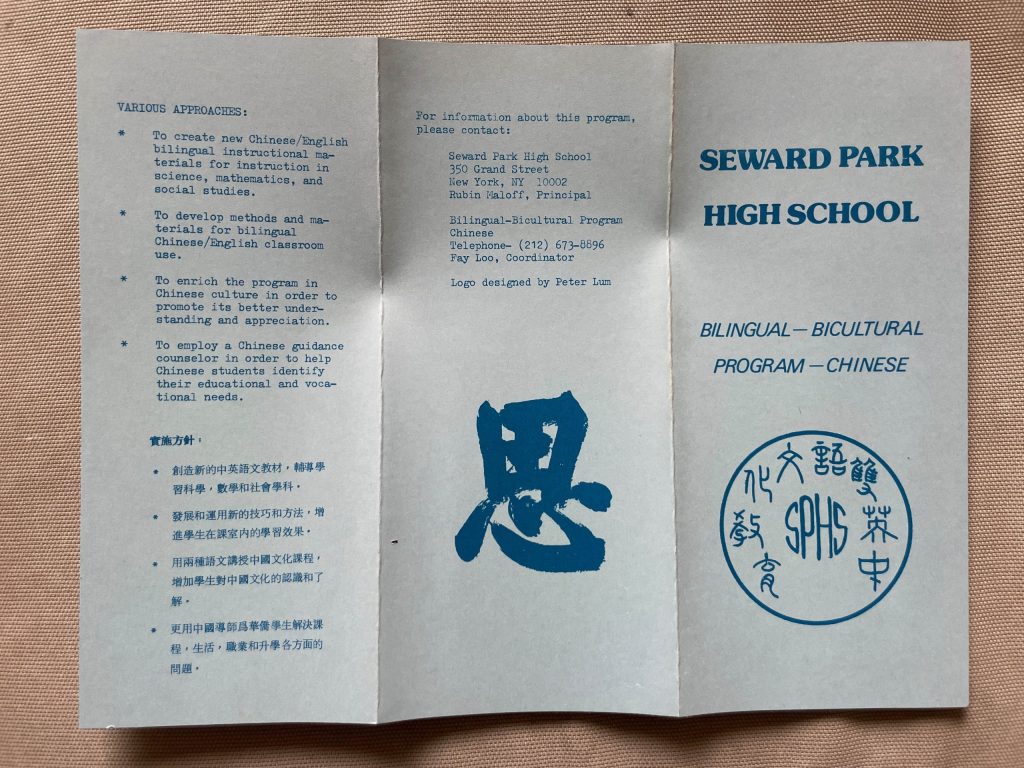
Pamphlet on Seward Park High School’s bilingual and bicultural Chinese program. Original document courtesy of Fay Loo, photographed at our interview session, June 2022.
+ What happened after?
I was still at the Board of Education and so they asked me what I wanted to do. I wanted to go back to a school with Chinese students (after 1965, [President] Kennedy had passed a law allowing Chinese immigration to happen, so there was an influx of Chinese students). At Seward Park High School, which is now closed, there were a lot, so I was put in there. Of 3000 students, approximately 1000 were Chinese. Around 700 of these students were immigrants. I realize that many of the students weren’t graduating because of their lack of English language skills. The Spanish community was also fighting because their students weren’t graduating as well because of the English, so they also fought for English to be better taught. I wrote a proposal to the federal government to have actual English classes and I was granted around $350,000 a year for this. Then, I hired my own teachers who were licensed.
+ What was Chinatown like at that time when you were growing up?
It was like — back into all Chinese faces. It felt very comfortable, though I’m comfortable on all sides. When I was in China, my father and my mother had Western friends, so I had already learned English.
I was impressed that I could get Chinese food. It was rather dirty at the time, not that clean. They didn’t have all of the fish markets then — there was only one market on Mott and Pell, and that’s where we went to shop. It wasn’t as clean as it is now.
+ What do you remember about the interior of the CCBA building and the classrooms?
The staircase was very narrow. We were on the second floor and on that floor, there was also the president’s office. He was the keeper of the whole building – A sort of super, though much more. He was very friendly and helpful. The principal of the Chinese school was Linda Woo.
The classrooms had white walls and were more permanent, with attached desks and chairs that didn’t move. There was also a third and fourth floor classroom. One time on the top floor, one of the male students had a heart attack. We called an ambulance and they had to put him in a chair to move him down – the stairs were so narrow they couldn’t put him on a stretcher.
At the entrance, there are stairs immediately to go up. The second floor was open and spacious.
+ How do you think these English language lessons were important for the Chinatown community?
It was important, but it was too short of a time to evaluate. I don’t know how much good it did for only one year. The students had fun though… The women would come and bring their peanuts and chat in class. I told the teachers they must speak to them in English.
+ Can you share any memories about the building’s past lives?
I got to know the head of The Lee Association at the time, Lee Man Bun (M.B. Lee). At the time, there were gangs in Chinatown and it was very frightening. I remember very well that M.B. Lee had a restaurant on Mott Street and he was fighting the gangs. One day, in his restaurant on the second floor, he was stabbed in the stomach. I remember going to visit him in the hospital and there were two cops by his bedside, to see that whoever came to visit him would be under supervision. It was one of those Chinatown things.
Working that one year in Chinatown, for every meal we had Chinese food, which was lovely. We didn’t have to do any cooking. We got to know one of the waiters who was very good in English; he was in our top class. We saw our students waiting tables.
+ What are your fondest memories of 62 Mott?
I had the most loveliest time because of Lily Din, Simone, Peter Lum, Ron Woo (I think he’s retired now, but he went to the Board of Education and went pretty high up I think), all became my best friends and we kept on being friends. That one year, even with all of the frustrating letters from Irving Chin, we had a good time. In general, we just went on with what we should do and ignored him. At the beginning, we had great respect for Irving, thinking what a lovely thing for him to do. That’s why I gave up my job at the elementary school. My mother, who was already here and had left communist China at the time (and my father had already passed away) asked me: You can roll out of bed and be there in one minute, because P.S.75 is a block away – why do you want to go all the way to Chinatown so early in the morning? I said: Someone wants to give such a lovely gift to Chinatown and wants me to help out. Yes, I’ll go.
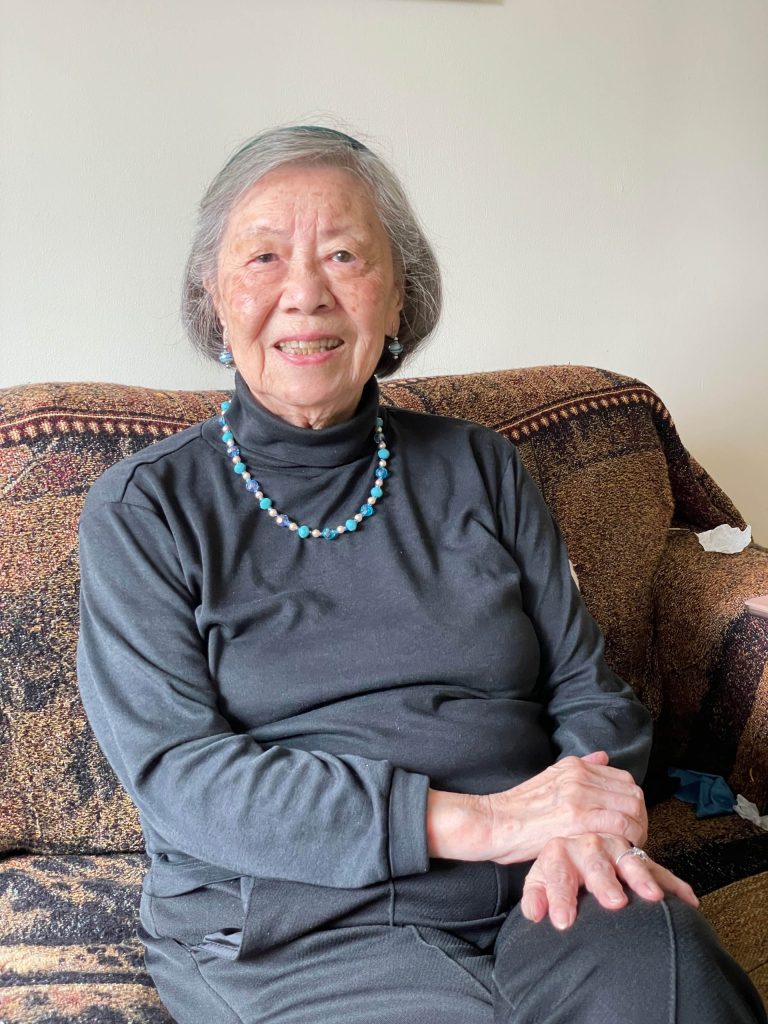
Fay Loo, photographed at our interview session, June 2022.
Interview
WITH ANITA AND JANE CHAN (FORMER STUDENTS AT THE NEW YORK CHINESE SCHOOL)
Interview conducted in June 2022.
+ Would you give me a brief introduction of yourself and your connection to Chinatown?
Anita & Jane Chan: We are sisters, first generation Chinese-Americans born and raised in NYC. Growing up, every week, we spent one day during our weekend going to Chinese school to learn Cantonese. (The way they taught it was definitely hard, purely based on memorization. Much later on, I learned that there is in fact Cantonese pinyin!) It was a three-hour class and after class we would usually eat lunch somewhere in Chinatown. Our doctor and dentist were also in Chinatown. Our mom worked there as a seamstress for many years, so many of our activities were defaulted to take place in Manhattan Chinatown. It was also the most accessible Chinatown by transit from where we lived in East New York, Brooklyn.
Our mom went to young adult class for half a year in 1990 at Manpower, 人力中心 (70 Mulberry Street). She met my dad around 1988, while taking English night classes at CCBA!
+ What Chinatown buildings are you connected to? How long and what years did you go to Chinese school at the Chinese Consolidated Benevolent Association (CCBA)? Are there other buildings or sites, including Columbus Park, that you feel strongly connected to?
Anita:
1.) NY Chinese School at CCBA (1998 to 2008) – I attended weekend Chinese class consistently for 10 years and also saw a few shows that took place in the auditorium in the basement
2.) Columbus Park – I played there. There used to be a section with sprinklers. There was a fair one year when I was a child that we went to and I won a pretty big prize: a bracelet-making kit.
3.) Elizabeth Center – basement of 17 Elizabeth Street, which sold many items including jewelry, yarn, toys, cards, clothes, stationary, etc. My mom brought us there first. When I was in high school, I still went there to hang out, but slowly many businesses left and it isn’t very busy anymore.
4.) Kam Fung Restaurant – shut down in the past years, due to the pandemic. I had my high school graduation lunch there. Once you enter the main door there are very long escalators to the main part of the restaurant. This was one of the biggest, if not the biggest, Chinese restaurant in Manhattan Chinatown. Based on how the entrance looked, it was hard to imagine how expansive upstairs was. They normally serve classic dim sum dishes pushed around in heated carts but do sell other dishes. All of their tables are round and many of them were really big, able to accommodate large groups.
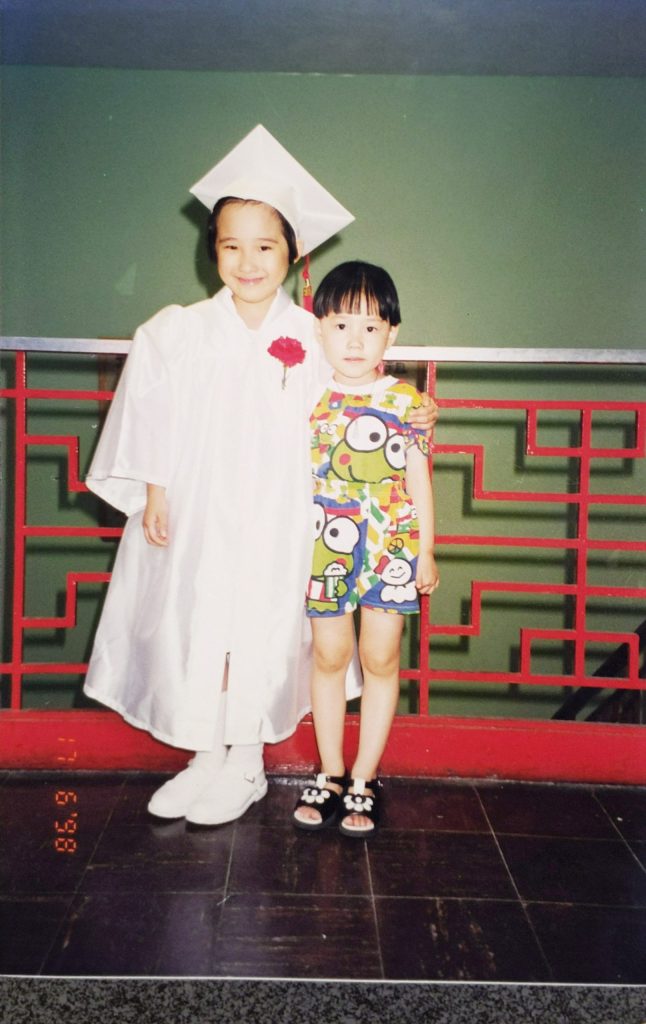
Anita and Jane Chan at the New York Chinese School at 62 Mott, June 1998. Photograph courtesy of Anita and Jane Chan.
Jane:
1.) NY Chinese School at CCBA (1997 to 2010) – I attended Chinese class every Sunday during the school year for three hours, then switched to Saturdays from 2008-2010.
2.) Manpower (~2002 or 2003 Summer) – Anita and I both attended Mandarin classes for about 4-6 weeks here.
3.) Wing Wong (was close to the Popeyes behind the N train Canal Street station on Lafayette Street) – This was our go-to restaurant for lunch after Chinese school in my earlier years. My mom would bring both Anita and I here immediately after dismissal.
4.) Fay Da Bakery – This bakery is diagonally across the street from the front entrance of the CCBA building. During the later years of when I attended Chinese school, I would frequent the bakery by myself because I was old enough to travel on my own. Sometimes I would stop by to buy breakfast, or stop by after Chinese school to bring some food home.
5.) Taipan Bakery – This bakery was also a super popular bakery I would visit, mostly with my mom during my younger years. After buying groceries from different stands on the streets, my mom would bring me here to buy some baked goods.
6.) Unnamed building across the street from the Sing Tao Newspaper building on the corner of Lafayette St. and Broome St. This was the building where our mom worked as a seamstress. When I was about 4-5 years old, I was brought here frequently after being picked up from daycare, so that my mom could finish some work, then we traveled home together.
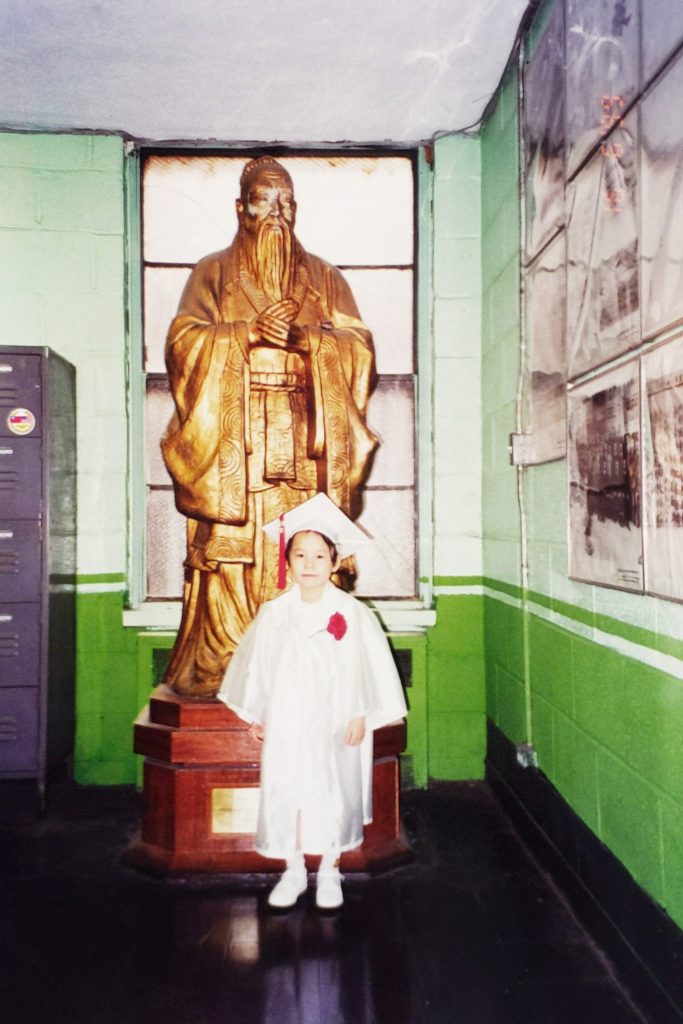
Anita in front of a statue of Confucius at the New York Chinese School. Photograph courtesy of Anita and Jane Chan.
+ What was the interior of the CCBA building like? Materials, colors, sounds? Describe what you remember, from the moment of walking in at the entrance.
Anita: There was lots of red, lots of stairs and it was not very spacious. The hallways were decorated with many things, like pictures, writing, and students’ work. I always remember entering from the front entrance, but for some years we were dismissed at the back entrance. It wasn’t until this year that I discovered CCBA is actually two buildings that were connected and not just one big building. I never wandered around inside the building much; I just went where I was supposed to go. I remember it was not well lit– I think most classrooms didn’t have windows. The auditorium is fairly big and at the end of every semester we would perform, usually the whole class reciting a Chinese poem.
Jane: The building interior was quite old, with mostly green-painted walls in the hallways and classrooms. Upon entering through the front of the building, I remember stairs that had a more traditional design with red patterns. There was also a statue of Confucius I believe, and pictures of Sun Yat Sen. Hallways were decorated with students’ drawings and written work in Chinese. The stairs were always a scarier place for me when I was younger because it was dimmer than the classrooms and hallways. The auditorium in the basement was also memorable because there would be a performance before winter break and before summer break every school year, and was also where the graduation ceremonies were held. It was somewhat spacious with a pretty high ceiling and large, bright red pillars. I also remember the gymnasium that was located on the top floor where the calligraphy and essay-writing contests were held. I was nominated to attend several times throughout my junior high and high school years. The gymnasium was very spacious and had a high ceiling.
+ What are your fondest memories of this building?
Anita: I felt a sense of pride and accomplishment performing at the end of the semester in the auditorium. The whole class would wear similar attire.
Jane: My fondest memories of the CCBA building were my junior high years, because I had a teacher who was very different from other teachers I had in the past and I became close friends with my classmates. This teacher taught us things that were outside of the curriculum and textbooks, and I learned even more about Chinese culture than I had in the previous years. She created a very strong classroom culture and bond between all of us. I was genuinely sad when it was graduation time, because I was the only one who was going to continue Chinese school and move on to high school.
+ What was the interior of the CCBA building like? Materials, colors, sounds? Describe what you remember, from the moment of walking in at the entrance.
Anita: There was lots of red, lots of stairs and it was not very spacious. The hallways were decorated with many things, like pictures, writing, and students’ work. I always remember entering from the front entrance, but for some years we were dismissed at the back entrance. It wasn’t until this year that I discovered CCBA is actually two buildings that were connected and not just one big building. I never wandered around inside the building much; I just went where I was supposed to go. I remember it was not well lit– I think most classrooms didn’t have windows. The auditorium is fairly big and at the end of every semester we would perform, usually the whole class reciting a Chinese poem.
Jane: The building interior was quite old, with mostly green-painted walls in the hallways and classrooms. Upon entering through the front of the building, I remember stairs that had a more traditional design with red patterns. There was also a statue of Confucius I believe, and pictures of Sun Yat Sen. Hallways were decorated with students’ drawings and written work in Chinese.
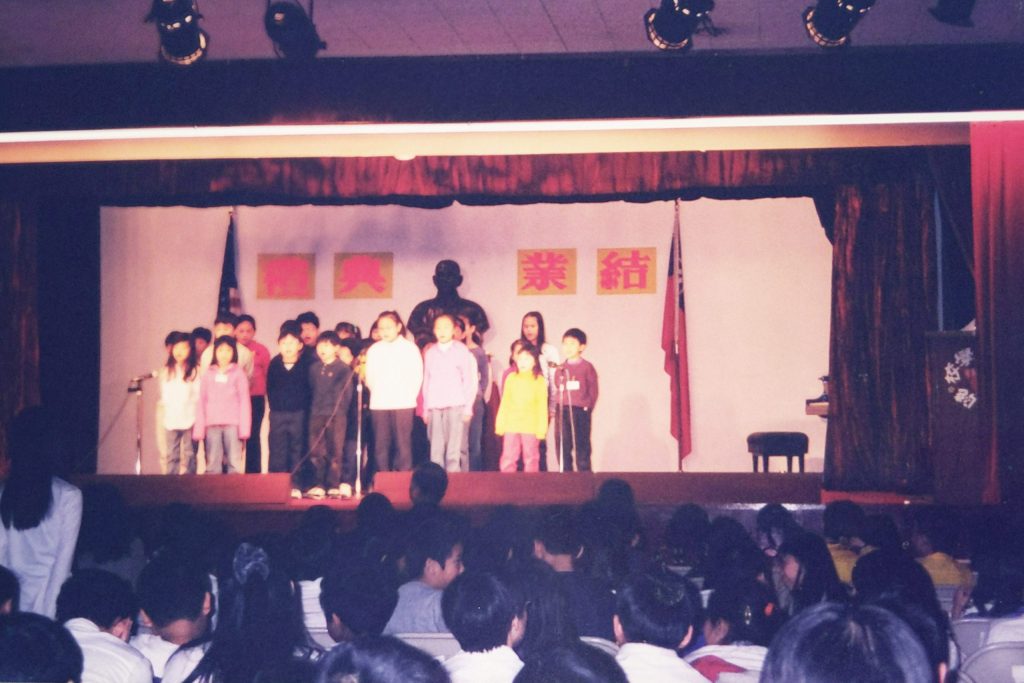
End of year performance held in the building’s auditorium. Photograph courtesy of Anita and Jane Chan.
The stairs were always a scarier place for me when I was younger because it was dimmer than the classrooms and hallways. The auditorium in the basement was also memorable because there would be a performance before winter break and before summer break every school year, and was also where the graduation ceremonies were held. It was somewhat spacious with a pretty high ceiling and large, bright red pillars. I also remember the gymnasium that was located on the top floor where the calligraphy and essay-writing contests were held. I was nominated to attend several times throughout my junior high and high school years. The gymnasium was very spacious and had a high ceiling.
+ What are your fondest memories of this building?
Anita: I felt a sense of pride and accomplishment performing at the end of the semester in the auditorium. The whole class would wear similar attire.
Jane: My fondest memories of the CCBA building were my junior high years, because I had a teacher who was very different from other teachers I had in the past and I became close friends with my classmates. This teacher taught us things that were outside of the curriculum and textbooks, and I learned even more about Chinese culture than I had in the previous years. She created a very strong classroom culture and bond between all of us. I was genuinely sad when it was graduation time, because I was the only one who was going to continue Chinese school and move on to high school.
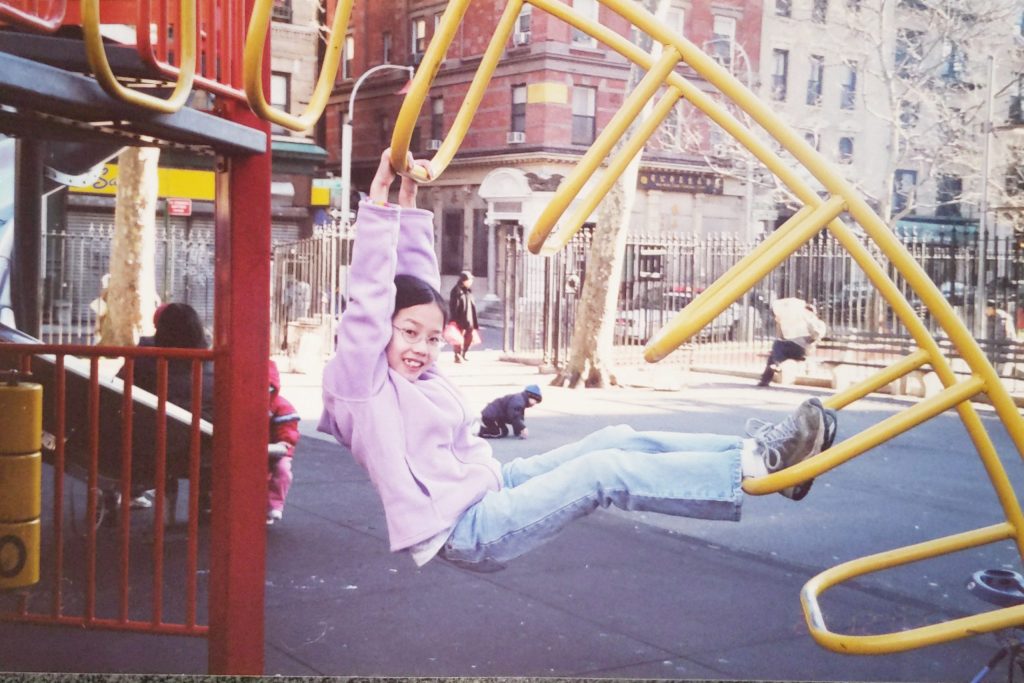
Anita as a child, playing at Columbus Park. Photograph courtesy of Anita and Jane Chan.
+ In all of the years you’ve been connected to Manhattan Chinatown, how have you seen it change over time?
Anita: We’ve been connected to Chinatown since birth, since mom worked there. Chinatown overall feels more touristy now but a few old school stores still remain. In the last several years, I’ve noticed there is a cleanup crew, which is needed and gives the feeling that the neighborhood is valued and taken care of. There are more hotels over the years.
Jane: I definitely have seen some changes, such as stores switching out, more tourists traveling, and one most notable change was an entire block of storefronts (on Canal Street, between Centre Street and Baxter Street) closing out. Those stores mostly sold souvenirs, memorabilia, and random cheaply made goods.
+ What was Chinatown like during your childhood (when you were attending Chinese school)?
Anita: It was very busy. Going to class and after class would require weaving through the streets strategically.
Jane: It was a true hustle and bustle experience. Certain streets were always crowded with passersby, tourists, and street vendors. Streets that had grocery stores and everyday goods stores were extremely busy and dirty with trash, and some parts of the pavement were constantly wet because of the fish markets. It was lively and felt extremely cultural though, a very different experience from one such as visiting a large indoor American supermarket. There were also many different restaurants that had a more traditional ‘80s and ‘90s feel, which were not modernized and had a home-y feeling to them.
Interview
WITH KERRI CULHANE (ARCHITECTURAL HISTORIAN)
Interview conducted in April 2022.
+ Can you give me an introduction of yourself and your connection to Chinatown? How did you come to be connected to Chinatown?
I am an urban and architectural historian by training, and for the last 20+ years I have worked with community-based organizations interested in telling the immigrant histories of the Lower East Side, including Chinatown. In 2008 I was hired by the Two Bridges Neighborhood Council to research and write a National Register of Historic Places nomination for Chinatown and Little Italy. Since both communities have co-existed and largely overlapped for the past 150 years, from a spatial perspective, it was impossible to write about them independently of another. The nomination won the Excellence in Historic Preservation Award from New York State in 2010, but I was always dissatisfied with the National Register history, which is, for a district of over 600 buildings, by its very nature overly general. In the course of research, I came up on some very tantalizing tangents that I have been slowly following up on over the past 12 years. During the course of THAT research, I have found information that contradicts some of the accepted truths about Chinatown that made their way into the nomination.
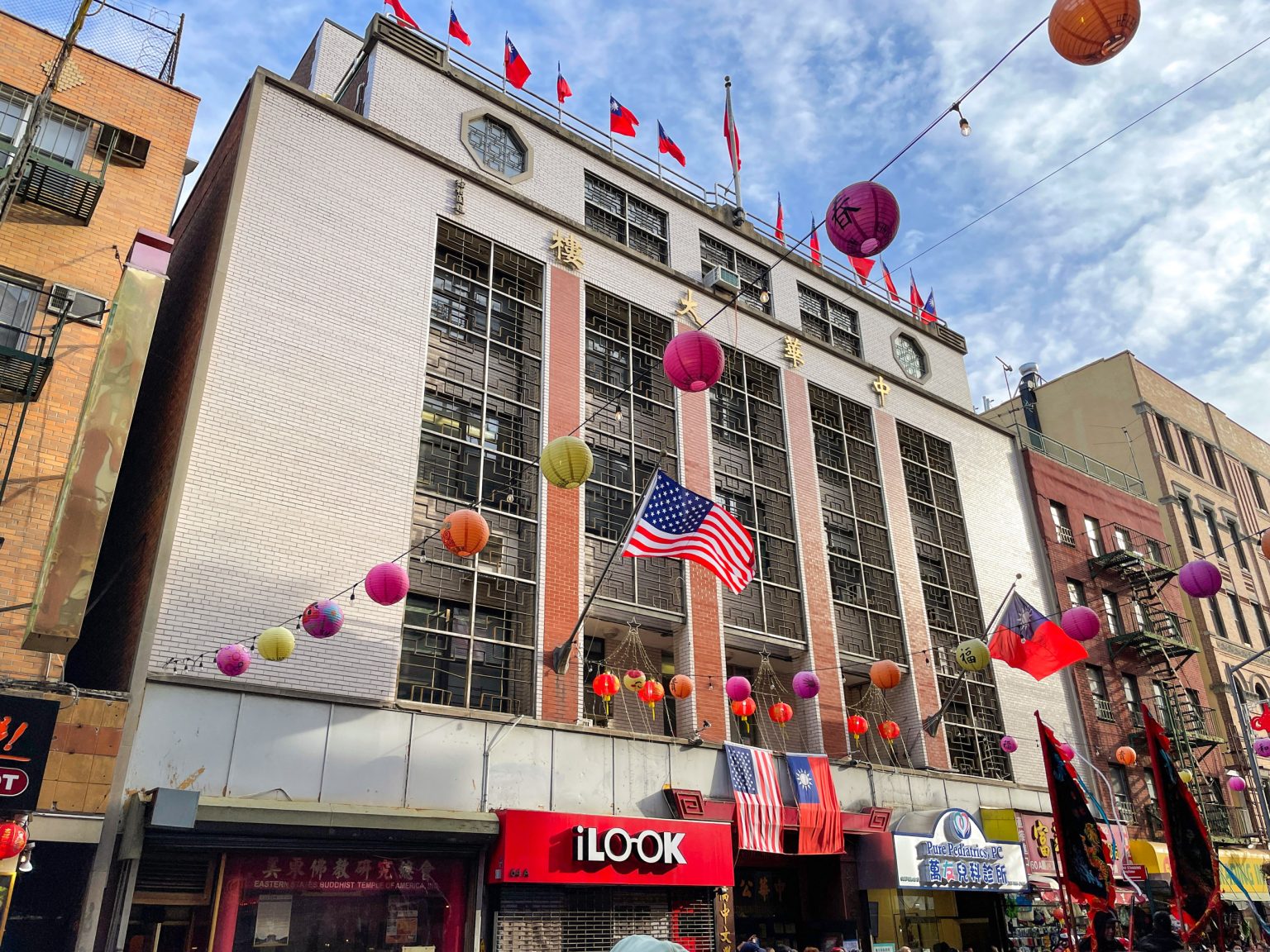
The facade of the CCBA building, adorned with flags. Photographed in 2022.
My current research is working to clarify the historical record and deepen the understanding about the development of Chinatown, politically, socially, culturally and as a built environment. A very important tangent was the discovery of the work of Chinatown native Chinese American architect Poy Gum Lee, AIA (1900-68) in Chinatown. Since 2019, I have been working on a doctoral thesis in architectural and urban history & theory at the Bartlett School of Architecture, University College London, exploring Chinese and Chinese American self-representation in Chinatown from its founding in the late 1870s up until the transformative Immigration and Nationality Act of 1965. Lee’s life and work constitute the historical throughline of the thesis.
+ What buildings have you researched deeply in Chinatown?
I have learned something about every building in Chinatown by looking at the building permits and conducting onsite surveys, but the buildings that stand out are the associations, those that were remodeled or built anew to house the merchant, district and family huiguan and gongsuo. These organizations, which historically formed the sociopolitical backbone of Chinatown, were social structures imported from China to serve the needs and interests of overseas Chinese starting in the mid to late nineteenth century. They were the first buildings modified by Chinese, either as leasees or owners, to serve the Chinese community. Early modifications were made to the exteriors to mimic the urban shophouses of Hong Kong and the Pearl River Delta, which incorporated broad galleries or covered balconies. I found a note in the 1895 building permits in which an architect made a case for the galleries with the Department of Buildings, calling them a “Chinese device” that would make the buildings more like “stores in China.” [Read the article here.] Interior modifications included the joining of multiple tenement apartments into single rooms to house association meeting halls or temples.
There is a common assumption that “Chinatown” architecture is intended solely for tourists, but this overlooks the modifications made to house the people and institutions that MAKE Chinatown. Of course, buildings are powerful expressions of identity and power, and how Chinese and Chinese American identity was communicated and understood plays out in the streetscapes of Chinatown. The CCBA and the On Leong Tong, historically the two most powerful associations in Chinatown, were both collaborators and competitors for political dominance, and their competition is legible in the built environment.
In 1888, the New York Times called the CCBA’s (Chinese Consolidated Benevolent Association) headquarters at 16 Mott the first “genuine Chinese building” in Chinatown, even though it was a remodeled early 19th c. townhouse turned tenement. This “understanding” of Chinese architecture sparked my interest in studying how these buildings were designed to be used by the Chinese community and received by the rest of non-Chinese New York. In the postwar era, when Chinese were more accepted in America due to Sino-American alliance during the Second World War, the CCBA, with the backing of the Republic of China, began the process of raising funds to design and build their new headquarters, Poy G. Lee, newly returned from China, was their architect of choice. He designed two versions of the CCBA in 1947 and 1957, but unfortunately for everyone, it took nearly 15 years and a change of architect to get the current “mid-century mundane” (this is a term borrowed from architectural historian & historic preservationist Frampton Tolbert) CCBA building at 60-62 Mott Street built (Andrew S. Yuen & Associates, 1958-60).
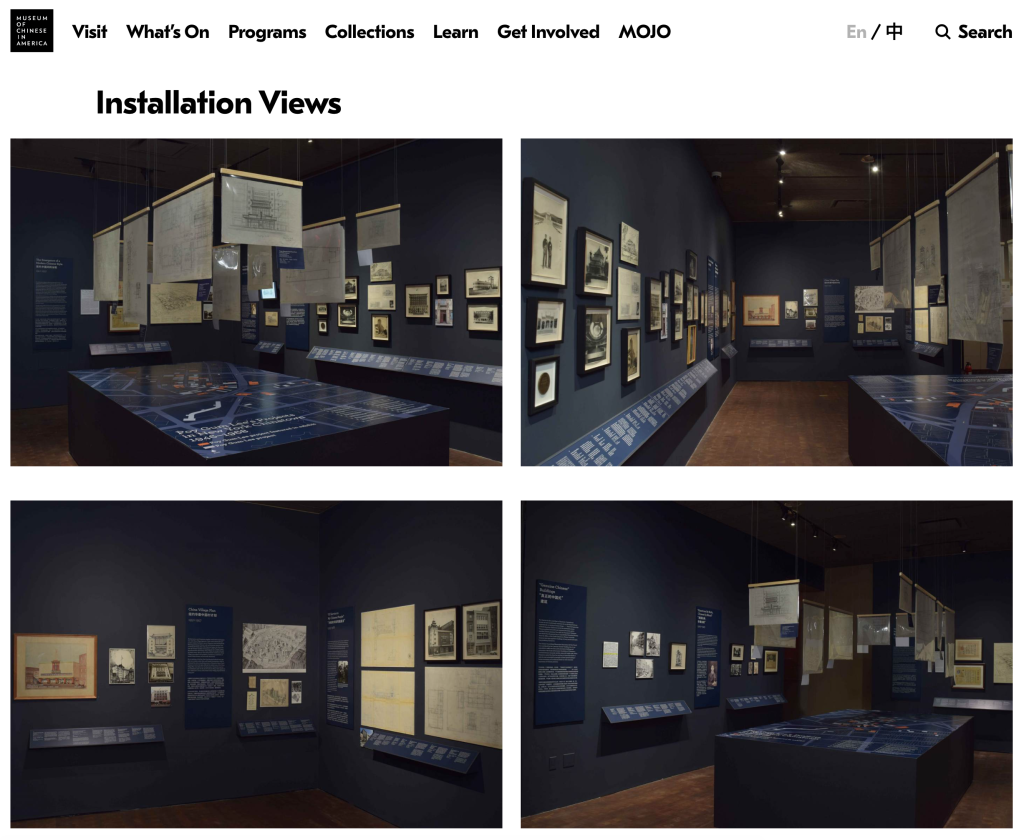
Screenshot from the MOCA website of Kerri Culhane’s exhibition on architect Poy Gum Lee.
+ Tell me about your research process. It would be really interesting to hear about your communication with tracking down Poy Gum Lee’s family and how your MOCA exhibition came about…
My independent post-National Register research has unfolded over nearly 12 years now, even though I was just sort of picked away at it initially. Many years were spent casually trying to track down information about Poy Gum Lee, and trying to make contact with his family by randomly googling and unsuccessfully emailing them through addresses found online. In 2014, I proposed doing an exhibition about Lee, the first Chinese American architect to practice in Chinatown, at MOCA. Curator Herb Tam was receptive, but he didn’t know at the time that I really had little material to go on. Luckily, in winter 2015, I finally made circuitous contact with Lee’s family in California. In Shanghai, the very generous Cíntia Kou (a photographer, among her many talents) had been leading walks around town to document the “Disappearing Corners” of the city as redevelopment accelerated. Some of Lee’s buildings in Shanghai were on her tours —Lee was well-known in China for his work there, where it turns out he was a founding member of the Society of Chinese architects in the 1920s, and among the first professional Chinese architects to work in China. She had been in touch with Lee’s family, and put me in touch with them. I flew to San Francisco to meet with Lee’s youngest daughter and his grandson, the keepers of Lee’s archive.
They could not have been more generous and trusting with this amazing trove of architectural drawings, photos, letters, newspaper clipping and other items that documented Lee’s remarkable and unique transnational career. They shipped the archive to MOCA for me to use to curate the exhibition, which I built almost entirely on the contents of the archive. They then generously donated the archive to MOCA, and many researchers have now been able to access it, expanding the understanding of Lee’s work. The exhibition, Chinese Style: Rediscovering the Architecture of Poy Gum Lee (1900-1968) opened at MOCA in September 2015.
+ What have you found in your research is the most interesting, or most impactful chapter of the building’s past life? In your opinion, what are the most noteworthy or interesting architectural features of the building?
For me, the expression of Chinese identity in the built environment, whether a modest balcony modification to approximate a shophouse gallery or a full-blown Chinese roof, reflect larger themes of the Chinese and Chinese American experience in New York and in the US in general. How the built environment informed outsider perceptions of Chinese, and how the spaces sheltered and enabled the Chinese American community (its politics, society, culture and economy) to develop demonstrates how the buildings served as a material strategy for an outsider immigrant group to negotiate acceptance in a very racist country.
+ What do you believe is the importance / impact of these buildings being constructed by these associations, by these members and residents of the Chinatown community? What are your fondest memories of this building?
As white, non-Chinese speaking woman, I am an unlikely historian of Chinatown. Conducting research into buildings owned by Chinatown’s traditional, patriarchal associations, access and trust has been a challenge. I have focused on the empirical record (building permits, the physical buildings, and the larger historical themes), and have made every effort to gain trust by sharing my findings freely with anyone interested, and trying to contribute to knowledge and understanding of Chinatown as a built environment. I have made some great connections with elders in the community, including Eric Ng, who in turn connected me to others who were willing to share (and sometimes not, but it’s always worth trying!). Through collaboration with organizations like MOCA in 2015 for the Lee exhibition and most recently Think!Chinatown, where I have served on the board for the past few years, I am able to share my research but also gain a cultural competency that enables me not only to be a better researcher, but to direct my research to inform current issues in Chinatown, for example the debates around 70 Mulberry, the former P.S. 23, which burned on the eve of the Lunar New Year in January 2020. The ensuing discussion illuminated the role of historic buildings and the larger built environment in the economic, social and cultural future of Chinatown.
+ How do you think Chinatown has changed over the past century (architecturally, culturally or as a community)?
One of the most cited academics writing about Chinatown, the geographer Kay Anderson, describes Chinatown as an “idea” – it is a racial construct formed by the encounter of Chinese and a dominant white society, albeit one with distinctly physical dimensions. From its very beginning in the 1870s, Chinatown has served as a cultural home (but not necessarily the physical home) for members of the Chinese diaspora in the New York region. Its architecture still largely reflects the late nineteenth century streetscapes in place when the Chinese arrived, with the steady accrual of modern storefronts, signage and even a few new buildings. The use of overtly Chinese architectural signifiers has ebbed and flowed over the years, reflecting the changing status of the Chinese in America, changes in architectural taste, and the changing nature of the Chinatown economy. Chinese America is diverse (economically, geographically, socially, culturally), especially in the wake of the 1965 Immigration & Nationality Act. There is no unified or singular expression of Chinese identity in the built environment; this is especially true in New York Chinatown, where streetscapes have been increasingly marked by an informalism that reflects the transition from a tourist economy to an enclave economy that serve the needs of the diasporic Chinese and really the pan-Asian diaspora for goods and services.
As with most immigrant enclaves, historically, the goal for the subsequent generations is to move beyond the immigrant neighborhood and assimilate into the American middle and upper classes. The reclaiming of Chinatown by younger generations who are taking on family businesses, investing time and energy into community building, working to protect affordable housing and small businesses, and fighting back against the stereotypes that are still perpetuated, further demonstrates the shift from tourist Chinatown toward a multigenerational community. That being said, gentrification nibbles away at Chinatown—or authentrification, think of the artists and galleries and restaurants moving in and using Chinese signage or other winking references to signify what they no doubt feel is a transgressive move into an exotic locale. This is the same “thrill” sought by the white slummers of a century ago who came to Chinatown in tourist busses to see people dressed up like hatchet men and opium smokers. In a recent New York Times puff piece, the white fashion and furniture designer owners of the bar du jour that just opened on Bayard Street even make reference to the alleged “secrets” of Chinatown. So as far as Chinatown has come, it remains, in the words of folklorist Winston Kyan, “American’s preferred destination ghetto.” Physically, socially and economically it is constantly changing, but the general American (mis)understanding of it remains, sadly, the same.
60-62-64 MOTT - BUILDING PHOTOGRAPHS
Photographs taken between 2022-2024.
11 ELIZABETH - REAR SIDE OF BUILDING PHOTOGRAPHS
Photograph taken in 2022.