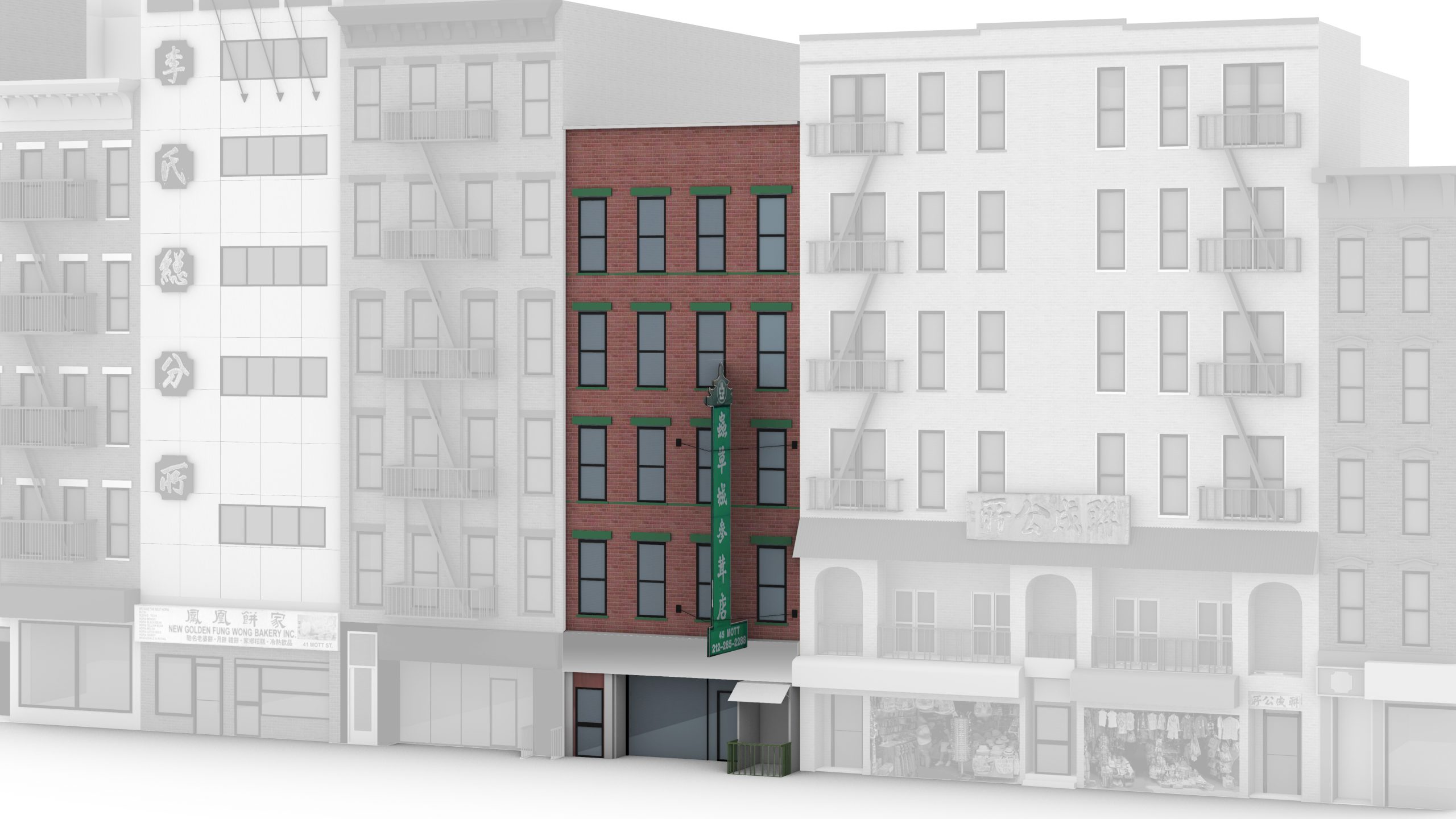
45 Mott
Built in 1886
2024
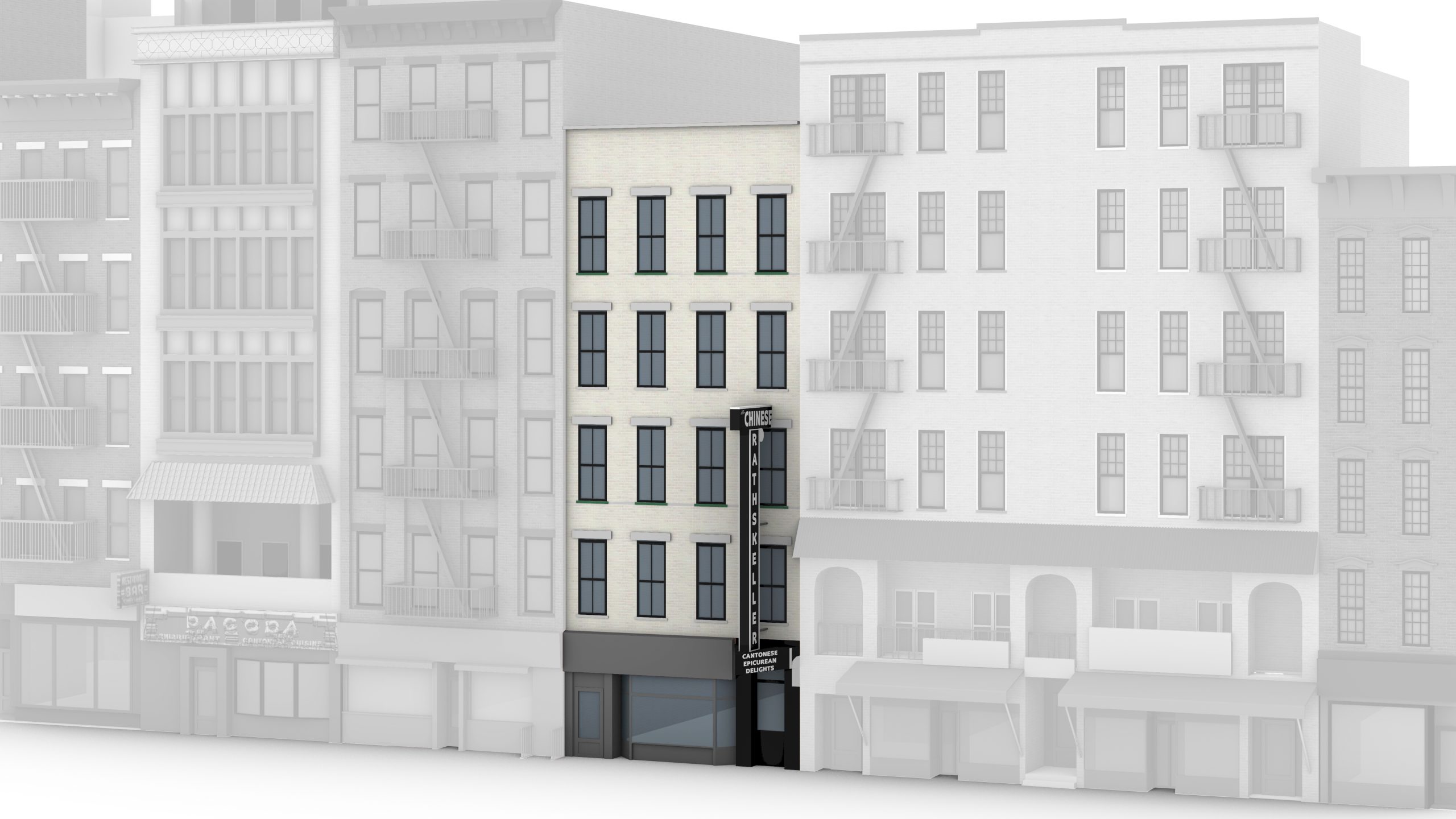
45 Mott
The Chinese Rathskeller Restaurant / The Bowl Shop
Built in 1886
1940s
Interview
WITH TRIPLE EDWARDS AND RANDALL QUAN (CHINATOWN RESIDENTS AND COUSINS)
Interview conducted in July 2026.
All photographs in this interview are courtesy of Triple Edwards, Randall Quan and the Quan Family unless otherwise noted.
+ Please give me a brief introduction of yourself and your connection to Chinatown. How long have you been living in Chinatown? How did you come to be connected to Chinatown?
TE: I’m a native New Yorker, although I was raised in the ‘burbs. My extended family always lived in Chinatown, and almost every weekend we drove back into the city to visit my grandparents, aunts, uncles, and cousins, and to eat at our family restaurant, the Rathskeller, or hang out in the next-door curio business, The Bowl Shop. My grandparent’s nearby apartment was the Quan family home. At one time the whole family lived there together, but after my Gong Gong passed, it was my Uncle and his family that stayed to care for my Po Po, and remained the central gathering place.
My mother and father wanted more room for the kids to grow up in, so we moved out to the Long Island suburbs when I was a wee babe. Living out there ended up being the best of both worlds — the beaches and the space of Long Island, with the city still close by. I, of course, always gravitated to city living, so it is no wonder that in 2006, after my Po passed at the ripe age of 100, I bought the family apartment, and made Chinatown my home.
We celebrated all of life’s occasions and milestones in Chinatown. That apartment was always the heart of our family, while the Rathskeller and The Bowl Shop were the head.
+ Describe your childhood in Chinatown. What was Chinatown like back then?
TE: It felt safe and vibrant. As a kid, I was always allowed to walk a couple of blocks by myself down Mott street over to my favorite newspaper store, Betty’s, to buy comic books. Most of my collection of ten thousand comics came from Betty’s.
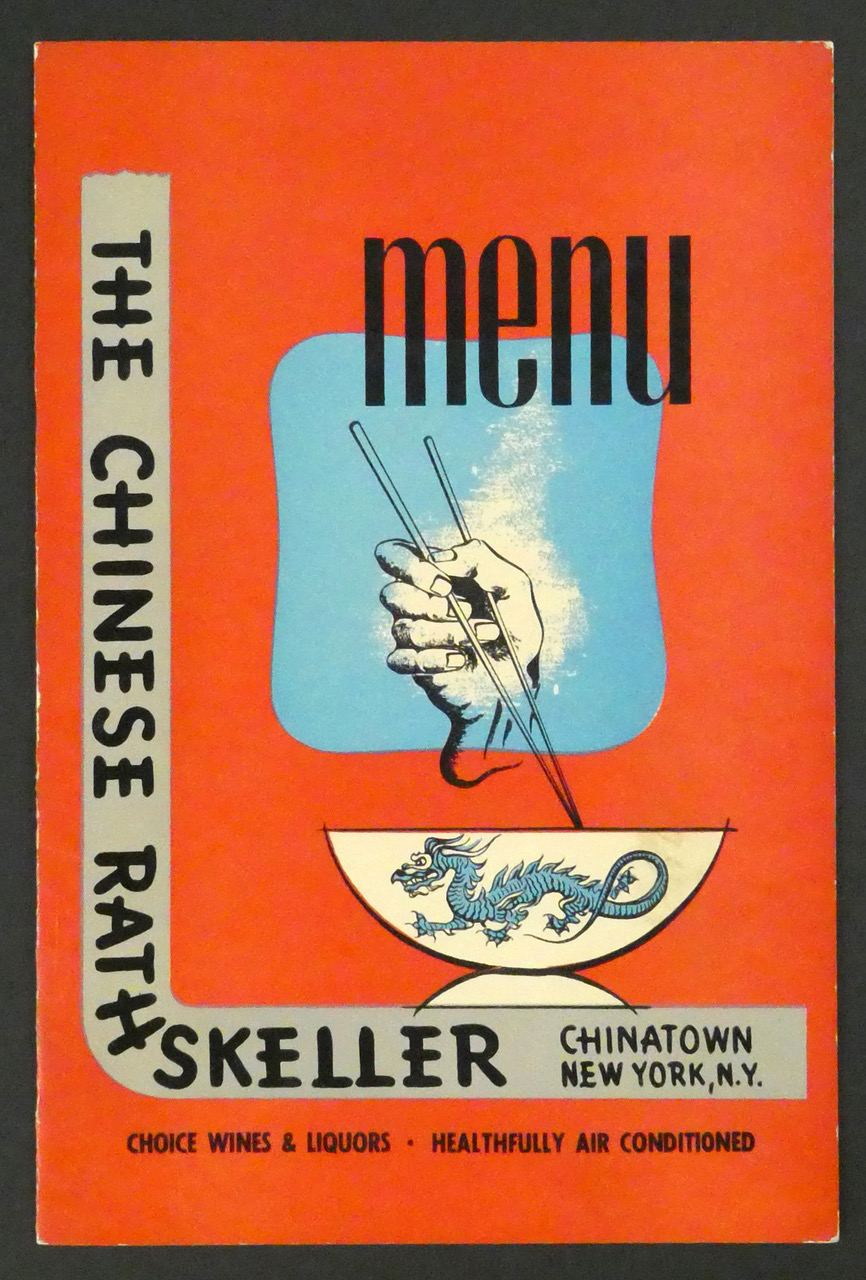
The Chinese Rathskeller menu, c. 1948.
(Left) The front entrance of the Chinese Rathskeller at its grand opening in 1936.
(Right) The restaurant’s offerings in its 1948 menu.
+ How did your family come to own the building?
RQ: Wei Quan, along with his sons Chew and Shun (Robert) purchased the building circa 1935. I’m not sure exactly who, legally, was on the title or if their import company bought it – I assume there are records at the Department of Buildings (DOB) about that. It was purchased from or with the help of two brothers from the Kee family. (The son and daughter-in-law of one of the brothers are Norman and Virginia Kee). I don’t know if the Kee brothers sold the building to the Quans or if they were more like realtors who brokered the deal.
It’s funny how the most I knew about Chinatown, from a child’s view, was my grandparents’ apartment, the Rathskeller, The Bowl Shop, and of course, Betty’s. When I slept over, my aunt would take my cousin and I around to do all her chores and I got to see more of downtown New York and Chinatown. Today’s influencers have nothing on my aunts and uncles, who always knew where to go in town to get the best of the best. Even though we were a family of great cooks, we also had our favorite go-to places in Chinatown for prepared foods and groceries: sui gao, roast duck, seaweed fish, joong… you name it, and my relatives were not shy about their opinions.
(Left) Chew Quan and Shun Quan outside the restaurant, June 1972.
(Right) The head chef at the helm of the kitchen, June 1972.
+ How long was the Chinese Rathskeller in this building? Please tell me the story of how the restaurant began… and how it was named!
RQ: The Chinese Rathskeller opened in December 1936. Chew Quan arrived in New York City in the early 1930s and started a company in Chinatown that imported restaurant supplies and foodstuffs, primarily from Guangdong, Hong Kong, Indochina (Vietnam) and Papeete (French Polynesia). Brother Shun joined Chew in New York City in the mid-1930s. They sold to small Chinese restaurants and supposedly several of those small restaurants couldn’t pay their bills, so the Quan brothers took over those businesses, not initially knowing how to run restaurants. People in the community told them that their father, Wei Quan, would be angry with them for not getting paid and instead taking over restaurants. But, realizing a market and eventually learning the restaurant business, they decided to open their own higher-end restaurant. They sold those other restaurants, and with an investment from their father and a loan from a bank, they presumably bought the building at 45 Mott and opened the Chinese Rathskeller.
In addition to the restaurant being in the basement, the name is an homage to Wei Quan’s time as a young man working in a German export company in either Foshan or Canton, where he first learned the import-export business. The restaurant closed in 1976 or 1977.
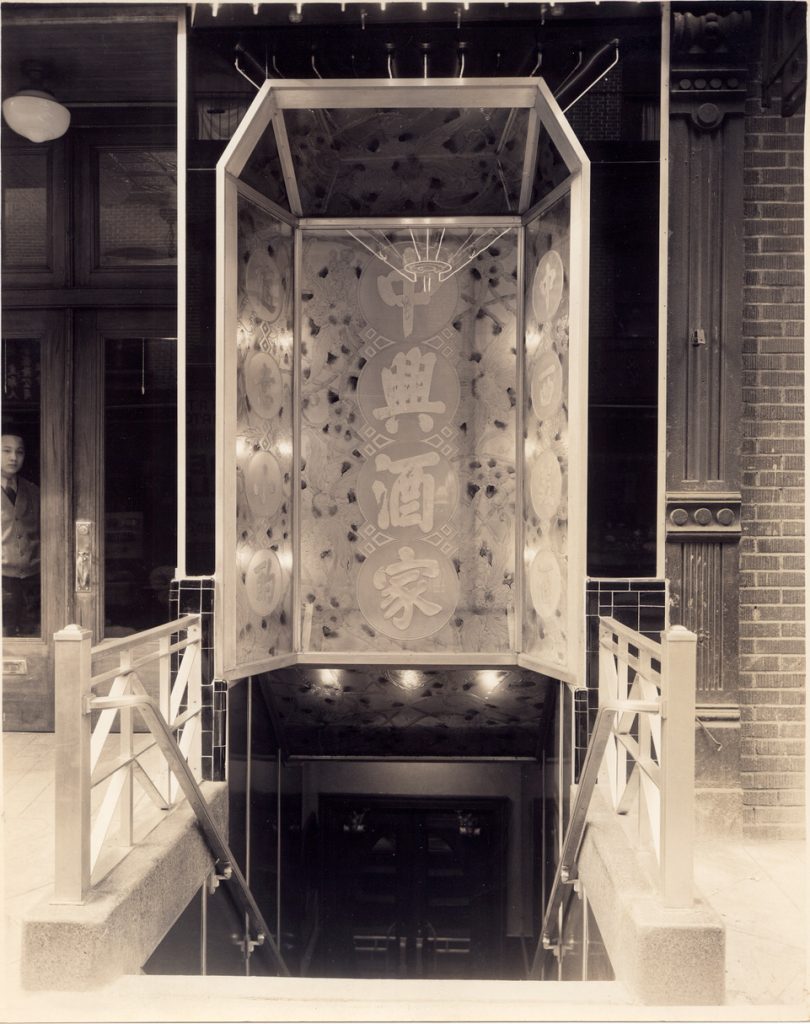
Front view of the restaurant’s entrance, c. 1940s.
+ Triple, you grew up coming to the restaurant as a child. Tell me about your relationship to the restaurant. What do you remember about the ambience?
TE: From a kid’s point of view, it was our playground while the adults socialized upstairs in the more private dining room. We ran around exploring all the nooks and crannies of the space, or headed downstairs to the bar to order Shirley Temple cocktails like little adults. Because it was a duplex, there was a long staircase with grooved stainless-steel handrails, and we used to race toothpicks down them. Out back through the kitchen, there was a wet bar with an ice machine, and we’d take cubes out into the alley and throw them up at the awning, trying to catch them on the way down. We played at and under the banquet tables, but when it was time to eat, we got down to serious business.
The waiters had their red jacketed uniforms, and we were served like it was theater. To many it would seem like a grand banquet occasion, but to us it was just a regular Saturday night.
I don’t remember any of my family working there except my Gong and his brother. There were a lot of restaurant workers who became familiar friends, as well as many different family members, colleagues, and friends who were invited to join us on occasion.
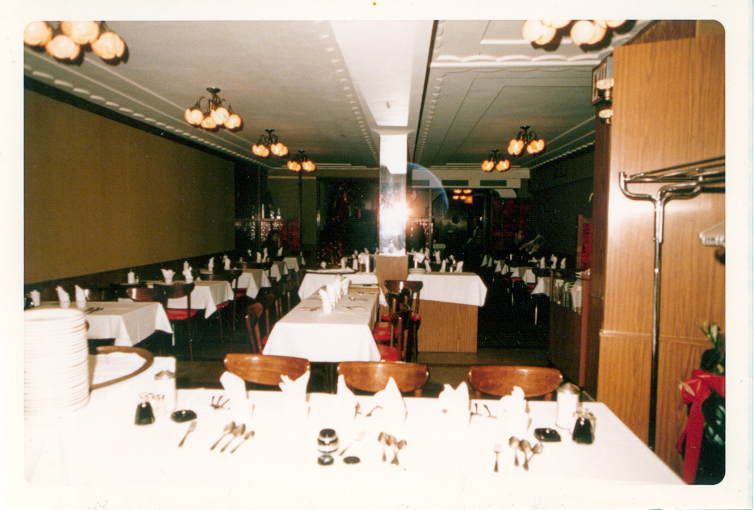
The restaurant interior, June 1972.
+ What do you remember about the interior of the restaurant – the finishings, materials, furnishing? What about The Bowl Shop?
Paint me a picture of what it felt like to be there.
TE: We didn’t mix with the patrons being served downstairs. We had our own private dining room at the top of the stairs, which was actually hidden at street level, since you had to go down to the basement for the main dining area – hence the name, the Rathskeller. [Rathskeller in German refers to a basement tavern or restaurant.] “Upstairs” felt cool and chic in a mid-century way, with horizontal wood panels striping the walls in black and brown and white globe pendants hung from the ceiling. Large round tables covered with crisp white linens were outfitted with glass lazy susans, while black leather banquettes lined the perimeters, along with the occasional four tops that were easy to reconfigure. Back then, people dressed up for dinner, so everyone made an effort to look sharp and glamorous.
The Bowl Shop, which was the storefront next to the staircase that went down into the restaurant, felt like a museum dedicated to the import of Far East goods. It was packed with interesting things to look at behind endless glass display cabinets from floor to ceiling, and closed drawers held secrets I could hardly imagine… but with the eye of a crow, I was drawn to all the sparkly stuff. Behind the front glass-top counter, we were even allowed into the hidden back office; really just a small galley behind a thick black curtain under the stairs. They kept stock there, along with a couple of desks with abacuses on them. It was like stepping into Ollivander’s from Harry Potter — tons of tiny, mysterious little boxes, darkly lit, quietly muffled compared to the world outside.
My Gong Gong would always let us pick some small trinket out as a present, so I remember things, like a lucky bean with a zoo’s worth of miniature ivory animals carved inside, magnetic turtles that were repulsive in the best way possible, and tiny wooden Chinese dolls. Would you believe I still have all of them? I tried a few times to get jade ring replicas like the ones my Po Po wore, since I admired them so much, but I was a kid who played hard, and I always ended up breaking them because they were glass and not jade.
+ What food did the Rathskeller serve? What were your favorite meals there?
TE: Looking back, we were spoiled by the best Cantonese cuisine there was to offer. How many of my Caucasian grade school mates out in the suburbs would even know what it was like to eat shark’s fin, abalone, snails, or squab? I don’t remember counting the number of courses, but it always started with soup and ended with fried rice and noodles. The middle was filled with endless meats, seafoods and vegetables. Of course, my favorite was the dessert of orange slices. “Is it sweet?” continues to be the immediate and age old question, but I much preferred the hot almond or peanut soup, which was dependably a sweet tooth satisfier.
Looking at the old surviving menu, I don’t believe we ever ate any of the American standards that were incorporated into the offerings. I’m sure they had egg rolls, but I don’t remember ever eating them there – that was lo fan food.
Anything I could poke with a chopstick and eat like meat on a stick was good by me, although learning to use chopsticks at a young age was more than a rite of passage, but a necessity for survival among a Chinese family with a big appetite. However, I remember one dish – a simple sautéed baby shrimp dish made just for the kids. Besides avoiding anything green, we learned to eat everything. We even ate all the seafood that would be absurdly expensive today, which in retrospect we took for granted. We always waited eagerly for the roasted chicken and duck to be served, partly for the love of the colorful ring of shrimp chips that surrounded the dish, but also to see who would be the first to take the heads and skewer them onto the top of a chopstick so we could put on a puppet show – probably barbaric to Westerners, but including the heads is a familiar part of the Chinese cuisine experience, and endless fun for us kids.
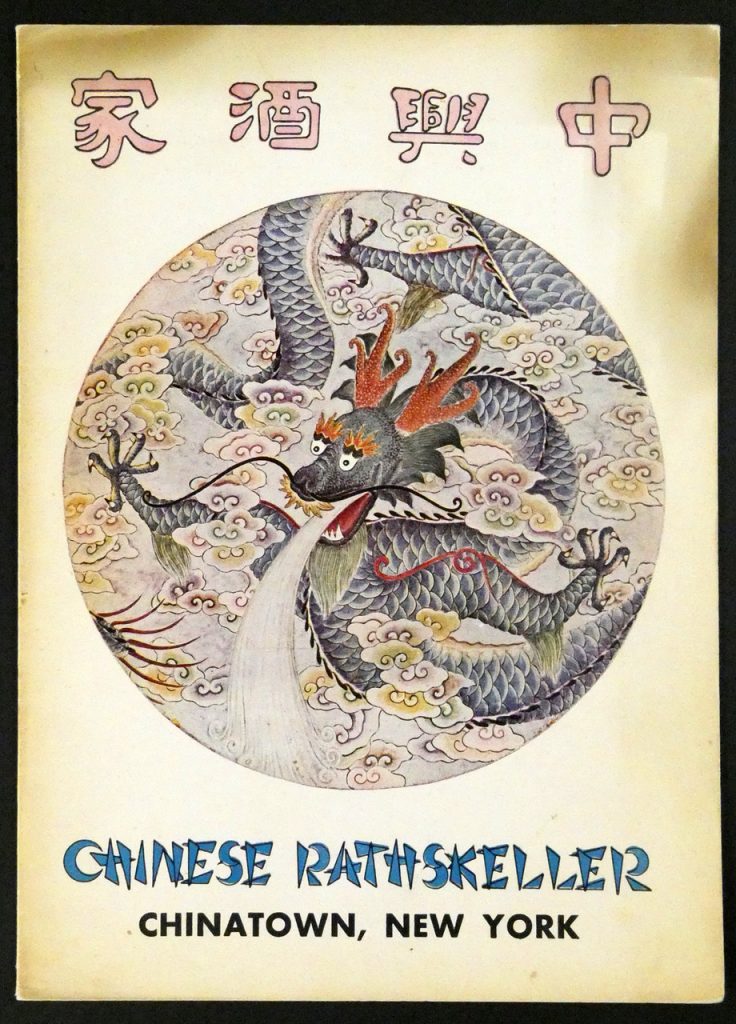
The cover of the restaurant’s 1950s menu.
Dishes, beveragess and dinner specials from the 1950s menu.
+ Who came to the restaurant to eat? Who came to The Bowl Shop to look for goods?
TE: I don’t really remember who the patrons were in the restaurant, but of course a lazy susan full of family friends would join us at our weekend feast. As a family-run business, The Bowl Shop was a place to hang out with my Gong during the day, and people from the neighborhood were always dropping by. It was a central gathering place – full of the family’s friends and neighborhood people – which is why Chinese New Year was always my favorite time to visit the shop. All of the kids got lai see [lucky red envelopes] from everybody who stopped in to say hi. We made out like bandits.
+ Can you tell me about any of the past lives of the building, before your family opened its businesses?
RQ: The building was built in 1915. It was a tenement building with commercial space on the ground floor. I don’t know what or who was in it before the Quans bought it. I believe it had all the water and sewer pipes at the back of the building, because of the 1901 building laws. There may have been single room occupancy (SRO) apartments on the upper floors with communal bathrooms in the back. These may have been standard 3-room railroad tenement apartments with the individual rooms rented out.
When Wei Quan’s wife immigrated to the U.S. in the late 1950s, she lived in an apartment. Wei Quan’s adult daughters also lived there at different times.
Chew Quan’s son, James Quan, had his dental office on the second floor in the 1970s until the time the building was sold.
The Quan family sold the building in 1983.
+ Do you remember if the building underwent any major renovations or changes?
RQ: The basement was turned into a restaurant and the second floor was renovated into a dental office, which included installing water and sewer pipes at the front of the building, because there were none.
+ Who owns 45 Mott now and how did your family decide to sell the building?
TE: After my grandfather died, his brother — who was his business partner — sold it without consulting our side of the family. I’ll leave it at that.
RQ: The Quan family sold the building in 1983.
+ What are your fondest memories of 45 Mott?
TE: The sense of family it created. We have always been a close-knit family. Despite the trauma of my Gong passing and losing the restaurant as a central part of our lives, we all remained close. The stores were brick and mortar, but our family is made out of stronger stuff. The power of the matriarch was strong, so we owe it all to my Po Po for inspiring all of her children to live close by and stay together. We call ourselves “The Hive” because we are of the same mind. The Hive continues to thrive throughout all generations as we live, love, and laugh together.
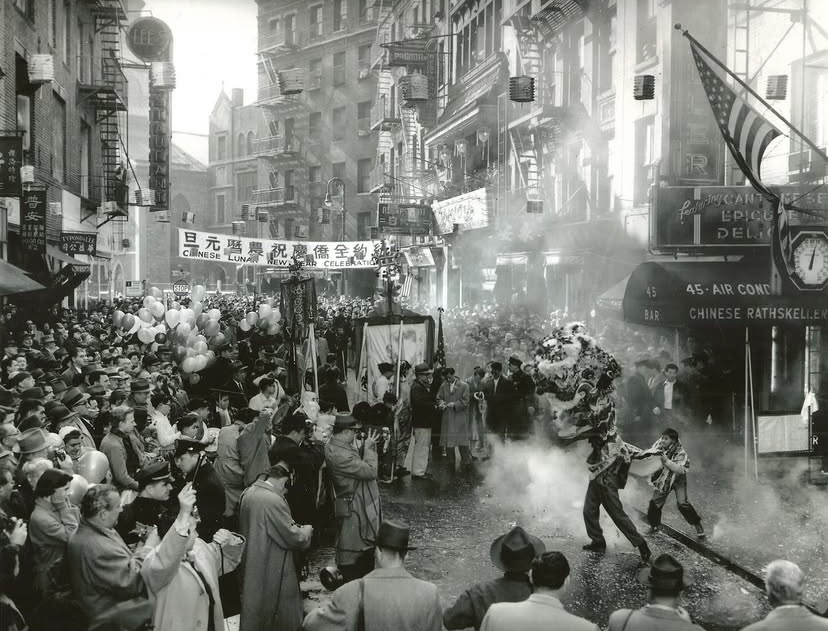
Lunar New Year in Chinatown, date unknown. The signage and awning of the Chinese Rathskeller can be seen on the right.
The Chinese and English menus, 1970s.
45 MOTT - BUILDING PHOTOGRAPHS
Photographs taken in 2024.